Haarsager on BPP, plus reactions

Well, I guess the NPR shoe I’d been warned about has dropped, with respect to the cancellation of BPP.

It was not a satisfying thud.

The comments on the BPP blog site, reacting to the memo, have begun rolling in. They are not, one would expect, positive. There’s some respectful language in there, but the overall feeling is that this formal response missed the point(s).

My own comment, submitted to NPR (and it may be up by the time you read this):

For all those saying NPR should have raised money directly for BPP, there’s a political mess you’re not aware of here.

If NPR openly attempted to raise money for any program, with large or small station carriage, the nationwide collection of stations would revolt. And please note the Board of NPR is majority-controlled by stations.

In short, it would never be attempted and would certainly be killed if it were.

There are indeed structural and cultural problems within NPR that make a project like BPP fail and put all forms of new media engagements at risk. But never forget that many of NPR’s most anti-new media anti-innovation qualities are inherited from the codependent relationship with the stations. In a sense, it’s no one’s fault, yet it’s everyone’s fault. And that’s the center of the problem.

The entire system is trapped by its own success in the radio medium — not the web. Asking it to change in fundamental ways (e.g. embracing direct funding, using the web innovatively and as a medium of first resort, building real community) is asking for a revolution in which heads would most certainly roll.

But public radio has not historically been a head-rolling collection of institutions.

If you want to change public media for the better, focus on your local station — volunteer, get on the Board, ask tough questions, demand new services, and prove to your station there’s money to be saved and made in engaging the community in new ways, especially online. And tell your station to let NPR grow and mature — even if that means audiences want direct relationships with the network rather than the station.  Local stations need a reason to exist beyond rebroadcasting NPR anyway.  It’s time they learned how to be local (again).

Or, failing all that, strike out on your own and create a new media entity with the soul of a public radio station but the structural DNA of a Google.

There’s a future for public media, to be sure. But only time will tell whether NPR will participate in it fully and faithfully.

Naturally, I have more thoughts, but didn’t want to post them at NPR’s site.

Overall review of the memo? Disappointing.

Haarsager’s memo language does not, as so many commenters already noted, ring true. There’s something wrong here; something out of place.

Canceling BPP doesn’t bother me per se (this kind of thing happens from time to time for many reasons, and BPP was cursed with bad luck from the start). But NPR’s handling of the cancellation has the feeling of political talking points about it, and that won’t fly in a new media era.  Words like “misdirection,” “willful ignorance” and “politically convenient” come to mind very easily here, and they shouldn’t. That’s not what I want to think about NPR.

But if you think my take on the situation is harsh, head over to the Huffington Post where Daniel Halloway has his way with the story.

For me, the upshot is that NPR is fundamentally flawed due to the nature of the relationships between stations and network. There’s no long-term-successful way forward unless that flaw is corrected, either by renegotiation of the relationship or by breaking free of the relationships entirely.

While it’s not an exact analog for where newspapers were 10 years ago, it’s close enough: a medium…

  • trapped by its own success
  • unable to innovate into a new model, even in small ways
  • finally dismantled by market forces beyond its control

I really hate this. This isn’t what I want for NPR specifically or public media broadly. Will someone please tell me I’m wrong? I don’t want to lose NPR!
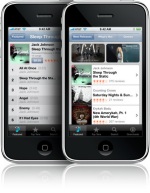
iPhone 3G sold out… Bad news music radio!

The word is out that a little more than a week after launch, the iPhone 3G is now just plain gone from stores across the U.S. — be they Apple Stores or AT&T stores. Indeed, AT&T was sold out nationwide on the first day. Apple Stores have carried the device intermittently ever since and as of Monday morning there were only 3 stores nationwide that had anything — each carrying only one model.
This is bad for music radio.

Okay, a bit over the top, but stay with me…

When the iPhone 2.0 software came out (which works on the old phones, not just the new sold-out ones), I dutifully downloaded and installed it on my own iPhone. Much of the system was unchanged. But the arrival of the App Store made all the difference, allowing the download and installation of applications that extend the functionality of the iPhone.

Two applications in particular were fascinating, in the context of broadcasting. One was AOL Radio, the other Pandora. Both of these services have existed at least for a few years online. But these are the first examples of full-bodied mobile implementations.

AOL Radio

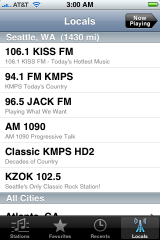
AOL Radio is pretty simple. It’s direct, live streaming access to the “AOL Radio” channels of music, sort of like satellite radio in that they aren’t local broadcast stations and are organized around tons of musical themes/styles. But it’s also an application that grants streaming access to hundreds of local terrestrial stations in the CBS collection. I can now listen, on the iPhone (with a live WiFi signal) to real-time streams of radio stations from coast to coast.

Since the iPhone goes everywhere with you, and given the near-ubiquity of WiFi signals, I now have hundreds of radio stations in my pocket. Sure, you could manage this before with several workarounds, but this is no workaround — this is a real implementation of a terrestrial transmitter threat that’s easy to use for mere mortals.

But that’s just AOL Radio. Forget that. That’s a threat we can obviate by getting our signals on the iPhone, too (not too hard — it’ll be done soon, I’m sure). Let’s get it on with Pandora.

Pandora

Pandora had interested me before, but only in an intellectual way. Now, presented again on the iPhone for free, I figured I’d try it again. It’s amazing, especially over WiFi. Let me say that again: it’s amazing.
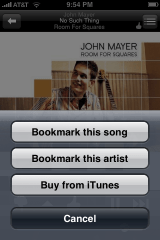
A huge library of songs, all gathered for you with the backing of the Music Genome Project. You pop in a favorite album, artist or song and Pandora generates a complete “station” for you of music from that artist and stuff that’s musically similar to the album/artist/song you’ve identified. And it works.

Let me say that again, too: IT WORKS.

What’s surprising is the sheer speed in which tracks pop down to the iPhone and start playing.  If you skip ahead the next track pops up nearly as fast as your CD player would find something further down the disc platter.  Oh, and the audio quality is easily equal to good FM (over WiFi — less so over 3G or EDGE networks).

I’ve begun discovering music and artists again. I’ve started buying music again. Sunday alone I dropped $30 on new music, buying tracks both from the iTunes Store and from the Amazon MP3 Downloads service.  All $30 were spent on artists I’d never experienced before Pandora suggested them and I bought them using links presented by Pandora.
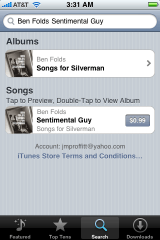
And get this… if the track or album is available on iTunes, you can buy it wirelessly right on the iPhone, no computer required.

Your own music discoveries can be broad or narrow based on how your “stations” are created and configured (which sounds a lot harder than it really is). And you can combine your stations into mix stations, granting you access to more eclectic recommendations.

Then there are more features on the regular Pandora web site. You can do the same thing via the full web that you do on the iPhone, but there are mild social networking features, extending the recommendation engine further. Plus, for more complex “station” operations, the full web site offers better tools. But it’s all one account, synchronized instantly back and forth as you use the service anywhere.

Why Listen to Music Radio?

Perhaps I’m already past the age where music radio makes sense for me, but I have to wonder what happens to music radio when this kind of access to music is virtually ubiquitous. Remember — the iPhone 3G sold 1 million devices in the first weekend and is sold out nationwide a week later. Pandora is a free service and free application — no advertising, no tricks — and it’s easy to use. (I began to wonder why I bothered syncing music to the iPhone — why not just live on Pandora recommendations alone?)
I’m curious if any music station programmers out there have a take on Pandora they’d like to share. I know there are things you can do with radio that Pandora will never match. And I know the Pandora catalog is limited by the licensing deals they can strike with publishers. But really… if you can listen to “stations” tailored to your preferences and discover new-to-you music in a hyper-efficient way, why turn to terrestrial radio for music at all?

If you’re human-hosting your music, you’d better be doing a better job than the Music Genome Project.

How network effects disrupt the liberal elite world of mass media

Here’s a fast and tight 25 minutes of thinking that everyone confronting the disintegration of mass media should view. It’s Mark Pesce speaking at the Personal Democracy Forum just last month (June 24).

http://www.viddler.com/player/aa10e87e/

I’ve certainly felt an increasing pull of networked social structures in the 21st century. There’s something new happening today, something unprecedented. Pesce puts words to that feeling and it sounds largely right. Plus it dovetails nicely with Clay Shirky’s ideas in Here Comes Everybody, a seminal work for broadcasters getting shoved around in this new media world.

My concern, however, is that other factors will derail these social network developments. For example, even given all the cell phones in the world, there are still tremendously autocratic / dictatorial leaders that the masses, supposedly connected, have not yet overthrown. Even in our own country, one of the most connected, we’ve been unable to defeat or marginalize a President that has acted repeatedly against our own national best interests.

Pesce’s ideas also seem to ignore the upheaval I’m betting we’ll see with the end of cheap oil, partially due to depletion and partially due to global warming controls. Seems to me a fundamental upheaval like that would disrupt the social order that’s supposed to be disrupted by the network effect. And what about global warming effects — with predicted mass extinction events (starting with ocean acidification) that will have unknown effects on the rest of our ecosystem?

In any case, it’s a fascinating talk. Well worth the time of mass media folks trying to understand why they’re no longer the center of the universe.

More BPP and innovation thinking

Earlier this week I was advised privately to wait for an announcement from NPR about BPP — without any hint of what said announcement might be — and I’m still waiting. I’d love to hear NPR announce a bold new plan to take the BPP straight to the web and change it up somehow. If anyone would care to shed additional light, I’m all ears (as are about 600 commenters on the NPR site).

In the meantime, there’s been some great pieces out there I’d like to point folks to (yeah, I know — you already saw these, but just in case…).

First up are two posts from Robert Paterson, a past NPR consultant and an avid BPP audience participant:

I’m not a fan of Paterson’s claim that the U.S. is heading into a full-blown depression (because that scares the bejesus out of me and I don’t know what to do about it), but the rest of it rings true, even if the economy were booming.

Next up is a post from Jeff Jarvis, one of my perennial faves:

(I love the title — talk about not burying the lede!)

The Jarvis piece is good, but the comments are even better.  When I visited, the first half of the comments were really insightful. And don’t miss Mindy McAdamscomment in there, too.

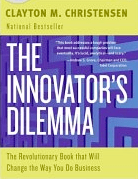
What worries me more and more is that Stephen Hill — that too-smart-for-his-own-good bastard! (and I say that with love) — is going to be proven right if we public media people don’t stop behaving like nitwits and face up to the Innovator’s Dilemma.

I’m not sure whether I have the energy to start my own public media company. Do I really have to? 😉

Web economics vs. Pubradio economics

The Bryant Park Project collapse at NPR sure has had the public media world a-twitter over the last 24 hours. I got one tip to wait for an announcement or something like that from NPR about the future of BPP. Okay. I’m waiting.

In the mean time, I just wanted to point to a simple example of how web economics differ so dramatically from traditional radio production and distribution economics. Because my central take is that the BPP could live on in a new web-focused model, one that it’s already primed to utilize. But to survive it would still need some NPR largesse — though less than it’s gotten to date.

The example I offer here is not a direct analog to the BPP situation, but it’s generally illustrative and great for fueling thought about how new media are different from old media. So here’s the post, by former Apple Computer evangelist Guy Kawasaki:

By the Numbers: How I built a Web 2.0, User-Generated Content, Citizen Journalism, Long-Tail, Social Media Site for $12,107.09

Now the $12k figure is a bit hopeful, as the founder himself was not paid for his time. That and other elements make the $12k more fanciful than real, but the point is still valid: it’s not that expensive to start and run a web-based company.

By contrast, NPR reportedly spent about $2 million on the BPP in the last year or so. For public media companies that’s a lot of money. An award-winning 1-hour-per-week radio program in my own shop in Anchorage costs around $350,000 per year to maintain (and we can’t even afford that). $2 million to NPR isn’t that much, but in real terms, it’s a lot.

In a lot of ways, it may have been better had BPP been given only $500,000 to get started.

As pointed out by Ken George in quotes he collected at WBUR’s The ConverStation, the BPP was probably destined to failure if the point was to make a radio-web hybrid. They should have made a web-radio hybrid instead, using web economics as the baseline organizing idea. Web economics scale from small to large. Radio economics, practiced by NPR and others, scale from medium to large only, and often only from large to huge.

Rob Paterson’s got the right ideas. They sound really revolutionary, and I like to think there’s a middle path of some kind where the old ideas and the new ones “can just get along.” But history will likely prove him right and anyone pushing a compromise wrong.

On the death of BPP

Well, the Bryant Park Project has less than a month left. Literally.

Was it too beautiful to live, perhaps? Hardly. I mean, can anyone really feign shock that well?

Let’s recount the strikes against this endeavor:

  • The economic downturn is hitting NPR like everyone else; news budgets are frozen and that’s just the beginning. Like any business looking to cut costs, whoever was hired last will be fired first, whether that’s a show or a person. That’s just the way it goes.
  • One of the original hosts (Burbank) — and let’s be honest, the host with real NPR cred — walked away just as the show was getting started. Talk about throwing off the rhythm.
  • The second host (Stewart) took off for maternity leave six months into the show. That can’t help.
  • Then the news anchor (Martin) left for a cush job at ABC News. (What is it with NPR people leaving a real news operation to go work for a fake news operation? Is it just the money?)
  • Plus the fill-in host (Pesca) has been splitting his time between BPP and NPR HQ the whole time.

I’m sure Matt Martinez was busting his ass every day trying to keep things rolling forward, but with a set of facts like these, what can you really do?

Add it up and can you imagine a show — any show in any format — making it to its first birthday without a hell of a lot of buy-in (political and cash) from the top?

But wait — there’s more!

  • This was fundamentally a Gen X show inside a Boomer network. What Boomer on the Board of NPR is going to protect a show they don’t air on their station, they don’t listen to and/or they don’t like?
  • This show never made it to the bulk of the listeners out there. The only people that knew about it were NPR junkies that took the time to browse the NPR web site, trolling for goodies. More might have liked it but never knew it existed.
  • In a risky economic environment, what local station program director is going to broadcast BPP instead of Morning Edition? Show of hands, please… yeah, that’s what I thought.
  • Assuming you’re a station with an HD Radio transmitter and you could program BPP onto a secondary channel, great! But who will hear it? Right: no one, because no one has an HD Radio. (BPP could be an Internet success because iPods and computers far outnumber HD Radios.)
  • Though BPP was successful on the web (something like 1,000,000 monthly uniques), we must remember that NPR is not a media company, it is a radio company. Arbitron numbers will always be bigger than Google Analytics numbers to a radio company. NPR may be trying to change to meet the challenges/opportunites of the web (and are making huge strides for a company that size), but it’s still a radio entity, so building a show specifically for the web is not a strategic option for them. At least not today.
  • Compared to an out-of-the-garage web startup, the cost of producing BPP was astronomical. Sure, web startups in Silicon Valley can devour $2 million at a power lunch, but for NPR and public radio that’s a huge sum, especially given all the other factors noted above. Web startups don’t need that much money, but to do BPP “the NPR way” requires big salaries and budgets. It was a radio economic solution applied to what was essentially a web economic problem — that makes it unsustainable on its face.

All in all, it’s a sad day for NPR. Not so much because it lost a program that was, in truth, faltering from the start, but because the Board appears to have missed a key opportunity here.

NPR could have taken a revised BPP straight to the web and made it the flagship show of a new web-scale innovation unit. BPP could have led NPR into a future not bound by the FCC, Arbitron, legacy stations, transmitters and more. For about $1 million a year they could have jump-started the next stage of their evolution.

I’m beginning to think Gen X and Gen Y need to band together and start their own national public media service — without the parochial split between radio and TV and web. Because PBS kills quality Gen X projects, too. Oh, and Fair Game was axed by PRI recently.

By the way, read the comments on the brief BPP blog post about the cancellation. There’s an audience there, to be sure. And it’s one that could easily sustain a web-based (and web-scaled) program and service. If I had $1 million to invest, I’d definitely put it into this audience.

How people behave as their ivory tower collapses

I have no vested interest the “old order” of journalism, be it at newspapers, in public radio or elsewhere. I don’t have a journalism degree (though I do have the kissing cousin degree: English). I’ve collected a paycheck from the media world for less than 4 years now, having spent many years before that in a variety of businesses.

But I would hope that even if I had studied journalism in college, spent a 20+ year career in the field, won awards and so on that I would show a hell of a lot more professionalism and simple human decency than the ugly curs trolling one newspaper intern’s blog this week.

Admittedly, it’s a volatile situation as people are losing their jobs at the Tampa Tribune and the newspaper company is confronting the facts: if they change nothing they’re definitely dead, and even if they change everything they might still be dead. That’s a tough situation for everyone.

It’s terrible to be laid off (it’s happened to me). Layoffs cast all reason out the window in favor of pain and fear. But come on. That doesn’t give you either the right or the moral authority to attack an intern as your personal scapegoat for everything that’s “wrong” with the media industry (in your eyes).

It’s been nearly 24 hours now since I read the post — a fascinating insider look that most journalists wouldn’t share with the public (oh, the delicious irony!) — and I’m still floored by the nasty and even threatening comments made in response to the post.

If your ivory tower is collapsing, shouldn’t you be looking for a safe way out or a safe place to land?