Out of the mouths of (27 year old) babes

If you’re involved in public radio, this is required reading / listening.

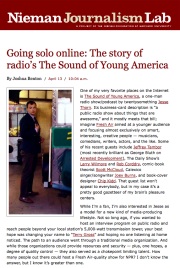
Jesse Thorn, host of public radio’s The Sound of Young America (which is really a podcast that happens to be on a handful of 25+ public radio stations nationwide), speaks with Josuha Benton (Nieman Journalism Lab / Harvard) about his notions of creativity, business, media scale, public radio economics, audience interaction, passion, awesome content and more.

In particular, he nails the problems of the public radio industry today: the saturation of the older, educated white market and the industry’s pull back from attempts to stretch into new market segments with old formulas. He also keenly understands and explains the financial models in “the system.”

Because what Thorn proposes is that public media programs, hosts, writers, and others do is, well… make great content and directly interact with the audience that gels around the content and experience. He’s suggesting you build a Tribe.

Take a listen…

While listening, pay special attention to his observations about how he pays himself for his work, how he interacts with his audience, and how small-scale his show’s production model is. Also pay attention to how he thinks programs in the future will work — using mass media as “calling cards” or “advertising” for the interactive media experience the programs are creating.

From a Tribes perspective and a mass media model perspective, there’s only one other major national project I know of that’s doing the same thing: Planet Money, in a tiny, experimental pocket of NPR. And that could be said to be an outgrowth of the defunct Bryant Park Project.

There will remain a place for mass-produced and mass-appeal general news production. But for everything else, and especially for any local station that wants to survive, your future is in building a community around awesome content and services, a la Jesse Thorn.

Bonus Listening: If you haven’t heard the SxSW presentation by Merlin Mann and John Gruber on creating content online, that’s your immediate next destination. Indeed, here’s your reading list for surviving in the 21st century media world:

Double-Bonus Listening / UPDATE 2009-04-19: Thanks to the unstoppable Jesse Thorn for stopping by with a comment (below) and sharing the link from the discussion at the 2009 Integrated Media Association conference in Atlanta. Highly recommended, too. Thanks Jesse!
Shirky on the collapse of newspapers

This is, hands down, the most important piece on the collapse of the newspaper industry that will be written all year:

Clay Shirky succinctly wraps up the last 20+ years of media history in just a few pages and explains how and why the newspaper industry will ultimately disintegrate.

He points to a future for journalism, but admits it will be a messy future, much as the world of information control and dissemination was utterly upended in the 16th century with the application of the printing press.

This piece reminded me of a speech given by Michael Rosenblum at the IMA conference in 2007. I have a whole hour of his storytelling and exhortations to take action on video, but here’s a brief (3:30) clip of just one story of technological innovation:

For those still clinging to news-on-paper notions: prepare your eulogies. Technology transforms society, whether you like it or not. Your horses are dead. The bowmen are here.

21st century leaders foster talent, not scale

I’m starting to (finally) get back into reading great stuff from around the web, fueling some new thinking. I stumbled across this nugget from consultants with frequently insightful writing:

…the rate of learning, innovation, and performance improvement within the institution must match (or exceed) that of the surrounding environment if the institution is to survive (or thrive). Given that innovation is inherently a human activity–one performed by talented individuals–it follows that talent will pull institutions into the 21st century.

That’s because a rapid rate of innovation cannot be programmed from above. At best what institutional leaders can do is to create the environments–the “creation spaces”–that foster innovation and faster learning. But here’s the rub: many of these institutional leaders are caught in the mindsets of the previous generation of infrastructures and the related assumption that scalable efficiency is the key to success. Talent, on the other hand, is under increasing pressure to get better faster and will either leave institutions that cannot help them or become catalysts for change within those institutions.

[full article]

Let’s just say I can vouch for the above quote 100%.

Questions for public media firms, leaders and talent:

  • Does your corporate culture, as led from the top, regularly share, explain and praise positive examples of media innovation both inside and outside the firm?
  • Do stakeholders in your firm’s success understand the risks of stasis in a rapidly-changing media and business environment?
  • Do you have a plan, a process or even just a notion of how to ensure everyone in your firm is learning substantial new things every year, every quarter?
  • Which activity absorbs more of your time: protecting sacred cows or fulfilling a mission in a presently-relevant way?
  • Is your firm innovating in media creation and delivery at a rate that matches or exceeds the media changes in your service area? (note that media changes occur at variable rates based on where you are)
  • Is your solution to a changing media environment becoming “too big to fail” (AIG) or becoming “too vital to ignore” (NPR)?
  • Are you leading a tribe or building an audience?

The letter I didn't send

The vast majority of public television viewers are kind, intelligent, supportive and understanding people. Generous, too. Lovely folks that I’m delighted to work with every day.

But there are also …pardon me… assholes.

Below I’ve included a viewer comment I got this week (with identity obscured), and the reply I never sent, but wish I did. I actually had the message in draft, but never clicked the Send button.

A little background: We are in our spring pledge drive right now, and that always upsets some people because much of the programming most PBS stations run during pledge is way, way outside the norm. It’s widely assumed that the people “giving” during pledge drives are actually “shopping” for stuff (books, DVDs, etc.) and don’t really care terribly much about the core public TV mission. I think it depends on the program and the viewer, but in general it does seem like regular viewers lose their beloved programs as they are broadly displaced by those giving — or buying — around the specialty programs.

Anyway, on to the letter…

VIEWER FEEDBACK
Tue, Mar 10, 2009 at 10:18 PM

As usual, throw the mission statement out the window and run reruns of Yoga and Guru’s and fake Irish Can Can dancing, over and over, and over and over. Some os us, a slim minority agreed, are interested in seeing the Treasury Secretary, not some twisting body parts for over paid middle class white folks. You know there is a Depression going on, but what do you care, too caught up with being local t.v. stars. GET A CLUE… either give us the news or give up the Charter to maybe an outfit in the Valley. Because you people are through the looking glass infatuated with your own stink. NEWS … not fake gurus !! I mean, the Babtist Temple idiot guy makes more sense then those dumb asses you peddle.

Oh, one other thing… this person has written nasty e-mails to us at least twice a year for several years now. He never fails to send the most bombastic and horrifying rants, and he always threatens to start his own station.  He sends in his hate both about our TV and our FM stations, depending upon which one “offended” him most recently.

I wish I’d sent him this reply (but didn’t)…

Ah, Mr. Xxxxx… Your hate-filled comments about pledge drive programs, our staff and volunteers and viewers that don’t keep in line with your expectations have arrived in our e-mail once again. I would think after several years you’d get tired of leaving this bag of flaming dog poop on our doorstep.

Yet, ironically, what your regular rants suggest is that you’re watching our station. Watching quite a bit. More than most people.

But you’re not paying as close attention as you could.

Because while in the past we’ve pre-empted virtually all Charlie Rose episodes during pledge drives, this time we made adjustments. THIS time, we’re running nearly all the Charlie Rose episodes during pledge (4 out of 5 each week). Sure, they may slip from 10pm to 10:30 or 11pm, but they’re on the air. We made extra work for ourselves — without adding staff — just to keep Rose fans hooked up with their favorite show.

Some viewers have noticed and appreciated the effort and even became supporting members because they recognize both the value of the program in their lives and the fact that we paid attention and changed things to respect their interests.

But not you. After all, why break with tradition?

I highly recommend you start your own public TV station. That way, you can have a front-row seat for what could very well be the death of an entire industry as the proliferation of TV channels and the Internet explosion thins the air so much that you can’t breathe. Meanwhile, thousands of your colleagues across the country collectively scratch their heads, trying to figure out just how to fund the business while still serving the public interest (more than any other TV service out there).

Go ahead — hire the lawyers and bicker with the FCC over licensing. Build a tower, buy a transmitter, hire a staff. Find a building, build a studio, buy cameras and then pay PBS hundreds of thousands of dollars a year for the privilege of airing their programs, leaving you no capacity to serve the local audience in a locally-relevant way.

Then you, too, can have the pleasure of reading some of the nastiest viewer comments you’ve read in your life — in the middle of the night when you’re trying to catch up, just once, with the mountains of work on your plate, left there because you can’t afford to hire staff to run the business efficiently.

In a situation like this, a little Irish dancing, a little yoga, and yes, even Yanni sounds pretty damn good.

As far as we can tell, this particular “fan” of public television has never given a dime.

What do you think — should I have clicked Send?

Digital Public Media: From Broadcasting to Leading a Tribe

Thanks to @garyinalaska, I was invited to speak at the Alaskan Apple Users Group (AAUG) on March 4 in Anchorage, on a topic more or less of my choosing, but dealing with “digital media survival.”

I took that notion, applied it to public media, and tried to bring forth my current thinking about how we in the public media space — at least where I am these days — must change in order to better serve our original mission and do it in a sustainable and meaningful way. Broadly, I suggested we must move from being a purely broadcasting-focused firm to leading a “tribe,” as Seth Godin would put it.

Frankly, my presentation needs work. A lot of work. But the core ideas are there. We’re only just getting started on this in my firm, so I should be able to revise this in the future once we’ve got more experience. For now, however, here’s the presentation files as well as lots of links that are the foundational pieces of the notions presented. I’d love to hear your comments or suggestions, and if you take these ideas and expand upon them, drop me a link.

  • Tribes: We Need You to Lead Us, by Seth Godin (Amazon.com)
  • Tribes: We Need You to Lead Us, by Seth Godin (free at Audible.com)
    Godin’s book on the tribes notion isn’t perfect (there are complaints out there about generalities that aren’t backed up with examples), but it’s quite good and I suspect it will form the backbone of our strategy going forward. It is not a prescriptive book; it has no “instructions” — it’s more faith than religion, if you know what I mean. In any case, as I noted in the presentation at AAUG, if all we in the current public media are doing is talking at people instead of communicating with and connecting people with shared interests and values, we’re not likely to survive. Content is free. Distribution is free. Contact, context, connection and community are priceless.
  • Seth Godin’s blog
    Godin covers the tribes notion periodically and relates tons of next-generation marketing and communications concepts; highly recommended reading for just about anyone.
  • Seth Godin Talking About Leading a Tribe (YouTube, 6 min)
    Audio quality is a little weak, but crank it up and you’ll hear everything you need to hear. Godin succinctly hits the notion that companies are focused on interrupting you enough to trick you into buying their products or services, but they don’t care about you.
  • Seth Godin: Sliced bread and other marketing delights (TED / YouTube, 19 min)
    TED Talks are legendary and Godin does his typically masterful job talking about marketing. This one is not about tribes, but the notions covered are integral to understanding how our historic mass media model is failing. It’s 19 minutes, but it doesn’t feel like it — he’s a wizard of fast presentations that are smart, funny and revealing.
  • “No One Cares About You” (YouTube, 2 min)
    Short and to-the-point advice to companies that think they need to get into social media to tell the world about what they are doing. Surprise: people don’t care about your company.
  • Kevin Kelly / The Technium: Better than free
    This piece set off a ton of blogosphere and public media commentary last year because Kelly sets forth not only the notion that you can’t stop things (media) from being free, but that there are still ways for companies and individuals to create value and gather revenue. Brilliant stuff.
  • Kevin Kelly / The Technium: 1,000 true fans
    Godin refers to this piece in Tribes, and rightly so. It’s a seminal work in the new media world, as it proposes that an artist can surivive if only he or she can find 1,000 true fans/supporters. Godin suggests, rightly, that the number might be 1,000, but it also might be 100 or 10,000 or 1,000,000 — depending upon your situation. But there is a number, and you need those true fans.
  • The Cluetrain Manifesto
    Now 10 years old, the Cluetrain is still being studied as companies of all kinds try to understand how to behave in the new media, interactive world. The 95 Theses are priceless.
  • Clay Shirky: “Gin, Television, and Social Surplus”
    Shirky addresses the rise of television in concert with the industrial revolution and how it acted as a “cognitive heat sink,” yet now people are participating in media creation rather than simply passively consuming it. Critical to understand because it signals and explains how and why people are, more and more, rejecting
  • Clay Shirky: Here Comes Everybody (the web site)
  • Clay Shirky: Here Comes Everybody (Amazon.com)
    Subtitled, “The Power of Organizing Without Organizations,” this is a critical idea that public media companies must understand. There are aspects of running a public media service that require the power of a formal organization. But engaging with and leading a tribe cannot be achieved by a pure firm (or corporate) approach because it cannot scale. But if we can “organize without an organization,” we can get there. Of special note are his brief references to “cost of coordination” and how and when a firm (a formal organization) is useful and when it stands in the way of progress.
  • Umair Haque / Bubblegeneration Strategy Lab
  • Umair Haque / Harvard Business Publishing
    His writing is perhaps the most dense of any of the links here — it’s probably a half- or full-generation ahead of contemporary economic thinking, so it can be hard to follow. But if you’ve got an imagination to see a world that doesn’t quite look like ours and a world that operates on different economic principles, expectations and practices, you should be following Haque. Those in traditional mass media — especially commercial media — will ignore Haque at their peril. By the way, his PowerPoint slides on co-creation of content (at Bubblegeneration) are equally dense, but there’s a kernel of public media’s future in there: a collaborative approach to media capture, editing and distribution that we could never have considered in the past.

Thanks again to @garyinalaska for the invite. The crowd was great!

I had 2/3 of Apple cycle right on 3/3

Previously I predicted that the iMac and Mac mini product cycle would come around in March/April. It was March 3 this year. Nailed that prediction, thank you very much.

But I also predicted Mac Pro cycle would center on the traditional WWDC timeframe of June. Well, those were seriously changed up on March 3 as well, so that one I screwed up.

I also suggested, though not too strongly, that AirPort products might go along with laptops, but that’s not what happened this time. On second thought, the AirPort stuff probably won’t have a regular cycle anyway — update when there’s something worth updating (a new IEEE standard, a new feature worth touting, etc.).

One prediction I’m toying with… the WWDC slips to July or August. That would offer more iPhone prep time each year, in the midst of other product launches and revisions.

In any case, I’m delighted with the revised products. Sure could go for an 8GB iMac!

gravitymedium.com site updated

Just wanted to point out I’ve updated gravitymedium.com with a fresh new theme, cleaned up the sidebar, rewritten some of the pages, removed the IntenseDebate plugin (didn’t need it) and so on.

I’m planning to do more writing here in the coming days, especially as I’m starting to put some of my new public media notions into action at the office and would like to report back. In general, I’ll get back to focusing on public media matters rather than general technology.

Upcoming topics (off the top of my head):

  • my Tweetup hosting experiences in Anchorage, including a station Tweetup and the creation of alaskatweets.com
  • our experience with creating on-air and online listener interaction to help plan a major broadcast schedule shuffle
  • the challenges of explaining the “streams” notion to employees and partners

Anyway, that’s the news for now. Follow me on Twitter for daily updates.

A new Apple product calendar

From here, at the end of Apple’s participation in the Macworld conference entirely, I suspect we will see them develop a revised annual cycle of product updates and announcements in various categories. What might that calendar look like?

Well, first off it won’t be a rigid calendar — it will have a give-and-take that’s more helpful for software development projects. Dumping Macworld gives them control over both the size and timing of each announcement, rather than being tied to venues, dates or formats dictated by a third party. That said, Apple would be well-advised to bite off projects in 12-month increments. Projects that run much longer than 9 months can easily start to lose focus and experience endless scope creep.

In any case, I’m betting on a roughly annual product cycle that might look something like this…

Continue reading “A new Apple product calendar”

My own Macworld 2009 predictions (updated)

Hey, you don’t have to be a paid pundit to play the Apple prediction game — anyone can play. Here are my own predictions for this year’s Macworld, as I tweeted them a few hours before the keynote.

Please note that, unless specifically called out in the prediction, I am not predicting any ship dates or prices, though everything will be out before September 2009.

Now updated with my results.

  • 17″ unibody MacBook Pro, sealed battery. Battery must be sealed for structural integrity of a super-thin/wide body.
    PREDICTION: People will bitch about the battery thing, but the thinness and sexiness of this model will shut most people up. And please — how many times do you really change batteries on your laptop each day? If multiple batteries are that important to you, then get the 15″ model and be done with it. Or get an outboard battery. Clearly you are an unusual case.
    RESULTS: Nailed it! Sure, they didn’t talk about structural integrity, focusing instead upon space constrictions. But I consider that close enough. And don’t take this away from me — I’ll need this win later as I lose on several more predictions!

Continue reading “My own Macworld 2009 predictions (updated)”