Long time, no see

It’s been a hell of an early fall. Just not so much on this blog.

First off, we had the reorganization that came through in mid-August, reshuffling the departments at APTI / KSKA / KAKM / APRN (there’s no end of acronyms, I assure you) in Anchorage. I ended up in charge of all public radio, public TV and all our web efforts — essentially all the “retail” aspects of our public media services.

That alone has taken significant time just to settle in. I’ve been picking up skills in TV traffic operations (if you don’t know, “traffic” is the process by which things like shows and commercials and other elements are scheduled to actually be broadcast to the public). I’ve also been learning about the various services we use from NPR, PBS, APM, PRI, NETA and so many more in both TV and radio. The web has, largely, lain fallow during this period, only getting updates when absolutely necessary.

In addition to just learning my job, we’ve been feeling out the other changes in the organization, covering up holes that our organizational plan left open. This takes time and attention.

Oh yeah, and that whole Sarah Palin thing. Sheesh. She’s running for something or other and it forces us to work harder on news coverage than normal as the campaign gyrates back and forth almost as much as the financial crisis. And the election in general just screws up our staff-bare operations constantly. Thankfully our FM PD knows what she’s doing.

Aside from all that I also agreed to help plan the one day of technical sessions at the Integrated Media Association (IMA) conference in Atlanta in February. I probably shouldn’t have done that.

Then in September I learned my father had colon cancer and would undergo surgery in early October. I flew south for a week to be with the family before, during and after the surgery. The surgery actually went fine, the recovery has been a little rocky, but all is looking up over the long haul. Unfortunately, being in the hospital for a week with no sleep and eating bad food, I ended up picking up a wicked head cold — just before flying home. (If you’ve ever flown in the midst of a head cold, you know the hell that follows.)

But there’s no time for head colds.
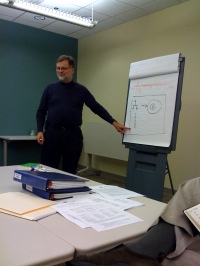
I’m now back in Alaska and working through the weekend and into next week with my fellow managers and, delightfully, Robert Paterson, a man I consider to be the most brilliant strategic consultant working in the public media sphere today (amongst other spheres). We’ve actually got Paterson in our offices, working with us every day for 5 days. It’s re-energizing our conversations about strategy and organization and so many things. The questions we’ve, honestly, been avoiding, are now getting onto the table.

We always knew our staffing reorganization was only a first step — it wasn’t a solution to all our problems, it wasn’t going to make our organization “whole” again. It fixed a few problems tactically and internally, but strategically it was too timid, too reactionary and didn’t deal with the problems we’ve got in operating the Alaska Public Radio Network in a semi-cooperative, semi-competitive way with more than 20 other public radio entitites in Alaska

So we’re now hard at work digging through our brains, building a new way forward, one that’s likely sustainable no matter what happens in the economy and one that establishes a new model for cooperation between the stations — and even entities beyond public radio. We’re on a tight deadline, with a first draft being constructed Monday and Tuesday and a sharing of the initial plan Wednesday and Thursday.

I have no idea how our Board, our staff or our legacy APRN partners will react.  This is partially because we’re not done yet, but it’s also because there are underpinnings to our thinking that are very current in economic thinking.

In any case, I should run — time to get to bed and prep for the slog to continue on Sunday.

In the mean time, let me share a collection of quotes by economist Umair Haque. It’s dense stuff. But it’s informing our notions deeply. The most relevant quotes right now include (boldface mine):

  • Trust is at the heart of value creation in the edgeconomy.”
  • “One of the tremendously cool things cheap interaction does is free us from the costs and risk of yesterday’s industrial assets. / Lightweight business models are possible because interaction is cheap — and in most markets, they utterly and totally dominate heavyweight business models.”
  • Open beats closed, Look – this isn’t about subscriptions, really. It’s about tremendous economic pressures for atomization and unbundling — and the fact that context is king.”
  • “Like I keep telling you, markets, networks, and communities… / Like I keep telling you, changing the world — for the better.”
  • “So if you wanna think radically — here’s a (really) easy way. Take the dominant business model/strategy in your market space, and use a market, network, or community to invert it… like Wikipedia, Google, Myspace, Facebook, etc. / This doesn’t mean do something superficial, like a social net for hairdryers. Rather, it means using markets, networks, and communities to shift resources and capabilities from core to edge.”
  • “Connected consumers want firms to be citizens of their microcultures.”
  • “How do we begin reorganizing the industrial economy? By using markets, networks, and communities to alter the way resources are managed: to weave a fabric of incentives for sustainable growth and authentic value creation into the economy — a new economic fabric thatʼs meaningful to people.”
  • “Google is investing in a shared resource [the ‘Chrome’ web browser] because it has the potential to expand the pie dramatically for all, and so Google stands to benefit more than by hoarding it.”
  • “What shared resource have you invested in — or should you invest in — to expand the pie sustainably for everyone over the long-run? / If the answer’s ‘none,’ it’s likely that you’re living on borrowed time.”
  • “…next-generation businesses are built on new DNA, or new ways to organize and manage economic activities.”
  • “We need no less than better corporate governance, a working shareholder democracy, a recognition of what capital really is (and isn’t), radically more enduring incentivesaligned with outcomes that actually matter to people — the capacity to trust and be trusted, more accurate and timely reporting, strategy that creates authentic value instead of just shifts numbers around, and business models that can yield sustainable growth.”
  • “…it is human outcomes that make work meaningful.”

More later, as we expand our thoughts and share and refine it with a larger audience.

Stand back… Wordsplosion!

Whenever my wife and I are out and about, we always either cringe or laugh at the ridiculous signs people put out in public. Especially signs for businesses, where the ostensibly make their living from not looking too stupid all the time. I mean, if you want my money, I gotta have some kind of trust in your ability to deliver your goods or services, so get that sign, menu, flyer, newsletter, web site right.

For those that experience similar spelling and punctation double-takes out there, I highly recommend the new blog Wordsplosion!

Fun stuff.

Dell Mini 9 inbound

I’ve got a new Dell Mini 9 headed my way later this month. It’s one of those teeny-weeny micro laptops — “netbooks” — that have all the kids excited these days. I’m curious if it can be an iPhone-with-a-keyboard for me as I bounce around from meeting to meeting inside and outside the office.

I live much of my worklife in Google Apps now, so simply having a keyboard, a reasonable screen and live ‘Net access is enough for me.

I’m also going to hand it to a couple of in-house journalists to see if this might make a good field laptop for remote reporting, including video chatting and such. I only wish Apple had made one of these first. Or maybe after I try it, I’ll understand why Steve Jobs skipped out on this party.

The cost was under $500 with shipping and I configured it with a slimmed-down copy of Windows XP, 1GB of RAM, a 640×480 webcam, and a 16GB solid state drive. Plus I’m picking up a 16GB SDHC card to pop into the side and a wireless mouse. I ordered a couple days after launch earlier this month and in theory I should see it next week sometime.

More info after I’ve played with it for a while.

Great survey… Have you taken it?

I know in a political election year we all cringe when someone approaches us with a “survey,” especially since those are almost always slanted to one side or the other. But here’s a great one — the PubForge Open Source Collaboration Survey. If you or someone at your public media station haven’t yet taken the survey, please do so right away.

The early results are interesting, as promoted by new media leader Dale Hobson (North Country Public Radio) in a recent e-mail to public radio folks (excerpted here):

Open source software has been widely adopted by stations as a whole: A majority of stations utilize open source software for some aspect of their online service. Where open source tools are not in use, there is considerable interest in finding ways to use them.

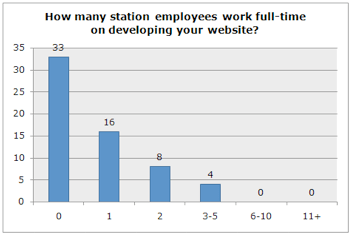
Allocating resources to web development and maintenance is critically low:

  • More than half (55%) of respondents have ZERO full-time employees developing their website.

Top of the development list–stations are looking for:

  • 72% – Freestanding player for streams, archives and user created playlists
  • 72% – Tools to integrate existing social media networks into public media sites
  • 68% – Complete CMS website solution, including audio file management
  • 66% – Software to enable more community participation for public media
  • 61% – Application for supporting micro payments (granular giving) to enable giving around specific content

In addition, the survey provides a snapshot of how stations are managing web content, what in-house skills and tools are available to them, how they are tracking visitors, and what they want to be able to do online, given the necessary resources.

There are more charts, more quotes and summary statements if you visit the site to see it all.

We need these kinds of surveys to be as accurate as possible, and the results are already illuminating. If you’re at a station, work with the web, and have just a few minutes, please take the survey.

What happens to web stats when Sarah Palin seekers stop by

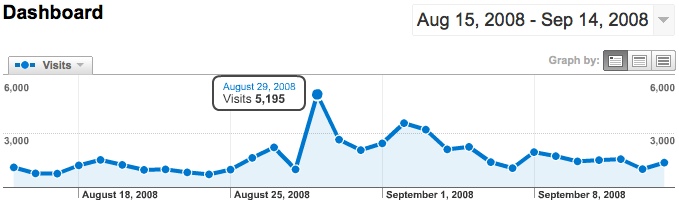
On an average day over the last several months, APRN.ORG (the web site for news from the Alaska Public Radio Network), our daily web visit count (according to Google Analytics) was usually under 1,000.  On a good day, we’d spike to maybe 1,200. On a great day, we’d spike to 1,500.

But once Sarah Palin was selected as the Republican VP nominee, you can imagine what happened.

As shown in the graph above, we suddenly spiked to nearly 5,200 visits in a single day, and hit over the 3,000 mark a couple times the following week.

Our traffic is dying down now, almost to normal levels. But what a ride that was. I only wish we had a dedicated web team to do more stuff. Maybe someday.

Another nail in the AP coffin

There have been so many great news services popping up in the last few years in the online space. Politico.com has been one of the big success stories. They make most of their money on a print edition distributed on Capitol Hill and K Street in DC, but their web property is followed nationally and their writers and pundits regularly appear on talking-head shows.

Now they’re undermining the Associated Press. Good for them.

At the rate things are changing for the AP and the news business in general, you’d think the AP would unleash a new plan to get folks interested in their services again. But I think not. The AP is still a juggernaut in the news business with a long way to go before their execs begin to freak out over lost customers and revenue. It sure is interesting to watch, though.

Back from the dead / digital collaboration

It’s has been — and remains — insane at the office these days. We’re in the midst of a pledge period for TV, we’re preparing for another one in FM, and for the most part it’s my first run-through these events as the person ultimately in charge of our streams, so there’s a learning curve. I’m finding it easy to pick things up — it just takes time. Plus, the company is still shaking out some of the changes from about a month ago as we radically redesigned the management structure. So far, so good.

I’ve been neglecting Twitter and Facebook and this site for nearly a month as these events have played out. Luckily, it’s kind of a quiet period in public media as folks work through pledge drives and just get back into the non-summer swing of things.

Yet this past week a critical post went up from Dennis Haarsager that’s required reading for pubradio folks and I think for public TV folks as well:

It makes a good deal of sense to me, as it gives a revitalized reason/purpose for national/local collaboration, as opposed to simple distribution. I’m not quite convinced it can be successful, but it’s got a shot if a critical mass of system leaders get on board. I know I’m paying attention.

That said, I’m concerned about future collaborations of all kinds, especially in the wake of a semi-private discussion in which I participated recently.

It seems public media’s chief difficulty today is not one of distribution, but one of mission. Why are we here, really? And do we all share the same response to that question? “Public service,” is not a real answer. We need a product, a specific service that can bind all of us together.

Personally, I think that’s news. I’ve railed against the national TV news media before for their lack of real public service, and I’ve suggested that public media’s greatest strength comes from news.  Not music, not arts and culture, not high society, but news. (Those other things are nice-to-haves, but they aren’t core things around which we can easily collaborate on various geographic or business scales.)

What does news, as a primary mission for public, have going for it?

  • The Associated Press is breaking down as newspapers and stations — including my own — tell the AP to take a flying leap with their high costs and their regurgitated stories
  • Newspapers are distracted as their profits crumble and they seem unable to find a way forward
  • TV news is an abysmal, rancid landfill of time-wasters and poor information
  • New low-cost journalism methods (not necessarily bad stuff, by the way) is on the rise, both in video and print, offering us new opportunities
  • Digital exchange of information and finished media products has never been faster, cheaper or easier
  • We have a public service mission unparalleled in the commercial world — a world setup to distribute commercials, not thoughtful information

NPR grew as media consumers discovered that quality news and information was, in fact, a good thing to have around. It grew in an otherwise toxic radio environment.

We have a chance, now, I think, to develop this shared mission and build collaborative structures around that. At the moment, Haarsager’s initial diagram (PDF) speaks to a broader service set than news alone. But keep the mission focused and the distribution / collaboration system begins to make sense.

Anything new that proposes to simplify collaboration in an ecosystem of diverse and often competing missions probably won’t get us very far.

America: Your new queen has been crowned

Alaska’s governor — my governor — Sarah Palin got picked up as the Republican VP nod on Friday and it make a complete mess of my day. I didn’t have any meetings, it was the day before Labor Day weekend — I was looking to wrap some things up and take a breather, but I guess not. We pulled together a ton of coverage and such in just a few hours. Be sure to check out APRN.org for all the goodies — from an Alaskan perspective, not from the beltway insiders and pundits that really don’t know anything about Palin.

Thankfully, both Jon Stewart and Stephen Colbert were there for me, at the end of a long day, with their coverage, too. As of this writing, only Stewart’s show has been posted to hulu.com — by the time you read this I suspect Colbert will be there, too.

http://www.hulu.com/embed/aTF09Qdss1lIPdq3RIj6xQ/511/797

The Curse of the PBS Tchotchkes

Okay, I know I owe everyone a better explanation for the changes at the public media company in Anchorage, where I’ve taken on a new role. I’ll get to that. But first I have to let off some steam.

Now that I’m in charge of radio, television and the web — as a singular unit we call “streams” — I’m the recipient of public TV promotional materials. And let me tell you, this is the worst part of the job.

I’m being buried alive in tchotchkes. OMG the tchotckes! In two weeks I’ve been inundated with the stuff.

Now I know why our PBS dues go up so dramatically every year. The networks, the producers, the distributors — they’re all mailing and shipping out endless streams of expensive trinkets and doodads in the hopes that I’ll love their program and run it day and night and promote it and call it George.

As Jon Stewart said during his infamous appearance on CNN’s now-dead “Crossfire” — Please. Stop. You’re hurting America.

Okay, maybe not hurting America, but you’re filling my office with stuff I don’t need.  We don’t select programs because you send me a chocolate bar or children’s bookends.  I’m not going to be a new-found fan of your show because you printed a four-color professional multi-tabbed binder or sent me “fun” stickers or magnets.  Put another way: Your ability to slap a logo on a plastic Chinese toy or hire a print shop does not impress me — it depresses me.

Please, TV producers and distributors: Put your money into making a better product. Edit tighter. Get better visuals in the program. Hire good photographers and videographers and sound engineers. Build a better web site. Collaborate with your public TV brethren and create a wonderful online-only marketplace for programs and additional information.

Most importantly: please lower my cost for buying your show.

Please do not send me a box of glossy postcards pushing the Mormon Tabernacle Choir. No more Good Grips spatulas or basting gear for that cooking show. Save the four-color promo stuff for lobbying Congress — not me. Keep the DVDs and put your show clips and previews online.  I’m already on your team, so please don’t waste $25 shipping me your latest professionally-developed marketing pouch with tiered inserts on velvety cardstock ($25 x 300 stations = $7,500).

Why is it that a network of stations, all committed to noncommercial public service, spends this much money on advertising to me?

Alaska politics: always entertaining

I know I’m way late for an update on the changes at work and how they fit into a larger strategic approach to the future, but I have an excuse! It’s the week before the Alaska Primary and we’re doing a big meet-the-candidates thing on our TV and radio stations for three nights this week and it’s sucking all the time out of my days and nights.

In the mean time, here’s a little extra treat.

In a tiny state (by population) like Alaska, the barrier to entering statewide politics is fairly low. Or at least the barrier to entering a political race is low — you still generally can’t win unless you’re at least somewhat credible. Still, in a state of less than 700,000 people total, the odds of any particular citizen winning a statewide office are pretty good — much better than most states. Of course, when the odds are good, the goods are often odd.

Case in point… Perennial candidate Daniel DeNardo, currently up for Alaska State House district 31. He appeared on our election coverage show on Tuesday night and explained to the world, well… he explained a lot of things. It’s best if I just let him talk. Enjoy!

[audio:http://media.kska.org/2008/running-20080819-d31-i-denardo.mp3%5D

Download Audio (MP3)

P.S. Best line from the moderator: “And how do you work on that in the legislature? They seem to be bogged down in the school budget.”