I just met with a true innovator in public media this week, someone that’s a bit of a hero, really, and in this brief conversation I was surprised to hear a comment about the web that was, well… stunning. (And I’m not going to divulge the identity of this person because it’s irrelevant to the story.)
When asked by a colleague of mine whether this public media company was currently selling online advertising via their web presence, the answer was not only “no,” but “no, and we don’t plan to.” This person went on to say that the cost of putting together and managing an online advertising system would outweigh the advertising revenue that could be gained. Their take is that careful cost analysis must be done before they do any new projects and right now the web doesn’t look like a good cost bet.
Fair enough. That’s actually the tack I’ve taken at our shop in Anchorage. Why bother with the rules, the systems, the web redesigns required when the payback would be so small on sites with comparatively low traffic numbers? I’ve avoided it to date.
But the comments didn’t stop there. This person further said they were going to wait until they had created a “scarcity” in the market for web advertising (on their properties) and then set prices for online ads when companies are “begging” to get their ads on the target site(s).
You’re going to create scarcity? On the web? Really?
I almost started to counter this idea right there, but out of respect left it alone.
Later I checked my RSS feed subscriptions and discovered a blog post from Google talking about how many pages there are in their index of the online world. Their numbers:
- 1998 — 26,000,000 pages (26 million)
- 2000 — 1,000,000,000 pages (1 billion)
- 2008 — 1,000,000,000,000 pages (1 trillion)
And presently the index grows by several billion pages each day.
But you’re going to create scarcity. Mmm-hmmm.
Okay, snarkiness aside… you can create scarcities online, I know. And public media entities are in a fairly good position to do that if they can gather their comparatively rarified audiences in the online space in large numbers and on a regular basis.
But there are two problems with this notion:
- You’re not the only property online with desirable demographics for advertisers, because your web audience also visits lots of other sites and other sites can offer more targeted demographics.
- Public media sites, especially for local stations, are… well… pretty bad as core web destinations. You’ll never be able to profitably sell such small and fairly broad audiences to advertisers in a market where #1 is true.
For the most part our public media (station) web sites are sorry shadows of our on-air presentations (there are, of course, a few exceptions where real investments have been made, mostly in the largest markets). Why?
- Our web services are typically afterthoughts.
- We do them because we “have to.”
- They are not must-see daily destinations.
- They are not valuable social networks.
- They have a fraction of the news presented by any local newspaper site.
- They are often unattractive and hard to navigate or bland, boring and so on.
The site visitor counts are understandably low.
And I level that charge against my own sites as well as the sites of other public media companies. They’re just not worth visiting regularly unless there’s something you heard/saw on air that you needed to hear/see again or you want to make a pledge online.
Further, if you did sell online advertising, how would you do it? You’d use your existing development / sales staff, wouldn’t you? Commissions, salaries, healthcare costs, etc. all loaded up on top of the sales. And then there’s the overhead costs of the rest of the organization as well. No wonder web advertising isn’t worth it — it works on a different scale.
And thus we return to the same point made recently about the Bryant Park Project failure at NPR: you cannot expect broadcast economics success from a web economics property. Web properties work on a different scale than radio or TV. It’s a smaller, lighter scale. It supports fewer overhead costs and requires less staff.
Two solutions:
- Create a web property that works on a web scale and draws its own audience and community. Make something that is a must-see daily destination, or create a site that solves people’s problems or provides a core service they need every day.
- Create your web property in an economic “bubble” outside the normal expectations of staffing and profitability of broadcasting — at least to start. If you want your web property to help pay your transmitter bills, you’re dreaming now and probably forever.
So I agree — don’t bother selling advertising on bland sites with low traffic. I wouldn’t try to “monetize” most station sites today.
Instead, discover how network economics can work for you and build something compelling outside the expectations of the legacy properties. This might even be — or probably should be — a spin-off property, a la Mark Fuerst‘s recommendation, captured on video here:
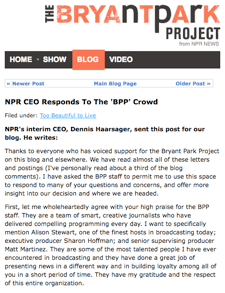 When the announcement went out about the cancellation of the Bryant Park Project, the comments on the NPR site numbered in the hundreds. The counts I saw stopped around 600, yet there may be more (who wants to count?).
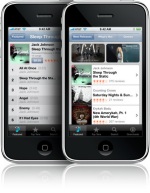 The word is out that a little more than a week after launch, the iPhone 3G is now just plain gone from stores across the U.S. — be they Apple Stores or AT&T stores. Indeed, AT&T was sold out nationwide on the first day. Apple Stores have carried the device intermittently ever since and as of Monday morning there were only 3 stores nationwide that had anything — each carrying only one model.
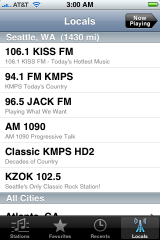 AOL Radio is pretty simple. It’s direct, live streaming access to the “AOL Radio” channels of music, sort of like satellite radio in that they aren’t local broadcast stations and are organized around tons of musical themes/styles. But it’s also an application that grants streaming access to hundreds of local terrestrial stations in the CBS collection. I can now listen, on the iPhone (with a live WiFi signal) to real-time streams of radio stations from coast to coast.
 Pandora had interested me before, but only in an intellectual way. Now, presented again on the iPhone for free, I figured I’d try it again. It’s amazing, especially over WiFi. Let me say that again: it’s amazing.
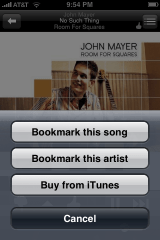 I’ve begun discovering music and artists again. I’ve started buying music again. Sunday alone I dropped $30 on new music, buying tracks both from the iTunes Store and from the Amazon MP3 Downloads service. All $30 were spent on artists I’d never experienced before Pandora suggested them and I bought them using links presented by Pandora.
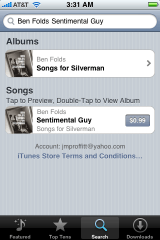 Perhaps I’m already past the age where music radio makes sense for me, but I have to wonder what happens to music radio when this kind of access to music is virtually ubiquitous. Remember — the iPhone 3G sold 1 million devices in the first weekend and is sold out nationwide a week later. Pandora is a free service and free application — no advertising, no tricks — and it’s easy to use. (I began to wonder why I bothered syncing music to the iPhone — why not just live on Pandora recommendations alone?)
 Earlier this week I was advised privately to wait for an announcement from NPR about BPP — without any hint of what said announcement might be — and I’m still waiting. I’d love to hear NPR announce a bold new plan to take the BPP straight to the web and change it up somehow. If anyone would care to shed additional light, I’m all ears (as are about
 Gravity Medium