Tip of the hat to Duncan Moon for sharing this little gem.
http://www.ucbcomedy.com/videos/embed/f19628c3680fe09073ccb2901345c089
Tech / Media / Strategy / Culture
Tip of the hat to Duncan Moon for sharing this little gem.
http://www.ucbcomedy.com/videos/embed/f19628c3680fe09073ccb2901345c089
Well, the week of presentations is now over. Here are both of them, for reference. They may not make sense out of context, but there were definitely some links in the Twitter presentation particularly that may be of use to the APRN journalists that attended my presentation last Friday.
This presentation was made to several managers of public radio stations in Alaska and then again to the Board of APTI a couple days later. It concerns the future of collaborative public media efforts in Alaska. Developed in cooperation with the unequaled Robert Paterson, and using ideas pioneers 40 years ago with Visa International, it’s a proposal for starting conversations statewide about finding a new way for us to collaborate and compete in a more natural way than we’re organized today. It’s kind of hard to follow without the narration/explanation, but I wanted to share it anyway. I’m happy to answer questions.
This presentation was made to a group of Alaska public radio journalists in Anchorage during an annual conference. The idea was to expose them to the Twitter service and suggest they try it out and see what others around the country — especially NPR — are doing with it. The reaction was… tepid. I think Alaska pubradio journalists are really saddled with a lot of responsibilities that just aren’t present in the rest of the country, and taking on new forms of media is just so hard for them. And then journalists also tend to be a skeptical lot — as they should be, of course. Again, narration helps, but there’s lots of links in it for reference.
http://www.nytimes.com/2008/11/14/business/media/14news.html
Good for them. Too bad it’s still terrible local TV news. What they should do is blend in a VJ process and stop doing ambulance-chasing and I’m-standing-outside-a-building-where-something-happened-6-hours-ago “live” reports.
The answer definitely lies in sharing news. News is a commodity. Content is worthless. Context and community are where new value will be found.
 If you have to write your own bio, because no one knows you, that’s when you know you have not arrived. That’s what I had to do Sunday night for a conference in Alaska coming up in a couple weeks. I guess I’m presenting — though I don’t yet know about what. I’ll just make it up. Anybody got a name for a hypothetical web 2.0 social network I can fake on the spot?
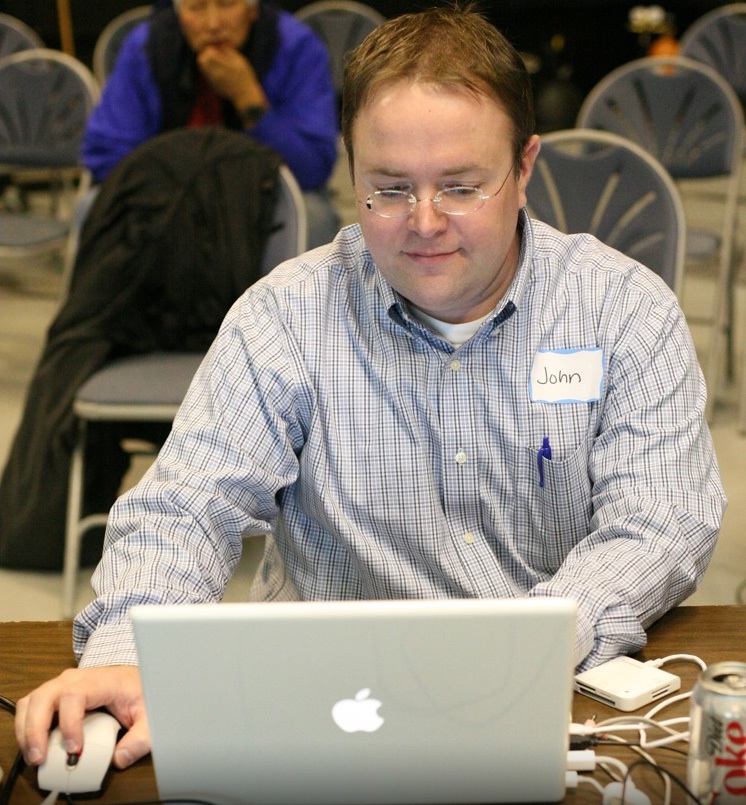
Anyway, I also had to pick out a photo to put out there so people can point, giggle, and say, “Aren’t you a little short to be a new media douchebag?”
Luckily, we just hosted a “Listening Room” for Down To The Wire on Sunday at the station, and we had a great photographer there, Brian Adams, who took this shot of me actually doing the new media deed for all to see (eeew!). Not too bad. And by the way, ladies, you can’t see my ring hand in the photo, but I’m taken. I know you’re disappointed.
Anyhoo… Check out this lame-o bi-o that will probably accompany the photo:
John Proffitt has immersed himself in new technologies and media since first working as a teaching assistant for a personal computing class 25 years ago — while still in middle school. Since then he’s earned Bachelor’s and Master’s degrees in English and education, later entering the fast-paced world of IT consulting and digital media. He’s worked in healthcare, manufacturing, banking and government contracting, developed content and software for a monthly CD-ROM magazine, built web sites and managed secure online transaction systems with support staffs as large as 21 and annual budgets of nearly $3 million. Raised on Sesame Street and enlightened by Morning Edition, he joined the public media ranks in 2004 at APTI in Anchorage. Today, he manages all radio, TV and web “streams” for KSKA-FM, KAKM-TV and APRN and explores new media methods as they intersects with the traditional missions of public broadcasting. He blogs and “tweets” with a network of contacts from NPR, PBS and major stations nationwide. Join him online at twitter.com/jmproffitt
Oh, yeah, I wanna hear this guy talk. Yeesh.
The worst part of the bio? It’s all true.
It’s been a hell of an early fall. Just not so much on this blog.
First off, we had the reorganization that came through in mid-August, reshuffling the departments at APTI / KSKA / KAKM / APRN (there’s no end of acronyms, I assure you) in Anchorage. I ended up in charge of all public radio, public TV and all our web efforts — essentially all the “retail” aspects of our public media services.
That alone has taken significant time just to settle in. I’ve been picking up skills in TV traffic operations (if you don’t know, “traffic” is the process by which things like shows and commercials and other elements are scheduled to actually be broadcast to the public). I’ve also been learning about the various services we use from NPR, PBS, APM, PRI, NETA and so many more in both TV and radio. The web has, largely, lain fallow during this period, only getting updates when absolutely necessary.
In addition to just learning my job, we’ve been feeling out the other changes in the organization, covering up holes that our organizational plan left open. This takes time and attention.
Oh yeah, and that whole Sarah Palin thing. Sheesh. She’s running for something or other and it forces us to work harder on news coverage than normal as the campaign gyrates back and forth almost as much as the financial crisis. And the election in general just screws up our staff-bare operations constantly. Thankfully our FM PD knows what she’s doing.
Aside from all that I also agreed to help plan the one day of technical sessions at the Integrated Media Association (IMA) conference in Atlanta in February. I probably shouldn’t have done that.
Then in September I learned my father had colon cancer and would undergo surgery in early October. I flew south for a week to be with the family before, during and after the surgery. The surgery actually went fine, the recovery has been a little rocky, but all is looking up over the long haul. Unfortunately, being in the hospital for a week with no sleep and eating bad food, I ended up picking up a wicked head cold — just before flying home. (If you’ve ever flown in the midst of a head cold, you know the hell that follows.)
But there’s no time for head colds.
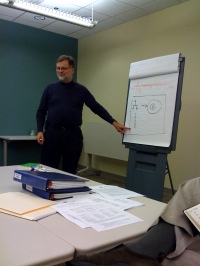 I’m now back in Alaska and working through the weekend and into next week with my fellow managers and, delightfully, Robert Paterson, a man I consider to be the most brilliant strategic consultant working in the public media sphere today (amongst other spheres). We’ve actually got Paterson in our offices, working with us every day for 5 days. It’s re-energizing our conversations about strategy and organization and so many things. The questions we’ve, honestly, been avoiding, are now getting onto the table.
We always knew our staffing reorganization was only a first step — it wasn’t a solution to all our problems, it wasn’t going to make our organization “whole” again. It fixed a few problems tactically and internally, but strategically it was too timid, too reactionary and didn’t deal with the problems we’ve got in operating the Alaska Public Radio Network in a semi-cooperative, semi-competitive way with more than 20 other public radio entitites in Alaska
So we’re now hard at work digging through our brains, building a new way forward, one that’s likely sustainable no matter what happens in the economy and one that establishes a new model for cooperation between the stations — and even entities beyond public radio. We’re on a tight deadline, with a first draft being constructed Monday and Tuesday and a sharing of the initial plan Wednesday and Thursday.
I have no idea how our Board, our staff or our legacy APRN partners will react. This is partially because we’re not done yet, but it’s also because there are underpinnings to our thinking that are very current in economic thinking.
In any case, I should run — time to get to bed and prep for the slog to continue on Sunday.
In the mean time, let me share a collection of quotes by economist Umair Haque. It’s dense stuff. But it’s informing our notions deeply. The most relevant quotes right now include (boldface mine):
More later, as we expand our thoughts and share and refine it with a larger audience.

Whenever my wife and I are out and about, we always either cringe or laugh at the ridiculous signs people put out in public. Especially signs for businesses, where the ostensibly make their living from not looking too stupid all the time. I mean, if you want my money, I gotta have some kind of trust in your ability to deliver your goods or services, so get that sign, menu, flyer, newsletter, web site right.
For those that experience similar spelling and punctation double-takes out there, I highly recommend the new blog Wordsplosion!
Fun stuff.

I’ve got a new Dell Mini 9 headed my way later this month. It’s one of those teeny-weeny micro laptops — “netbooks” — that have all the kids excited these days. I’m curious if it can be an iPhone-with-a-keyboard for me as I bounce around from meeting to meeting inside and outside the office.
I live much of my worklife in Google Apps now, so simply having a keyboard, a reasonable screen and live ‘Net access is enough for me.
I’m also going to hand it to a couple of in-house journalists to see if this might make a good field laptop for remote reporting, including video chatting and such. I only wish Apple had made one of these first. Or maybe after I try it, I’ll understand why Steve Jobs skipped out on this party.
The cost was under $500 with shipping and I configured it with a slimmed-down copy of Windows XP, 1GB of RAM, a 640×480 webcam, and a 16GB solid state drive. Plus I’m picking up a 16GB SDHC card to pop into the side and a wireless mouse. I ordered a couple days after launch earlier this month and in theory I should see it next week sometime.
More info after I’ve played with it for a while.
I know in a political election year we all cringe when someone approaches us with a “survey,” especially since those are almost always slanted to one side or the other. But here’s a great one — the PubForge Open Source Collaboration Survey. If you or someone at your public media station haven’t yet taken the survey, please do so right away.
The early results are interesting, as promoted by new media leader Dale Hobson (North Country Public Radio) in a recent e-mail to public radio folks (excerpted here):
Open source software has been widely adopted by stations as a whole: A majority of stations utilize open source software for some aspect of their online service. Where open source tools are not in use, there is considerable interest in finding ways to use them.
Allocating resources to web development and maintenance is critically low:
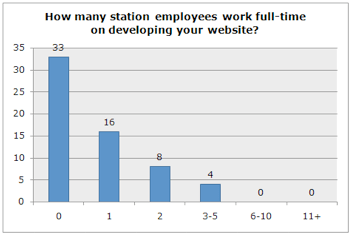
- More than half (55%) of respondents have ZERO full-time employees developing their website.
Top of the development list–stations are looking for:
- 72% – Freestanding player for streams, archives and user created playlists
- 72% – Tools to integrate existing social media networks into public media sites
- 68% – Complete CMS website solution, including audio file management
- 66% – Software to enable more community participation for public media
- 61% – Application for supporting micro payments (granular giving) to enable giving around specific content
In addition, the survey provides a snapshot of how stations are managing web content, what in-house skills and tools are available to them, how they are tracking visitors, and what they want to be able to do online, given the necessary resources.
There are more charts, more quotes and summary statements if you visit the site to see it all.
We need these kinds of surveys to be as accurate as possible, and the results are already illuminating. If you’re at a station, work with the web, and have just a few minutes, please take the survey.
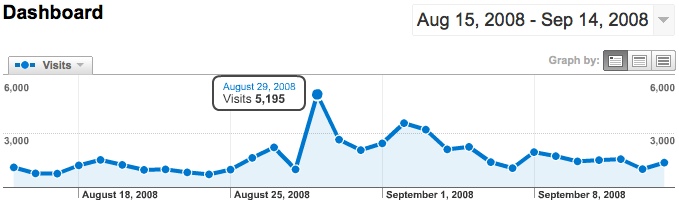
On an average day over the last several months, APRN.ORG (the web site for news from the Alaska Public Radio Network), our daily web visit count (according to Google Analytics) was usually under 1,000. On a good day, we’d spike to maybe 1,200. On a great day, we’d spike to 1,500.
But once Sarah Palin was selected as the Republican VP nominee, you can imagine what happened.
As shown in the graph above, we suddenly spiked to nearly 5,200 visits in a single day, and hit over the 3,000 mark a couple times the following week.
Our traffic is dying down now, almost to normal levels. But what a ride that was. I only wish we had a dedicated web team to do more stuff. Maybe someday.
There have been so many great news services popping up in the last few years in the online space. Politico.com has been one of the big success stories. They make most of their money on a print edition distributed on Capitol Hill and K Street in DC, but their web property is followed nationally and their writers and pundits regularly appear on talking-head shows.
Now they’re undermining the Associated Press. Good for them.
At the rate things are changing for the AP and the news business in general, you’d think the AP would unleash a new plan to get folks interested in their services again. But I think not. The AP is still a juggernaut in the news business with a long way to go before their execs begin to freak out over lost customers and revenue. It sure is interesting to watch, though.
 Gravity Medium