One last BPP article (probably) and On The Media's Garfield feels the sting of the hive

Three good pieces of note that I’m finally getting to this evening.

First up (blogged earlier by Todd Mundt) is a take on the Bryant Park Project collapse from someone else that’s young and actually creating public radio programming. Only in this case it’s done on a small scale and is therefore sustainable.

The Sound of Young America‘s Jesse Thorn chimes in on both the BPP and the Fair Game cancellations. He offers lots of insightful commentary (so read the whole thing); here’s one great passage:

Fair Game and especially BPP were designed for a multi-platform future that’s in its earliest stages. Despite speculation to the contrary, both were building very strong podcast audiences. That said, both PRI and NPR are organizations that can’t afford to alienate stations, and that means they can’t really go directly to listeners for money. So the only real option available to them to monetize those online audiences is underwriting, and that’s a pretty modest revenue stream right now. So while both shows were relatively good at online stuff, they weren’t getting much money out of it. Certainly not millions of dollars.

Separately, On The Media‘s Bob Garfield is getting a lesson on web comments this week in the wake of the latest OTM show. Garfield went off in the show about web-based comments and commenters, even provoking Ira Glass to refer to him as a “royalist” with respect to how he views comments and the great unwashed masses.

One media commenter and experienced software pro — Derek Powazek — went a step further and wrote two pieces about comments and how they should work, taking Garfield to task for ignoring a long 10-year history of better comments across the web as well as playing the part of Grandpa Simpson.

This is Not a Comment (26 July 2008)

The story completely missed moderation queues, reputation management systems, or any of the hundreds of comment systems built over the last decade to address this very problem. Garfield seems to base the entire story on some bad comments on the OTM site, a site that provides a completely open, no signup required, comment system. But instead of asking “Is there a better way to do this?” he goes for the much easier story: “Gosh internet commenters sure are dumb!”

10 Ways Newspapers Can Improve Comments (28 July 2008)

The real reason comments on newspaper sites suck isn’t that internet commenters suck, it’s that the editors aren’t doing their jobs. If more newspapers implemented these 10 things, I guarantee the quality of their comments would go up. And this is just the basic stuff, mostly unchanged since I wrote Design for Community seven years ago.

Powazek’s seminal book is basically out of print at this point, only available via used book sellers starting at $50 a copy. But the 10 points he offers above are a great condensed version to get you started.

I’m hoping to use his ideas (and the book) to get things rolling (someday!) in my own shop in Anchorage.

And I’m still in the camp that believes your ability to serve your community — online or otherwise — will keep you alive whereas a mass media approach in which you teleport content in from other places won’t make it in the future.

UPDATE: Jeff Jarvis recounts the many examples in which the web community has responded to Garfield’s notes on comments. He links to no less than 8 cogent comments on commenting.
The BPP ends, the BPP Diner begins

Well, today is the first Monday without the Bryant Park Project since they went on the air last fall. Last Friday they posted this tongue-in-cheek end-of-show video:

http://static.ning.com/BPPDiner/widgets/video/flvplayer/flvplayer.swf?v=3.4.4%3A6369
Find more videos like this on The BPP Diner

BPP lovers can continue to meet on a new social networking site here, kindly started by BPP listener and public media consultant extraordinaire Robert Paterson.

I’ve joined and I’ll be fascinated to see if the community is sustainable once the core of the social network — the hosts and staff — are no longer working 40+ hours a week on an NPR program and sharing that experience with the “diners.”

Sex testing for athletes? The future is here!

Okay, this has nothing to do with public media, but it just caught me off-guard today. The NY Times reports Olympics officials in China are prepared to do gender testing on athletes to ensure females competing in female events are actually female.

Well, this was predicted several years ago by the short-lived (though still alive) animated series Futurama. Good news for the Olympics — they’re still around in the year 3000…

[flashvideo filename=video/BendHer.flv /]

You're going to create scarcity on the web? Wow. Let me know how that turns out.

I just met with a true innovator in public media this week, someone that’s a bit of a hero, really, and in this brief conversation I was surprised to hear a comment about the web that was, well… stunning. (And I’m not going to divulge the identity of this person because it’s irrelevant to the story.)

When asked by a colleague of mine whether this public media company was currently selling online advertising via their web presence, the answer was not only “no,” but “no, and we don’t plan to.” This person went on to say that the cost of putting together and managing an online advertising system would outweigh the advertising revenue that could be gained. Their take is that careful cost analysis must be done before they do any new projects and right now the web doesn’t look like a good cost bet.

Fair enough. That’s actually the tack I’ve taken at our shop in Anchorage. Why bother with the rules, the systems, the web redesigns required when the payback would be so small on sites with comparatively low traffic numbers?  I’ve avoided it to date.

But the comments didn’t stop there. This person further said they were going to wait until they had created a “scarcity” in the market for web advertising (on their properties) and then set prices for online ads when companies are “begging” to get their ads on the target site(s).

You’re going to create scarcity? On the web? Really?

I almost started to counter this idea right there, but out of respect left it alone.

Later I checked my RSS feed subscriptions and discovered a blog post from Google talking about how many pages there are in their index of the online world. Their numbers:

  • 1998 — 26,000,000 pages (26 million)
  • 2000 — 1,000,000,000 pages (1 billion)
  • 2008 — 1,000,000,000,000 pages (1 trillion)

And presently the index grows by several billion pages each day.

But you’re going to create scarcity. Mmm-hmmm.

Okay, snarkiness aside… you can create scarcities online, I know. And public media entities are in a fairly good position to do that if they can gather their comparatively rarified audiences in the online space in large numbers and on a regular basis.

But there are two problems with this notion:

  1. You’re not the only property online with desirable demographics for advertisers, because your web audience also visits lots of other sites and other sites can offer more targeted demographics.
  2. Public media sites, especially for local stations, are… well… pretty bad as core web destinations. You’ll never be able to profitably sell such small and fairly broad audiences to advertisers in a market where #1 is true.

For the most part our public media (station) web sites are sorry shadows of our on-air presentations (there are, of course, a few exceptions where real investments have been made, mostly in the largest markets). Why?

  • Our web services are typically afterthoughts.
  • We do them because we “have to.”
  • They are not must-see daily destinations.
  • They are not valuable social networks.
  • They have a fraction of the news presented by any local newspaper site.
  • They are often unattractive and hard to navigate or bland, boring and so on.

The site visitor counts are understandably low.

And I level that charge against my own sites as well as the sites of other public media companies. They’re just not worth visiting regularly unless there’s something you heard/saw on air that you needed to hear/see again or you want to make a pledge online.

Further, if you did sell online advertising, how would you do it? You’d use your existing development / sales staff, wouldn’t you?  Commissions, salaries, healthcare costs, etc. all loaded up on top of the sales.  And then there’s the overhead costs of the rest of the organization as well.  No wonder web advertising isn’t worth it — it works on a different scale.

And thus we return to the same point made recently about the Bryant Park Project failure at NPR: you cannot expect broadcast economics success from a web economics property. Web properties work on a different scale than radio or TV. It’s a smaller, lighter scale. It supports fewer overhead costs and requires less staff.

Two solutions:

  1. Create a web property that works on a web scale and draws its own audience and community. Make something that is a must-see daily destination, or create a site that solves people’s problems or provides a core service they need every day.
  2. Create your web property in an economic “bubble” outside the normal expectations of staffing and profitability of broadcasting — at least to start. If you want your web property to help pay your transmitter bills, you’re dreaming now and probably forever.

So I agree — don’t bother selling advertising on bland sites with low traffic. I wouldn’t try to “monetize” most station sites today.

Instead, discover how network economics can work for you and build something compelling outside the expectations of the legacy properties. This might even be — or probably should be — a spin-off property, a la Mark Fuerst‘s recommendation, captured on video here:

Former NPR digital chief Thomas moves up at Etsy

Back in April I mentioned the departure of Maria Thomas from her digital post at NPR. She left to join handmade crafts marketplace Etsy as their COO.

Well, just a few months laster she’s now CEO, as noted on the Etsy site and by Fred Wilson, venture capitalist and blogger extraordinaire.

Congratulations to Maria and Etsy on great news!

It makes me wonder what might have been had the stations and NPR actually agreed to do something in the wake of the New Realities conversations a couple years ago, conversations in which Thomas participated deeply. Had Thomas stayed at NPR, she could have kicked (even more) serious online ass for the network, but instead NPR, via the Board, has signaled the importance of the “R” over all things digital, especially in the BPP cancellation.

Someone I bumped into late this week with knowledge of the public radio system commented that the stations need to get out of NPR’s way and let it grow and mature. I couldn’t agree more — and I work at a station, one that ostensibly could be “hurt” by NPR’s evolution. A strong, vibrant, changing NPR would be good for everyone.

Here’s the thing… NPR’s future success cannot come at the expense of local stations if they are truly engaged with their communities. If NPR built direct relationships and funding deals with the public,  that would only cut stations out of the picture if their local community relationships were weaker than the ones NPR could build. If that’s the case — if NPR’s success really would be your station’s death — then just what are you doing in public media anyway?

Favorite BPP reaction comments (so far)

When the announcement went out about the cancellation of the Bryant Park Project, the comments on the NPR site numbered in the hundreds. The counts I saw stopped around 600, yet there may be more (who wants to count?).
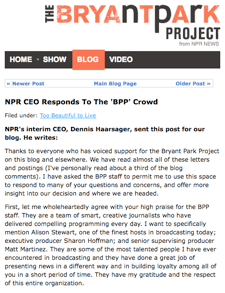
Now the comments are piling up in reaction to interim CEO Dennis Haarsager’s posting about the cancellation. I already gave my comments. What I find remarkable is that so many in the audience “get it.” Making NPR’s decision here all the more puzzling / frustrating.

Here’s a selection of comments and comment excerpts that I found compelling and instructive (they’re numbered here for reference, but are not numbered at the NPR site):

Continue reading “Favorite BPP reaction comments (so far)”

Haarsager on BPP, plus reactions

Well, I guess the NPR shoe I’d been warned about has dropped, with respect to the cancellation of BPP.

It was not a satisfying thud.

The comments on the BPP blog site, reacting to the memo, have begun rolling in. They are not, one would expect, positive. There’s some respectful language in there, but the overall feeling is that this formal response missed the point(s).

My own comment, submitted to NPR (and it may be up by the time you read this):

For all those saying NPR should have raised money directly for BPP, there’s a political mess you’re not aware of here.

If NPR openly attempted to raise money for any program, with large or small station carriage, the nationwide collection of stations would revolt. And please note the Board of NPR is majority-controlled by stations.

In short, it would never be attempted and would certainly be killed if it were.

There are indeed structural and cultural problems within NPR that make a project like BPP fail and put all forms of new media engagements at risk. But never forget that many of NPR’s most anti-new media anti-innovation qualities are inherited from the codependent relationship with the stations. In a sense, it’s no one’s fault, yet it’s everyone’s fault. And that’s the center of the problem.

The entire system is trapped by its own success in the radio medium — not the web. Asking it to change in fundamental ways (e.g. embracing direct funding, using the web innovatively and as a medium of first resort, building real community) is asking for a revolution in which heads would most certainly roll.

But public radio has not historically been a head-rolling collection of institutions.

If you want to change public media for the better, focus on your local station — volunteer, get on the Board, ask tough questions, demand new services, and prove to your station there’s money to be saved and made in engaging the community in new ways, especially online. And tell your station to let NPR grow and mature — even if that means audiences want direct relationships with the network rather than the station.  Local stations need a reason to exist beyond rebroadcasting NPR anyway.  It’s time they learned how to be local (again).

Or, failing all that, strike out on your own and create a new media entity with the soul of a public radio station but the structural DNA of a Google.

There’s a future for public media, to be sure. But only time will tell whether NPR will participate in it fully and faithfully.

Naturally, I have more thoughts, but didn’t want to post them at NPR’s site.

Overall review of the memo? Disappointing.

Haarsager’s memo language does not, as so many commenters already noted, ring true. There’s something wrong here; something out of place.

Canceling BPP doesn’t bother me per se (this kind of thing happens from time to time for many reasons, and BPP was cursed with bad luck from the start). But NPR’s handling of the cancellation has the feeling of political talking points about it, and that won’t fly in a new media era.  Words like “misdirection,” “willful ignorance” and “politically convenient” come to mind very easily here, and they shouldn’t. That’s not what I want to think about NPR.

But if you think my take on the situation is harsh, head over to the Huffington Post where Daniel Halloway has his way with the story.

For me, the upshot is that NPR is fundamentally flawed due to the nature of the relationships between stations and network. There’s no long-term-successful way forward unless that flaw is corrected, either by renegotiation of the relationship or by breaking free of the relationships entirely.

While it’s not an exact analog for where newspapers were 10 years ago, it’s close enough: a medium…

  • trapped by its own success
  • unable to innovate into a new model, even in small ways
  • finally dismantled by market forces beyond its control

I really hate this. This isn’t what I want for NPR specifically or public media broadly. Will someone please tell me I’m wrong? I don’t want to lose NPR!

iPhone 3G sold out… Bad news music radio!

The word is out that a little more than a week after launch, the iPhone 3G is now just plain gone from stores across the U.S. — be they Apple Stores or AT&T stores. Indeed, AT&T was sold out nationwide on the first day. Apple Stores have carried the device intermittently ever since and as of Monday morning there were only 3 stores nationwide that had anything — each carrying only one model.
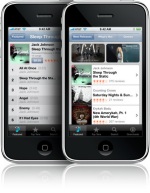
This is bad for music radio.

Okay, a bit over the top, but stay with me…

When the iPhone 2.0 software came out (which works on the old phones, not just the new sold-out ones), I dutifully downloaded and installed it on my own iPhone. Much of the system was unchanged. But the arrival of the App Store made all the difference, allowing the download and installation of applications that extend the functionality of the iPhone.

Two applications in particular were fascinating, in the context of broadcasting. One was AOL Radio, the other Pandora. Both of these services have existed at least for a few years online. But these are the first examples of full-bodied mobile implementations.

AOL Radio

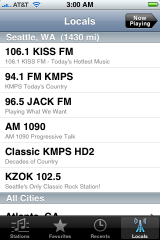
AOL Radio is pretty simple. It’s direct, live streaming access to the “AOL Radio” channels of music, sort of like satellite radio in that they aren’t local broadcast stations and are organized around tons of musical themes/styles. But it’s also an application that grants streaming access to hundreds of local terrestrial stations in the CBS collection. I can now listen, on the iPhone (with a live WiFi signal) to real-time streams of radio stations from coast to coast.

Since the iPhone goes everywhere with you, and given the near-ubiquity of WiFi signals, I now have hundreds of radio stations in my pocket. Sure, you could manage this before with several workarounds, but this is no workaround — this is a real implementation of a terrestrial transmitter threat that’s easy to use for mere mortals.

But that’s just AOL Radio. Forget that. That’s a threat we can obviate by getting our signals on the iPhone, too (not too hard — it’ll be done soon, I’m sure). Let’s get it on with Pandora.

Pandora

Pandora had interested me before, but only in an intellectual way. Now, presented again on the iPhone for free, I figured I’d try it again. It’s amazing, especially over WiFi. Let me say that again: it’s amazing.
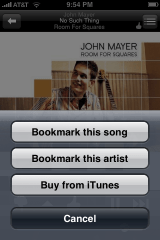
A huge library of songs, all gathered for you with the backing of the Music Genome Project. You pop in a favorite album, artist or song and Pandora generates a complete “station” for you of music from that artist and stuff that’s musically similar to the album/artist/song you’ve identified. And it works.

Let me say that again, too: IT WORKS.

What’s surprising is the sheer speed in which tracks pop down to the iPhone and start playing.  If you skip ahead the next track pops up nearly as fast as your CD player would find something further down the disc platter.  Oh, and the audio quality is easily equal to good FM (over WiFi — less so over 3G or EDGE networks).

I’ve begun discovering music and artists again. I’ve started buying music again. Sunday alone I dropped $30 on new music, buying tracks both from the iTunes Store and from the Amazon MP3 Downloads service.  All $30 were spent on artists I’d never experienced before Pandora suggested them and I bought them using links presented by Pandora.
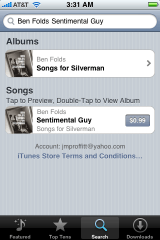
And get this… if the track or album is available on iTunes, you can buy it wirelessly right on the iPhone, no computer required.

Your own music discoveries can be broad or narrow based on how your “stations” are created and configured (which sounds a lot harder than it really is). And you can combine your stations into mix stations, granting you access to more eclectic recommendations.

Then there are more features on the regular Pandora web site. You can do the same thing via the full web that you do on the iPhone, but there are mild social networking features, extending the recommendation engine further. Plus, for more complex “station” operations, the full web site offers better tools. But it’s all one account, synchronized instantly back and forth as you use the service anywhere.

Why Listen to Music Radio?

Perhaps I’m already past the age where music radio makes sense for me, but I have to wonder what happens to music radio when this kind of access to music is virtually ubiquitous. Remember — the iPhone 3G sold 1 million devices in the first weekend and is sold out nationwide a week later. Pandora is a free service and free application — no advertising, no tricks — and it’s easy to use. (I began to wonder why I bothered syncing music to the iPhone — why not just live on Pandora recommendations alone?)

I’m curious if any music station programmers out there have a take on Pandora they’d like to share. I know there are things you can do with radio that Pandora will never match. And I know the Pandora catalog is limited by the licensing deals they can strike with publishers. But really… if you can listen to “stations” tailored to your preferences and discover new-to-you music in a hyper-efficient way, why turn to terrestrial radio for music at all?

If you’re human-hosting your music, you’d better be doing a better job than the Music Genome Project.

How network effects disrupt the liberal elite world of mass media

Here’s a fast and tight 25 minutes of thinking that everyone confronting the disintegration of mass media should view. It’s Mark Pesce speaking at the Personal Democracy Forum just last month (June 24).

http://www.viddler.com/player/aa10e87e/

I’ve certainly felt an increasing pull of networked social structures in the 21st century. There’s something new happening today, something unprecedented. Pesce puts words to that feeling and it sounds largely right. Plus it dovetails nicely with Clay Shirky’s ideas in Here Comes Everybody, a seminal work for broadcasters getting shoved around in this new media world.

My concern, however, is that other factors will derail these social network developments. For example, even given all the cell phones in the world, there are still tremendously autocratic / dictatorial leaders that the masses, supposedly connected, have not yet overthrown. Even in our own country, one of the most connected, we’ve been unable to defeat or marginalize a President that has acted repeatedly against our own national best interests.

Pesce’s ideas also seem to ignore the upheaval I’m betting we’ll see with the end of cheap oil, partially due to depletion and partially due to global warming controls. Seems to me a fundamental upheaval like that would disrupt the social order that’s supposed to be disrupted by the network effect. And what about global warming effects — with predicted mass extinction events (starting with ocean acidification) that will have unknown effects on the rest of our ecosystem?

In any case, it’s a fascinating talk. Well worth the time of mass media folks trying to understand why they’re no longer the center of the universe.