
A public media device?

With the launch of this new purpose-built GPS device (above) branded with Geocaching in mind, I got to wondering… Is it time for public media stations to consider contract design and manufacturing of purpose-built digital devices? After all, GPS units have been around for decades now, but this is the first major foray into the field that’s specifically designed around the Geocaching game and brand.

Sure, it’s probably too early for public media to actually build and sell custom devices, but it may be time to think about it.

Several years ago I saw a device from Colorado Public Radio designed to receive Internet streams from the station — and it had only one function: receiving the station. You couldn’t even point the device to another station. I don’t know if they ever mass produced the device, but I thought that was a fun little idea.

The public radio community has developed iPhone apps, of course — some impressive ones at that, with help from PRX, CPB and others. I imagine PBS may get into the game once the iPad is released — if the stations will allow it. Or maybe the producers will do it themselves, without PBS or station approval.

Can you imagine a full-screen interactive Frontline app with embedded documents, video clips, full episodes, links to online resources, live data and more? What a fabulous research tool, teaching tool, voter education tool and more! TV begins to look very flat, dull and excessively linear at that point.

Who knows if public media will go hardware — maybe software is enough. But let’s not think too small.

Healthcare, journalism, racism, obscenity and the FCC

While Americans have gained a national health care plan, something darker has been unleashed. Racism in American political life has been emboldened by the attacks on the administration allowed on certain media. Meanwhile the FCC takes refuge behind 1st Amendment rhetoric and concerns itself with “wardrobe malfunctions” rather than assaults on democracy perpetrated by so-called journalists.

via nowthedetails.blogspot.com

Former NPR ombudsman Jeffrey Dvorkin is always enlightening to follow.

If CNN told the truth

Wolf Blitzer should cry himself to sleep for the sins he visits upon our nation every day. And that goes for all the cable “news” network hosts. You too, Anderson Cooper — you’re part of the problem.

http://media.theonion.com/flash/video/embedded_player.swf
Breaking News: Some Bullshit Happening Somewhere

It’s always good to see a CNN documentary like this.

Gruber on Apple

I love John Gruber. So smart, so deeply into Apple’s mindset. Great commentary here from the recent Macworld event in San Francisco. He talks about 10 issues he think Apple needs to deal with, one way or another. Great stuff.

http://c.brightcove.com/services/viewer/federated_f9/55300429001?isVid=1&publisherID=54694250001

Pew Research on Millennials – Wed, Feb 24

“Tune in” to a special Pew Research Center conference on the Millennial generation starting at 9:00am Eastern on Wednesday, February 24.

I’ll be on the road, driving 4,000 miles from Anchorage to St. Louis, unable to watch. But if I were at a computer with a live web connection, I’d totally watch.

Public media companies and leaders need to understand how younger generations view the world. Others, like Jacobs Media, have done a good job with profiling younger folks. But we seem to forget these lessons.

So check out the webcast here.

MUST SEE: Future of gaming, future of society?

Om Malik posted the following video by Jesse Schell and raved about it over on Giga Om. And rightly so. It’s a 30-minute roller coaster ride of ideas about the “experience economy,” authenticity, gaming psychology, Facebook, and the future of social media and possibly even society.

I still need some time to wrap my head around this. It’s such a new way of thinking for public service media, yet it’s so crucial we start thinking about media as an “experience,” not just something to be passively consumed. If we’re serious about creating positive outcomes for people and communities, immersive and “authentic” experiences will be much better suited to reaching our goals than simply giving people information and suggesting they consider changing their behaviors.

In my particular case, I’m wondering what kind of “gaming” elements can be added for readers of the St. Louis Beacon to keep them more engaged, get them more informed and connect them to each other and positive outcomes for the community. Or how might we offer “points” for participants in upcoming public service media projects we’re going to do at KETC?

In any case, this is a MUST SEE VIDEO. Take the time. It’s well worth it.

http://g4tv.com/lv3/44277

Farewell Alaska. Hello St. Louis!

Announcement Time!

As of this week I accepted an exciting new position with public service media company KETC in St. Louis, Missouri. Starting in early March, I’ll be their new Director of Digital Engagement.

Historically KETC has been, and to this day is, a public television station in a TV market of roughly 3 million, broadcasting national PBS programming as well as locally-generated shows, some of which are distributed nationally on occasion. Amongst public TV stations, KETC is one of the oldest on record. Seriously — check out their amazing timeline going back to 1954, a full 13 years before the Public Broadcasting Act. Now that is history.

Yet for all that rich history, KETC is becoming something very new today: a public service media company, not simply a broadcaster. Over the past few years they’ve embarked on a remarkable transformation, developing closer relationships with their community and using media to solve problems.

It started with outreach around The War, in which KETC set the national standard for gathering local veteran stories and integrating it with the Ken Burns documentary.

This new way of working and thinking culminated with the local, then national, Facing the Mortgage Crisis, in which the station literally networked nonprofits, government agencies, banks and homeowners in a united effort to slow or even stop the wave of foreclosures hitting the area following the financial meltdown. The project included social media, broadcast, old-fashioned networking, live events and lots of online work. The accomplishment in St. Louis were so impressive the CPB expanded the program to selected stations nationwide.

Now a new project is beginning; one focused on issues around the topic of immigration. They’re even remodeling part of the building to house the new local nonprofit news service — the St. Louis Beacon — and the cross-functional multiplatform digital media team… all together in the same space. And I’ll be there to help.
I can’t tell you how exciting this is. I’ve watched KETC from afar, oftentimes through consultant Rob Paterson‘s postings. This is an opportunity for me to put up or shut up on digital engagement and public service media. And I will do my best, for the good of St. Louis (a town I knew as a child, as it turns out), and hopefully for a broader public broadcasting community looking to understand how to move into what CPB’s Rob Bole calls “public purpose media.”

Sadly, this means I will be leaving Alaska very soon indeed, having lived on the Last Frontier for the past 9 years. The departure is made all the harder because I must leave behind a vibrant social media community I helped create over the past year. That community has gone on to raise money for a friend in need, form a local Ignite chapter and, from what I’m told, a wedding may be in the works. 🙂

So farewell Alaska. I will miss your Chugach mountain skyline and the warm embrace of entertaining and thoughtful friends all too soon.

And hello St. Louis! Let’s make something meaningful together.

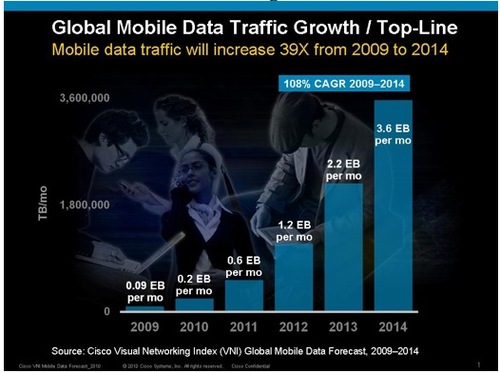
Cisco projecting explosive mobile data growth

found via gigaom.com

Explosive growth in mobile data is the norm in projections these days. I used a chart like this one in a presentation back in December.

It’s hard to imagine a 39X mobile data growth rate in just 5 years. But there it is.

What works online would work in public service media

There’s a lesson in here for public media:

More emotional stories were more likely to be e-mailed, the researchers found, and positive articles were shared more than negative ones. Longer articles generally did better than shorter articles, although Dr. Berger said that might just be because the longer articles were about more engaging topics.

via nytimes.com

This follows along comments I made at WOSU this past December: factual news is a commodity — don’t spend a lot of effort on it. Pass along baseline facts, but don’t trump it up as some vaunted public service. Everyone’s doing that already.

Instead, focus on public service media — solving problems and exposing stories that have meaningful impact on the community. Consider the qualities of articles that are passed along, like the ones at the NY Times.

Highly recommended reading.