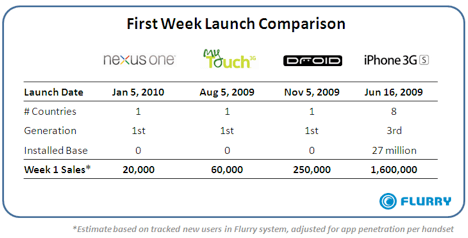
Nexus One: 20,000 / iPhone 3GS: 1,600,000


via gigaom.com

This is not good.

I love the iPhone, but it needs competition. While the Android series of phones are interesting, they still aren’t stacking up as serious competitors, either from a unit sales perspective or, more importantly, from a software perspective.

This is the difference between messianic vision for a product or service and simply throwing engineers and marketers into a room together.

When will someone give Apple a run for its money?

The mission problem

On December 6, 2009 Rob Bole, the CPB’s VP for Digital Media Strategies, wrote a great post: The Mogul’s Dilemma: Our Mystic Guideposts to Failure. Highly recommended reading. I was reminded of it today in the MediaShift post that actually started with me and then ended with Rob while talking about the infrastructure needed for modern public service media.

Back in late December, when I finally read Bole’s post, I posted my own comments. I saw my notes again today and was surprised to see just how much I wrote. And rather than let the comments sit there alone, I wanted to capture them here on my site for reference. Here’s what I had to say in response:

I totally agree about operators and strategic thinkers as you’ve presented in your thoughts here. When I started in public media in 2004, I was taken aback by how risk-averse the system was in technology, but also in core services and mission. So while I’ve personally beaten the drum for moves toward web services, I’ve also come to realize there’s a very deep-seated problem in “the system” that hasn’t yet been solved in most places.

It’s a mission problem.

What I’ve found is a lot of folks who built their careers and even their personal identities within broadcasting. To ask them or — if you dare — tell them to change, to learn new things and to act in new ways is pretty much an insult to their finely-crafted sense of selves (even if you deeply respect their past work).

But I found more than just entitlement along the way. I also found a loss of Passion and Purpose.

Public broadcasting became a system, an industry, a business. It became broadcasting, it became TV, it became radio — the platform was the thing and identities were inextricably intertwined with the platform. I’ve worked with TV engineers that were irritated when asked to solve radio engineering problems because TV Mattered and Radio Didn’t. In a world defined by technology platform, how do you have a serious conversation about ethereal things like “mission?”

It seems to me that over the years the high-minded notions of the Public Broadcasting Act have been lost. There’s been a failure to renew the mission, to redefine it in modern terms and to find people passionately committed to it. “Broadcasting fulfilled that mission, so why does it need to change?”

It’s taken me 5 years to reach the conclusion that the Internet, TV, radio, newspapers — none of that matters. Those are all technology choices, and they’re all commodities now. What matters is what you do with them, and frankly, most public broadcasting companies and leaders haven’t committed to this new perspective yet.

But there’s one that’s on the way. KETC in St. Louis is transforming itself, little by little, into a company on a mission for its community. They’re learning the best ways to be the “operator” you call for in this post, and they’re doing it across media platforms and out in the community. They originated the “Facing the Mortgage Crisis” project, and they did it because their community needed help and they felt a calling to deal with the issue, not to curry favor with the CPB or other funders.

And it’s not been easy. Each of the projects they’ve undertaken in the last couple of years have been big risks. They didn’t have complete funding. They had to bring together teams from legacy and new units to get the work done. They had to invent new methods and go out into a community that they, like most stations, had largely ignored for many years, preferring to broadcast, broadcast, broadcast.

I would encourage you to help stations find their Purpose and build Passion around that. With those two things, the right operators will magically show up — they’ll want to be a part of that Purpose. The strategic thinkers will join up, too, because there’s plenty of strategy to work out once you have your broad Purpose defined (or re-defined).

Here’s something practical:

Ask stations the two questions I first asked when I joined a public media company back in 2004:

  1. Who are you?
  2. Why are you here?

Very simple questions. You might be surprised how many people across the “system” don’t have good answers.

But if they can’t answer those questions — without quoting a tired mission statement — none of the rest of the debate over operators or strategy will really matter.

P.S. I’ve never gotten a good answer to my questions. But KETC may be the first to at least SHOW us some answers.

The Levelator 2 has arrived

If you work with digital audio recorded under less-than-studio-perfect engineering — especially spoken content — you are hereby requested and required to immediately download the new Levelator 2, free from the awesome nonprofit Conversations Network.

Public media’s good friend — nay, philanthropist innovatorDoug Kaye and his audio engineering wizards have offered up this tool for free to help all us poor schlubs make our audio sound better. It’s perfect for podcasting and especially well-suited to multi-person multi-microphone recording in which the various speakers are alternatively louder and softer than the next speaker.

I’ve been using The Levelator for years now and it almost always makes your audio sound much better, especially when you’re distributing the audio to online listeners or folks subscribing to your podcast.

Read more and download right away for Mac, Windows or Linux.

You know what they say: Location, Location, Location!

via youtube.com

I remember talking to IT pals of mine 5 years ago about how location-based information was going to be the Next Big Thing. It took 5 years, but we’re finally here.

Public service media can use location, too. Indeed, as creators, conveners and curators of media that’s focused on communities in specific locations, this stuff will be huge.

If we get out of the studio and get into the community, that is.

Google sidesteps the commodity phone business

The second point that I think is key is the recognition that Google has the opportunity to play a bit of business model jujitsu against competitors with Android, noted in this sentence: “It could afford to do this because Google aims solely to protect the great business they already have in advertising, not to make money directly from the product (HW or SW in this case).” This is a point that we discuss in a variety of different business markets. It’s why we think that those who understand how to embrace the difference between scarce and infinite goods have a huge advantage. If you can make money by giving away a product for free that some legacy business relies on charging for — and then making your money up in an ancillary market (made bigger by giving your product away for free), then you have a massive advantage to disrupt the market.

Google doesn’t need or even want your handset money or your OS licensing money — those things have no margin and/or entail too much overhead cost in support. But if Google can build a vast lead in mobile device advertising (which is more than just display ads, by the way), then their core business is protected from new entrants.

In public service media, I’ve previously talked (and presented) about commodity news and how we should either be giving away the commodity product — even to our legacy “competitors” — or simply stop producing it altogether. Know what business you’re in. Let everyone else scramble for the commodity scraps.

Techdirt on the Cable TV vs. Internet battle

…both of these stories suggest a prime battleground for the next year: as the old TV businesses come to grips with the internet (finally). Just like other parts of the entertainment industry, it will be messy and annoying — and incumbent players are going to make a lot of really stupid mistakes. But, in the end, we should start to get some pretty cool stuff out of it — though, most likely not directly from the incumbent players, but from the upstarts and innovators on the margins.

2010: The Year of Skype?

Skype is finally spun off from eBay and owns its own intellectual property. They’re already expanding to integrate with business phone systems and now they’re working with TV manufacturers to put Skype into “smart” TVs.

Imagine: 720p live videoconferencing from your TV, no computer required. And let’s be clear: we’re talking about Skype being built-in to your TV as a feature that’s one button away, not through some set-top box. What will it mean when you can have a high-quality videoconferencing system easy enough for the grandparents and kids?

Check out this introductory video from Skype to get a sense of what they’re announcing:

http://download.skype.com/share/videos/player.swf

I already do occasional video chat sessions with family and friends thousands of miles away and it works pretty darn well (via both Skype and iChat). Make video calling a reality from home and traditional TV just met its latest threat to time that used to be spent passively consuming video media.

We already know 2010 will be the year of the tablet (via Apple and other players, but mostly Apple). It could also be the year Skype breaks past geek niche product into the mainstream.

Public Service Media requires decentralized action

Let’s start with an insightful quote from David Brooks writing in the NY Times this past weekend:

For better or worse, over the past 50 years we have concentrated authority in centralized agencies and reduced the role of decentralized citizen action. We’ve done this in many spheres of life. Maybe that’s wise, maybe it’s not. But we shouldn’t imagine that these centralized institutions are going to work perfectly or even well most of the time.

In this case, Brooks was talking about centralized agency performance in the face of terrorism threats, but his talk about the powers — or lack of powers — in centralized government agencies got me to thinking about public service media. It seems to me that if we’re serious about public service media, we’re going to have to act locally and work to deemphasize national content distribution, services and cash flows. We’ve gone too far into centralized, and we’ve lost our way in our hometowns.

It strikes me that, more than anything else, those who will successfully practice public service media in this new decade will rely upon themselves and their communities, rather than waiting for solutions or directions to arrive from national agencies or media producers. Local solutions can’t come from somewhere else (though ideas can). The age of centralization and top-down service is over for now. Such approaches don’t scale down to real problems and palpable action well, and they smack of paternalistic “do this and do it this way” directives. We’ve put too much faith and power into centralized systems, enfeebling our abilities to act in our own communities.

Serving community needs almost always must be done on a localized basis. Yet over the past 20 years the public broadcasting universe has concentrated more and more power, intelligence, money and experience in the core networks and stations: PBS, NPR, APM, PRI, WGBH, KQED, WETA, WNYC and so on. Donors to local pubcasting stations are really helping pay Paula Kerger (PBS) more than $500,000 a year and Steve Inskeep and Renee Montagne (NPR) more than $600,000 a year combined, not to mention so many others. Yet the services they individually provide, while nice, are not vital to solving community problems where we live (they don’t even solve problems in the Washington, DC metro area, for that matter).

Consider what could be done with the money spent on the centralized networks in a local area. In one market with which I have passing familiarity, with about 2.8 million people in the MSA, the local PBS station sends more than $1.2 million annually to PBS alone. That’s money leaving the community, going to PBS (and ultimately to program producers) and what that community gets back is national PBS content. I’m not sure that’s a good return on the community’s investment, not to mention the duplication of effort that happens across 300 cities nationwide — stations do pretty much the same thing everywhere: create a PBS station that looks like all the others, save for the logo.
Meanwhile, that’s $1.2 million that isn’t being spent to provide services that are locally relevant and useful to the community. What if that money paid for 12 people to write, shoot video, take pictures, interview people and gather and post information and host interactive communities that solve real problems? And what if those 12 people helped organize a community of 48 people that were actively and collaboratively involved in solving problems, multiplying the positive effect? That would be a major, real-world impact — well worth $1.2 million in local funding from a community of 2.8 million ($2.30 per citizen per year).

Now, I know what you’re thinking: “What do we do about Antiques Roadshow?” Well, that show can go to A&E. Oh, except they already have that show, called Pawn Stars. Zing! But seriously, I can address the restructuring of public TV funding and programming in a future post. For now, my point is that local public service media companies must focus on local needs and solutions. Leave the nationals to do their work (in new ways, in new funding models).

When the 1967 Public Broadcasting Act came along, there was a deep-rooted need for local media creation that served local needs in a noncommercial way. Over the years, the professionalism of the system has destroyed local capacity, concentrating capacity at the national level, where both PBS and NPR are competing with national media outlets and behaving in ways disconnected from local needs. In many ways, the dreams of the 1967 PBA writers were attained, but have been steadily lost.

It’s time to swing the pendulum back the other way.
Changing the rules of the game

I was catching up on some reading over the Christmas weekend and came across a fascinating post over at Reflections of a Newsosaur about Panorama — a fascinating project from McSweeney’s that puts a ton of new journalism out into the world… in print.

But what was just as interesting as the project was the reaction on the blog. Immediately the news pros out there ragged on the effort as “just a magazine” and derided the project’s ability to produce so much (admittedly great) content on a daily basis. Harumph! they cried out.

But thankfully one commenter had the right idea — who says all “real” news has to be daily? Who wrote these rules, and what if they don’t apply anymore, or shouldn’t apply?

Indeed.

If you goal is to change the world (for the better), then you have to… well… change the world. That means some things in your world will change.

Even amidst all the change in the media world, newspaper leaders and supporters would rather dump on an innovative new project on not meeting their imaginary “standards” than consider how they might change to do insanely great journalism. We don’t need daily print publications, we need engaging stories and information that help us solve problems in our lives and communities. Maybe you do that every day, maybe every other day, maybe weekly, monthly — whatever is the right process to fit your economic and storytelling capacity.

The worst thing we can do, if we want to make impacts as public service media companies, is to keep doing what public broadcasters have always done, without modification, without experimentation, without considering the needs of the community today, not the community’s needs from 1979.

Sign me up for a TV hooked to the web

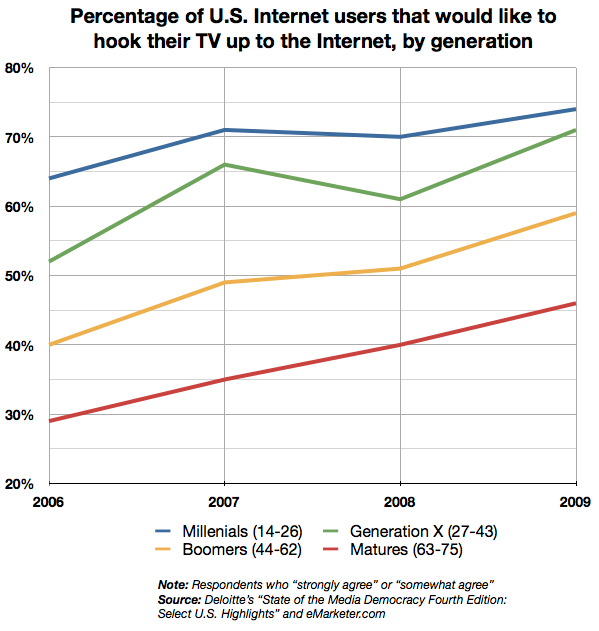
Interesting chart of some numbers published by eMarketer recently, taken from a Deloitte research report:

It’s remarkable to note how fast and consistently “matures” are getting interested in hooking their TVs up to the Internet. But everyone’s desires are rising, in all age ranges.

I’d like to hook up a TV directly, too. Of course, I’ve already got an Xbox 360, Playstation 3, Wii and Apple TV, and they’re all live on the Internet. But it’s still not quite the experience I’m looking for. I’ve considered setting up a Mac mini, but just don’t want the cost and the hassle.

And what happens when the interactive Internet — complete with social experiences — is on your big screen and “TV” is still a crummy, compressed image from your cable or satellite provider? That’s some tough competition for broadcast.