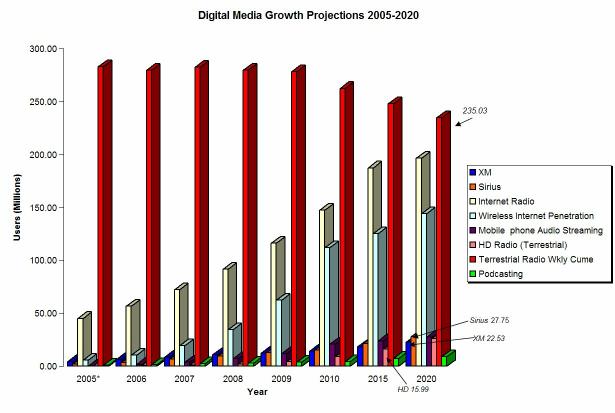
Chart created by Bridge Ratings (2006). Click for a larger version.
Last week on the PUBRADIO mailing list, the topic of HD Radio came up again. Commenters went one way, then another — all talking about programming and broadcasting as they usually do. Technology didn’t really enter into the equation, yet it’s one of the core issues in terms of consumer adoption patterns.
Why is HD Radio failing to catch on? Lots of reasons easily come to mind:
- Broadcast audio streams aren’t something new — it’s called Radio and we’ve had it for 100 years; why bother to get a new radio when the old one works fine?
- The higher quality audio possible with HD Radio is nice, but in most listening situations (cheap radios, cars in traffic, noisy offices) the improvement over analog FM is negligible
- Multichannel service really hasn’t arrived at most HD-capable stations so far
- While HD Radio signals are less prone to some types of interference, real-world experience suggests it’s a generally weaker signal, especially if you’re comparing devices with internal antennas (clock radios)
- Though most consumers don’t know it, there are software revisions appearing with HD Radio right now, and most radios are not field-upgradable — it’s not “safe” to invest big bucks in receivers yet
- Satellite radio has blunted the multichannel argument and still offers less commercialism than an HD Radio multichannel service would (admittedly, you have to pay for sat radio, but many are willing to do so)
- Internet audio streams have a bigger audience already and are growing faster than all other streamed audio services
Continue reading “iBiquity: How a closed-source model is killing HD Radio”
 Gravity Medium