The attached AT&T video has been making the rounds lately on Twitter and beyond. It’s a series of commercials broadcast in 1993 — dubbed the “You Will” campaign — centered on the notion that AT&T is working to bring you next-generation technologies and experiences.
Keeping in mind these commercials were first broadcast 16 years ago (!) and were pitched at the time as futuristic fantasies, it’s remarkable to see how many of these predictions have come true, and come true to a such a complete degree.
For fun, let’s watch the video, then review the predictions and compare them to current technological facts in the industrialized world.
http://www.youtube.com/v/TZb0avfQme8&hl=en&fs=1&rel=0
Borrow a book from thousands of miles away
Status: Done and improving
In the 1993 futurist’s eyes, a person looks at a book through a digital screen of some kind; as they swipe a finger across the screen, the pages of the book turn. While that’s a very literal representation of a book from a distance, we pretty much have that functionality today in lots of ways. PDF documents make digital documents look the same on any screen or platform, plus the contents are searchable. Google’s book digitization efforts (legal wranglings notwithstanding) are a remarkable and growing achievement. Plus the arrival of Amazon’s Kindle — the first mass-market e-book reader to even marginally catch on — arrived last year. And I have at least two iPhone apps that let you swipe a finger across the screen and watch a virtual page turn.
Interestingly, the notion of “borrowing” a book likely won’t come true. That suggests that only one person can look at or “use” a book at a time. But in a world of digital goods, everyone can have a copy simultaneously. No late fees.
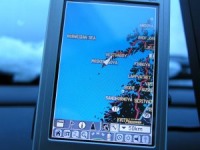 Cross the country without stopping for directions
Status: Done
No argument on this one. AT&T’s futurists showed an in-dash GPS navigation system that’s increasingly common today. The devices are even portable. The only thing AT&T did to jazz up what we already have is to put Hollywood-style fly-through structural videos into the screen. Everything else — road locations, spoken directions — we’ve already got.
Send someone a fax from the beach
Status: Done, but already outdated
Faxes? That’s so 1993. While technically you can send a fax from the beach today, why would you? Nope – today we shoot video with our cell phones and upload the clips to instantly share with friends and family worldwide. Not to mention sending e-mail. All that’s required is a live Internet connection via cell service or WiFi — which is nearly ubiquitous. In fact, with the right phone and connection, you can stream live video from wherever you are to thousands of live viewers anywhere on the ‘Net.
The other thing shown in the video is the fax sender writing on what we would call a tablet PC screen. Tablets are widely available, but rarely purchased these days. The pen-style interface pioneered by the Newton actually shipped for the first time in 1993 and, with an appropriate modem, you could actually send a fax from the device. You just couldn’t do it without a physical phone line yet.
Pay a toll without slowing down
Status: Done
This was done years ago, especially on toll roads in the more trafficked parts of the country. You pop an RFID chip into your car from the toll road operator, pass through the toll area at a reasonable speed, and your account is debited appropriately. Simple. In fact, I had an RFID chip from Mobil years ago that let me pay for gas by simply waving my tiny keyfob near a gas pump pad and everything was handled in the background. This is old hat.
The one thing the futurists got wrong is the notion of speeding through the toll booth at 90mph, as the driver appears to do in the commercial. That’s just not safe.
 Buy concert tickets from a cash machine
Status: Done, but not in the way AT&T predicted
Cash machines, or ATMs, are really still just for simple bank-related transactions these days. And rightly so. C’mon — you’ve stood behind the person that’s taking so long to use the ATM you wonder if they’re handling their secret Swiss bank account — we don’t want these devices used for more transactions! On the other hand, you can buy anything online, and you can do it from any number of ‘Net-connected devices.
Example: Last spring I was in Washington, DC with family and we decided to see a movie. Not being from the area, we didn’t know what theaters were nearby or what was playing. So I whipped out the iPhone, got a GPS fix on my location, and used the Fandango app to find the nearest theaters and get current showtimes. Then with a few taps, I selected a movie, a time and paid for the tickets instantly. This would have been unimaginable just 3 years ago, let alone 16.
All told, we can buy concert tickets today from far more locations than just ATMs.
Tuck your baby in from a phone booth
Status: Done, but no phone booth
Leave it to a phone company to see a future for phone booths. We do have Internet cafes — a kind of 21st-century phone booth, I suppose — but people traveling a lot already have their own laptops, most with webcams built-in. With Skype, iChat and lots of other apps out there, you can “tuck your baby in” from anywhere your laptop hooks up to the Internet.
Open doors with the sound of your voice
Status: Can be done, but it’s not done much or easily
The automated home has always been “just around the corner” ever since the Jetsons were first on the air (1962). You can do this “voice print” thing today, but you have to be really determined. While voice recognition, as a form of biometrics, does exist, it’s not widely used and not generally in consumer electronics. What you can do fairly easily today is get an RFID key that will unlock the door for you without a word, but just physical presence.
Carry your medical history in your wallet
Status: Not quite there yet
Google Health, one example of the Personal Health Record (PHR) movement, exists already. So if you’re determined to digitize your medical records and you’re willing to take on the perceived privacy risks, you can do it right now. Info in your wallet? Well… sort of. You can bring up your data on any Internet-connected computer with your username and password, so there’s that. And again, if you’re determined and willing to take the risk, you can store the same data on a USB flash drive — and that would fit in your pocket.
Generally speaking, digitization of health info continues to move incredibly slowly, probably due to privacy worries and the lack of standards for data interoperability (despite early work on the HL7 standard and work on HIPAA). Plus, there are no economic incentives for the players involved. So this will come someday… someday…
Attend a meeting in your bare feet
Status: Done
You’ve been on conference calls where there are screaming children or barking dogs in the background, right? Yeah, me too. This one’s definitely done. Maybe overdone.
Watch the movie you want to the minute you want to
Status: Done
Video-on-demand has been around in one form or another for many years now. It’s not universally available and it may require “extra” subscriptions to your cable, satellite or fiber provider, but it’s out there. If you consider computer screens as legitimate viewing devices, you can also add Hulu as an example of a monstrously huge on-demand viewing service.
Learn special things from faraway places
Status: Done
Distance learning is old hat on most university campuses these days. It may not be as flashy or as interactive as the example shown in the commercial, but it’s out there. Video, audio, remote interactivity options — it’s all there. Not to mention discussion boards, blogs, real-time chats and more.
—
So what’s the score? Of 11 predictions, 9 are already a full reality (82%) while the other 2 are largely done while still under active development. If you’re willing to work for it, the futurists were completely on the ball on all counts.
Pretty amazing.
 If you’re involved in public radio, this is required reading / listening.
 Gravity Medium