Huge citizen journalism win in Detroit

Man, I wish I was in the Detroit area now, despite the auto manufacturing disaster. This looks promising.

By the way, don’t dismiss The Oakland Press as some tiny suburban paper. It’s a pretty big paper, given the size of the communities they cover. Detroit is “big,” but the areas north and northwest of the city proper are huge.

Don’t miss it. Thanks to Jay Rosen (@jayrosen_nyu) for the find.

2 Fox and NBC Stations to Pool Video News Gathering

http://www.nytimes.com/2008/11/14/business/media/14news.html

Good for them. Too bad it’s still terrible local TV news. What they should do is blend in a VJ process and stop doing ambulance-chasing and I’m-standing-outside-a-building-where-something-happened-6-hours-ago “live” reports.

The answer definitely lies in sharing news. News is a commodity. Content is worthless. Context and community are where new value will be found.

What happens to web stats when Sarah Palin seekers stop by

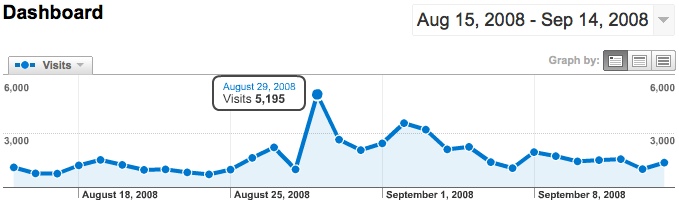
On an average day over the last several months, APRN.ORG (the web site for news from the Alaska Public Radio Network), our daily web visit count (according to Google Analytics) was usually under 1,000.  On a good day, we’d spike to maybe 1,200. On a great day, we’d spike to 1,500.

But once Sarah Palin was selected as the Republican VP nominee, you can imagine what happened.

As shown in the graph above, we suddenly spiked to nearly 5,200 visits in a single day, and hit over the 3,000 mark a couple times the following week.

Our traffic is dying down now, almost to normal levels. But what a ride that was. I only wish we had a dedicated web team to do more stuff. Maybe someday.

How people behave as their ivory tower collapses

I have no vested interest the “old order” of journalism, be it at newspapers, in public radio or elsewhere. I don’t have a journalism degree (though I do have the kissing cousin degree: English). I’ve collected a paycheck from the media world for less than 4 years now, having spent many years before that in a variety of businesses.

But I would hope that even if I had studied journalism in college, spent a 20+ year career in the field, won awards and so on that I would show a hell of a lot more professionalism and simple human decency than the ugly curs trolling one newspaper intern’s blog this week.

Admittedly, it’s a volatile situation as people are losing their jobs at the Tampa Tribune and the newspaper company is confronting the facts: if they change nothing they’re definitely dead, and even if they change everything they might still be dead. That’s a tough situation for everyone.

It’s terrible to be laid off (it’s happened to me). Layoffs cast all reason out the window in favor of pain and fear. But come on. That doesn’t give you either the right or the moral authority to attack an intern as your personal scapegoat for everything that’s “wrong” with the media industry (in your eyes).

It’s been nearly 24 hours now since I read the post — a fascinating insider look that most journalists wouldn’t share with the public (oh, the delicious irony!) — and I’m still floored by the nasty and even threatening comments made in response to the post.

If your ivory tower is collapsing, shouldn’t you be looking for a safe way out or a safe place to land?

News: Our most important edge

There’s been a lot of chatter this week about NPR’s coverage of the earthquakes and their aftermath in the Sichuan province of China, and for good reason. Reporting, especially by Melissa Block from Chengdu, has been remarkable: it’s immediate, detailed, dispassionate, and yet so completely human and humane. Lots of folks in public media have noted how proud they were to be professionally associated with just this kind of public service, and I felt the same way.

Indeed, I felt about NPR’s coverage exactly the opposite of what I feel every time I see or hear commercial media reporting on, well… anything. I’ve cited before my disgust for all things TV news and especially cable news. The disasters that are CNN, MSNBC, Fox, CBS, ABC, NBC and so on would be laughable if they weren’t so fundamentally damaging to our democracy. They’re a cancer, not a public service, as they make our nation dumber with each minute of air time. They’re part of what I call the “bread-and-circuses” media. (And I’m not saying this for dramatic effect — I’m literally angered and saddened with each appearance of Wolf Blitzer and the army of morons that make up commercial TV news.)

Which leads me to a positive point, rather than just a rant.

Continue reading “News: Our most important edge”

TV News: Just die already

I hate TV news and TV “journalists.” Local, national, cable, network — you name it, I hate it and them. CNN, a once-proud innovator in quality news, is now even less than a joke. It’s no longer a laughable service, it’s one that should make every self-respecting democracy-loving American weep. CBS, already a shameful service, now wants to buy news from CNN? Well, sure — what the hell’s the difference at this point, anyway?

(The one exception, of course, is most of the stuff distributed via PBS. The pubcasting news/public affairs shows have their own problems, but integrity or seriousness of intent is not one of them.)

Thank God there are so many smart people in the world that are as outraged by (commercial) TV news as I am. The reaction to Wednesday night’s Clinton/Obama debate in Pennsylvania was instantaneous, nearly universally negative and — bonus — entertaining to boot.

Check out these Twitter posts (tweets) regarding the debate, from a variety of users…

  • 45 minutes into the debate and I’m thinking this is exactly why network TV must die. Not one real issue – just flag pins, Wright, and Bosnia
  • And should a former Clinton campaign manager be one of the two people conducting the debate? Doesn’t ABC have any real journalists?
  • ABC’s debate was a bigger joke than CNN’s compassion forum. it’s good the newseum in dc is now open because real journalism is cold and dead
  • hehe Charles said “fascinating debate”. What debate was he watching?
  • Just wrote a letter to my local affiliate complaining about how bad the Debate was handled. I felt bad for both candidates
  • Reddit-fueled debate backlash nearing 10,000 complaints on ABC website: http://ping.fm/aTKoi (wait til Digg kicks in)
  • 50 minutes into the democratic debate and yet not one question of substance. No policy, all bullshit.
  • terrible debate. ABC News sucks.
  • Almost 10,00 comments on abcnews.com http://is.gd/6KM detesting the debate questions as tabloid and irrelevant. And they were.
  • What the hell is wrong with ABC? Effing flag pins and fake scandals? Well done. You’d have been better off letting The View run the debate.
  • the real question about tonight’s debate…will the press cover how bad abc news handled it???
  • tried giving feedback on the debate on the abc news site but couldn’t register. site is probably overloaded. comment count is now over 9500!
  • just under 4 hours since the debate and the abc news site has received almost 9400 comments, almost all negative!
  • to me, the big news of the debate is how terrible the moderators were. they were trying to create news. they were debating the candidates.
  • Josh Marshall of TalkingPointsMemo says that after tonight, they need to give the debates back to the Women League of Voters?

Let’s set aside the new media topic for a moment and address journalism, ethics and trust. Public media purveyors: Your job is to be everything that ABC, CNN, CBS and others are not. Do that, on any platform, and the support will follow.
TWiT tackles news, blogs, NPR, podcasting, new media

This Week in Tech (TWiT) is a great little tech-oriented podcast with a broad international following (somwhere north of 200,000 weekly listeners). But on the March 31 show they went off the tech industry track and tackled issues related to news, newspapers, news radio, NPR, podcasts, blogs, Twitter, reporting and more.

Public media folks may be interested to hear how folks that work in media — but outside our industry niche — talk about what we’re doing and the major trends affecting everyone publishing everything.

You can listen to and/or download this week’s episode here.

Paterson on leadership (at NPR)

While I do appreciate Robert Paterson’s take on the leadership issue that’s likely below the surface of the NPR / Stern debate, I’m struggling to believe that that’s the core of this week’s story — that Ken Stern just ruffled too many feathers and it was time for a different leader. Sure, hard-charging generals are not the best leaders in all situations, and after 10 years of whip-cracking you might need a smooth operator. That makes eminent sense.

But in the shifting media environment about which so many of us write and ruminate, isn’t a hard-charging general needed at the top? Someone that has both the vision and the drive to push through to a new way of thinking and doing. The media environment changes in play today are not just operational in nature, where a COO might fix this, improve that — they’re strategic shifts. Seismic shifts. World-upside-down shifts. Only a CEO and her or his board of directors can handle those issues and realign the company. And given the time-to-market pressures of new media on old media, NPR probably didn’t (and doesn’t) have the time for all the required dinners and socials and private meetings, nor could it afford compromise after political compromise on the way to a new strategy.

NPR — like all media companies, for-profit or nonprofit, operating in any or all media formats — must grapple with the fundamental changes in progress. The relationship between producers, distributors and consumers is completely inverting.

Of course, this entire discussion could be moot. Public media’s future may have to be created outside the voluminous corpus of NPR (or APM or PRI or APT or PBS or …). Developing a new model with fundamentally different DNA may not be possible inside the system, either with a hard-charging general or a sweet-talking politician.

Jarvis on NPR

Well he’s not “on” NPR, but he comments on the NPR / Ken Stern thing, as you might expect. He even gives a shout-out to yours truly (blush!). I returned the favor by commenting on his post.

  • Trouble for NPR — BuzzMachine / 7 Mar 2008 (Update: Note Dennis Haarsager’s comment to this post at Jarvis’ blog)

In that post he also refers to a great year-old post about public radio, following a meeting he had at NPR along with other new media folks. This is the post that introduces the great new word “converstation”:

NPR / Ken Stern article links (updated)

Here’s a collection of Ken Stern / NPR article links for those interested in a curated list.
Updated 24 Mar 2008.

Older Articles (for context)

Feel free to share more links in the comments.