 One thing I cannot abide is prevarication. It’s why I’ll never be a successful politician (or an unsuccessful one, for that matter).
So it irks me every time a public broadcasting leader gets up in front of a crowd and trots out the old chestnut of how public broadcasting — especially public TV — is so much better than commercial broadcasting because we produce “Masterpiece Theater” and they produce “Dog the Bounty Hunter.” Recently PBS CEO Paula Kerger took to one of these many stages and talked about how PBS kids programming is so much better than the commercial kids garbage out there, especially since PBS doesn’t attach kids merchandising to the broadcasts.
Too bad someone blew the bullshit siren. [Hat tip to Current for the find.]
And please, let’s not slice-and-dice this story into “well, it wasn’t PBS that did it, it was WGBH, the producer…” yadda, yadda, yadda. The public does not understand these distinctions and we all know it. The conservative blogger also busts out the old Sesame Workshop example, which has dogged the network for years because no one has had the guts to speak the truth without blushing (which I’ll get to in a minute).
Separately, the issue of PBS buying Nielsen ratings data came up in this Washington Post column (scroll to the bottom), in which Kerger attempts to politically sidestep the fact that the network bought the access to help it sell air time to sponsors. The columnist said Kerger’s explanation of the Nielsen deal “sounded suspiciously like a CBS sales exec at a pitch with potential advertisers.”
Good grief. The problem isn’t that Kerger sounded like a CBS sales exec, it’s that she sounded suspiciously like a CBS sales exec! It’s suspicious because her language was deliberately double-talky. We’ve been taught to be apologetic for operating like businesses, and her roundabout language gives away our cultural discomfort with bottom-line considerations.
I’m tired of the song-and-dance promoted from the tops of our public media ecosystem. Our leaders attack commercial media and praise noncommercial despite the fact that the differences are not so stark; there are good programs in commercial media, and we have some dogs of our own. We rag on “Ice Road Truckers” but secretly sit transfixed for hours during a weekend marathon. We despise the rampant commercialism of kids programming but align ourselves with companies that participate in the same TV-industrial complex.
Let’s get real. Here’s some of what I would like to see in print and hear from our leaders when they talk to the public:
- Nonprofits are still businesses. If they’re run without good business practices, they will fail. If a nonprofit corporation fails, the public good they were organized to pursue will be lost. So it’s good to operate like a business. Stop acting like this is a bad thing!
- Sesame Workshop makes money from character licensing? Good for them! Money they make in that way offsets the cost to PBS and stations. Without that separate income, that show would cost stations a metric ton more to produce, meaning that show or others would be canceled. Nonprofits are specifically allowed to make unrelated income — they just have to pay taxes on that income. So guess what happens…
- kids get “Sesame Street” products they like, attaching them to a program with great educational value
- people are employed in making, transporting and selling the products
- taxes are collected on the profits, helping pay for government programs (like public broadcasting)
- actors, directors, producers, writers and other artists are paid a fair wage
- the cost to PBS and stations is reduced for a beloved program
- …and this is bad how?
- Corporations used to be more openly philanthropic, but now they want something for their money — we can’t change that. So we can either take their money and create “advertising lite” options for them, or leave the money on the table. Maybe it is wrong to take the money and add corporate messages to our content. If you’ve got a better idea, we’re all ears.
- Yeah, we don’t like the slide toward advertising either. But watch 1 hour of PBS and 1 hour of Discovery and compare the number, frequency, length and stridency of the commercials you see. There’s a difference and you know it.
- Buying Nielsen data is standard practice in the TV world. It helps us get sponsorship dollars. Frankly, you should be shocked it took us this long.
- Don’t like our mild commercialism? Push for legislation to fund public media at a level where corporate sponsorship isn’t needed, BBC-style. We don’t like selling ourselves anyway.
- We produce “Antiques Roadshow” because it gets ratings (and dollars) not because it’s programming that consistently lives up to our mission.
- We broadcast “Lawrence Welk” because old people like it and we want their money when they die.
- There’s quite a few programs on commercial media we like and respect — it’s not all garbage. For example, we’re mad we didn’t think of “Mythbusters” first.
- Sometimes we will use marketing tactics to make people aware of our programs. Deal.
Would I phrase all the messages exactly this way? No, of course not.
But the messages must be clear: we’re businesses, we do good things for our communities and we use a variety of tactics to achieve our goals, some of which involve trade-offs of mission and sustainability.
And if you can suggest ways in which we never have to make trade-offs, let’s talk.
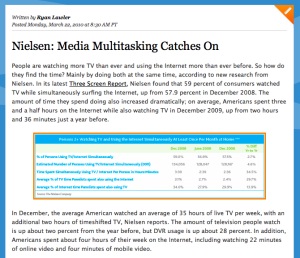 NewTeeVee has a nice post summarizing some recent Nielsen data on TV viewing + simultaneous Internet usage.
 Gravity Medium