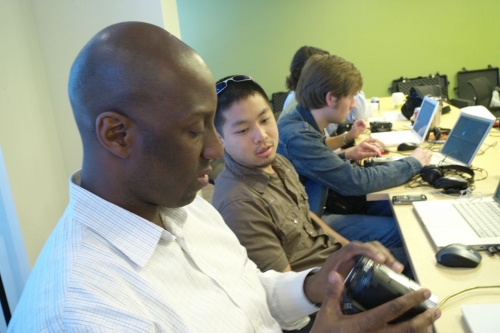
Can you imagine doing this in your public broadcasting company?

Michael Rosenblum — a perennial favorite writer of mine — has a series of posts this week about how the Travel Channel (a division of Discovery, the company vacuuming up viewers out of the PBS audience) is training all of their employees how to plan, shoot, edit and finish good video using the small cameras and laptop editing systems that are the hallmark of the Travel Channel Academy.

The best post is A Commitment to Literacy.

Imagine a world in which everyone in your public media company — your radio folks, your TV folks, your web folks, sales people, engineers, everyone — learned the pieces and parts of your craft, your public service. Everyone would have a basic, functional literacy about audio, video, text, photos, social media and so on. Wouldn’t that make your company smarter, faster, more dynamic, more engaged, more productive? Everyone would have a stake, an experience, that directly relates to the core mission and functions of your public service business.

I work in a public radio and public TV company in which several employees don’t even have televisions at home. Those that do have TVs mostly don’t watch them or spend very little time watching our own channel. I almost never watch our station — it doesn’t speak to me much. [To tell the truth, I haven’t turned on the TV to watch anything since Memorial Day. But I have watched a couple TV shows on Hulu.]

So what could make our media outlets more engaging — even for our own teammates? Contextual relevancy — meaning. It needs to be a meaningful thing to them. They need to feel involved. Same for the people formerly known as the audience.

The future of media companies will be focused not on distribution technologies (which will fade into the infrastructure background), but on meaningful media production and the social transactions that go along with it — the conversations, the sharing, the community, the Context. Imagine a company where everyone is immersed in media and community relationships.

I want my receptionist to know how to shoot and edit video. I want the membership people to be able to record and edit audio. I want to have a staff populated with smart people that can write, take a good photo, and sling digital media around without throwing up their hands in frustration.

Sure, there are day-to-day tasks that need to just get done, and they don’t involve video cameras or microphones or web sites and they aren’t always “fun.” (Believe me, I know — I have to go setup a bunch of stuff for a pledge drive starting right after this.) But if every job and every task were infused with the knowledge of why and how we do what we do, wouldn’t that make working in public media all the more meaningful for everyone involved? And wouldn’t that make for a better public service?

On advertising market shifts

Recently, Robert Paterson pointed out a Diane Mermigas piece talking about shifts in the advertising market, especially in relationship to network TV sales. According to the Mermigas analysis, network TV stands to lose up to $1.5 billion during this season of “up fronts” alone. That’s a lot of dough for any industry to lose nearly overnight, even if it is spread across several mega-media corporations.

I commented on Paterson’s site, but realized I liked my response so much I wanted to elevate it to my own blog in the process. Here’s Paterson’s question and my own response:

Is this the problem stated in Money terms?
Here is Diane Mermigas talking about the commercial networks — is this the same for NPR and PBS?

I would say Public Media are not impacted as directly by advertising losses like this, nor do the losses/impacts happen in phase with commercial media.

But the losses are there or soon will be (depending on the size and sophistication of your advertising clients).

But what’s worse — much worse — is that revenue from advertising (sponsorship!) is not managed as professionally in public media as it is in commercial media. This means that trends in ad spending are not understood as well in public media as they are elsewhere. So as changes ripple through the ad space, public media won’t figure it out for several cycles. Blunted reaction times will lead to lost opportunity and lost money.

Commercial outlets have a firm, financial bottom line and they calculate where that line lies every day, every week, every month, every quarter. Public media is not so fastidious. Our bottom line is the soft concept of “public service” (imagined in many different ways) and revenue is only a means to that end. We don’t have hard measures of public service, we don’t analyze so deeply or accurately, as a group (I’m sure there are some exceptions, of course).

Indeed, as nonprofits, we tend to downplay “overhead” costs like sales analysts or “management” functions that could lead us to higher revenues and better customer relationships in the underwriting space. We don’t really operate like a business where it matters most — where money intersects with mission.

On top of all that, then there’s the problem of TV. All TV outlets have fewer and fewer viewers as the mass media model breaks down in a flurry of new outlets and platforms. And then there’s the demographics of PBS generally, which are less-than-desirable for many marketers.

In short, the money is moving where it can get greater impact, and public media outlets are pooly prepared to sense the change or alter course to meet the advertisers at their new destinations.

The solution? Get engaged locally in a way that’s unassailable by national trends. Build deep relationships that, yes, can be “monetized” in both corporate and individual realms. Develop relationships with sponsors that have historically not played in local media. Plus, get your butt online in a real way, not with business card web sites. Oh, and be sure to have some hard-nosed analysts on board that keep the business honest on the numbers — avoid the doe-eyed optimism that sometimes overtakes “soft” nonprofits like ours.

News: Our most important edge

There’s been a lot of chatter this week about NPR’s coverage of the earthquakes and their aftermath in the Sichuan province of China, and for good reason. Reporting, especially by Melissa Block from Chengdu, has been remarkable: it’s immediate, detailed, dispassionate, and yet so completely human and humane. Lots of folks in public media have noted how proud they were to be professionally associated with just this kind of public service, and I felt the same way.

Indeed, I felt about NPR’s coverage exactly the opposite of what I feel every time I see or hear commercial media reporting on, well… anything. I’ve cited before my disgust for all things TV news and especially cable news. The disasters that are CNN, MSNBC, Fox, CBS, ABC, NBC and so on would be laughable if they weren’t so fundamentally damaging to our democracy. They’re a cancer, not a public service, as they make our nation dumber with each minute of air time. They’re part of what I call the “bread-and-circuses” media. (And I’m not saying this for dramatic effect — I’m literally angered and saddened with each appearance of Wolf Blitzer and the army of morons that make up commercial TV news.)

Which leads me to a positive point, rather than just a rant.

Continue reading “News: Our most important edge”

Mundt cuts the cord, lives to tell about it

Bravo to Todd Mundt on both “cutting the cord” from his cable company and writing in-depth about the process and experience of consuming media — up to and including HD video — without cable (or satellite) TV service.

The mix of technologies required today are a bit daunting to anyone that wants just a plain old “boob tube” experience, but for any moderately inclined hobbyist, this is pretty accessible.

Furthermore — and this is the kicker — there’s more content out there on the ‘Net than on PBS, as lots of sources distribute directly and PBS (for various reasons, many of them good) chooses not to carry the stuff.

Read all about it here.

(For the record, Todd reports that he still uses the cable company for Internet access, just not for TV. My own experience is that my local cableco won’t sell me high speed service without a TV bundle, so I can’t fully follow his example. However, I have stopped watching BSG on TV and instead watch exclusively via hulu and DVD).

Oh, and be sure to follow Todd on Twitter, if you aren’t already.

Video on KPBS' use of Google Maps

Those of us that follow public media already know the story of the San Diego wildfires last fall and how KPBS online staff rose to the occasion with a quick usage of Google Maps and Twitter to keep the public informed. It’s a great story.

Now Google, in a lightly self-promotional way, has posted a video starring the team from KPBS that made it all possible. It’s wonderful to see new media folks in the public media world getting some credit. And now you’ll be able to spot them at the next conference you attend!

For more from the KPBS team — and others that have used social media in disaster situations — be sure to listen to the Disaster Relief and Emergency Preparedness session from IMA 2008:

The wildfires in southern California, the bridge collapse in Minneapolis, the bombing in London. Hear the experiences of our colleagues faced with these crises: what tools they used, how they deployed their staff; what collaborations helped them deliver effective service.

Moderator: Andy Carvin, NPR

Panelists: Leng Caloh, Senior Online Editor, KPBS; Peter Horrocks, Head of the Multi Media Newsroom, BBC; Julia Schrenkler, New Media Interactive Producer, Minnesota Public Radio

[audio:http://wowzaweb.streamguys.com/~ima/2008audio/using-social-media-for-disaster-relief-and-emergency-preparedness.mp3%5D

Download the original MP3 audio file here.

TV News: Just die already

I hate TV news and TV “journalists.” Local, national, cable, network — you name it, I hate it and them. CNN, a once-proud innovator in quality news, is now even less than a joke. It’s no longer a laughable service, it’s one that should make every self-respecting democracy-loving American weep. CBS, already a shameful service, now wants to buy news from CNN? Well, sure — what the hell’s the difference at this point, anyway?

(The one exception, of course, is most of the stuff distributed via PBS. The pubcasting news/public affairs shows have their own problems, but integrity or seriousness of intent is not one of them.)

Thank God there are so many smart people in the world that are as outraged by (commercial) TV news as I am. The reaction to Wednesday night’s Clinton/Obama debate in Pennsylvania was instantaneous, nearly universally negative and — bonus — entertaining to boot.

Check out these Twitter posts (tweets) regarding the debate, from a variety of users…

  • 45 minutes into the debate and I’m thinking this is exactly why network TV must die. Not one real issue – just flag pins, Wright, and Bosnia
  • And should a former Clinton campaign manager be one of the two people conducting the debate? Doesn’t ABC have any real journalists?
  • ABC’s debate was a bigger joke than CNN’s compassion forum. it’s good the newseum in dc is now open because real journalism is cold and dead
  • hehe Charles said “fascinating debate”. What debate was he watching?
  • Just wrote a letter to my local affiliate complaining about how bad the Debate was handled. I felt bad for both candidates
  • Reddit-fueled debate backlash nearing 10,000 complaints on ABC website: http://ping.fm/aTKoi (wait til Digg kicks in)
  • 50 minutes into the democratic debate and yet not one question of substance. No policy, all bullshit.
  • terrible debate. ABC News sucks.
  • Almost 10,00 comments on abcnews.com http://is.gd/6KM detesting the debate questions as tabloid and irrelevant. And they were.
  • What the hell is wrong with ABC? Effing flag pins and fake scandals? Well done. You’d have been better off letting The View run the debate.
  • the real question about tonight’s debate…will the press cover how bad abc news handled it???
  • tried giving feedback on the debate on the abc news site but couldn’t register. site is probably overloaded. comment count is now over 9500!
  • just under 4 hours since the debate and the abc news site has received almost 9400 comments, almost all negative!
  • to me, the big news of the debate is how terrible the moderators were. they were trying to create news. they were debating the candidates.
  • Josh Marshall of TalkingPointsMemo says that after tonight, they need to give the debates back to the Women League of Voters?

Let’s set aside the new media topic for a moment and address journalism, ethics and trust. Public media purveyors: Your job is to be everything that ABC, CNN, CBS and others are not. Do that, on any platform, and the support will follow.

While you were out…

Robert Paterson continued the hit parade of great writing while I was away and there are two do-not-miss pieces that public media folks should have read. If you haven’t yet be sure to check these out…

WETA – Bringing the heart to Radio – Future of Public Radio
There’s a ton of great insight in this one piece. Given that many stations are in pledge at this time, I found one quote to be especially timely:

Look deep into the idea of Membership and you will find it is usually about if you do this we will do that. Or it may be if you don’t do this we will go off the air. The word Tawdry comes to my mind.

But he’s not really writing about membership or pledge or ratings, in the end. His piece talks about building relationships through shared experiences and values. It’s the essence of “social media” and what we do when we’re at our best today and what we must do to build a sustainable future that has shared meaning for a media outlet and a group of media consumers.

If you want to get a handle on how/why social media will trump mass media in time, this is where you start reading.

The Mystery of Attraction on the web – Luis Suarez
This piece is a little more personal and for public media folks requires a little more reading between the lines. While Paterson describes an experience of meeting a new person via social media tools online (which in itself is fascinating), the real meaning comes later as he discusses how online media is closing the loop on human social patterns that began before recorded history. Technology may in fact be recreating social models that have been broken (by technology) over the past 100 years or so.

I know — that sounds really big and really out there. But be sure to read the piece in full and all the comments. My own experience is beginning to parallel Paterson’s due to three changes in my life: first, I live in a smaller community than in the past; second, I work in public media (which is a tiny community); and third, through online tools like blogs, Twitter and more I’m finding others that are grappling with issues similar to mine and interacting with them. My “community” is deepening at a time when society as a whole is becoming much more shallow.

Some choice passages:

We most of all wish to live in a village – in a tribe – the web enables us to find the best village and tribe possible as it offers us the choice of the whole world to find the best matches rather than having to make the best of our blood and local pool.

It means that we have to rethink the whole idea of “local”. My village is made up of people who live all over the world. I have closer ties to them than to most that live 10 miles away from me.

It means that community as far as My Community cannot scale beyond a small town. Otherwise there is too much noise.

It means that those who wish to design for community would be advised to follow the rules of community in real life – In real life, we scale out from those that mean the most to us to the noise.

So if you worked for a TV or radio station and you accepted this realty – how would you approach connecting to your city?

For public media folks that wish to move from mass media to social media, these ideas are critical. The tribe — as described here and repeatedly by Seth Godin — is not just some marketing-speak. It’s about shared experience and shared values, and it’s a path to establishing a new and enduring meaning for public media. After all, haven’t we promoted the idea that public media are the beacons of quality in a world of crass quantity?  Well, now we have the chance to live up to the talk.

We won’t be everybody’s best friend, but we can aim to be in the smallest, tightest circle possible with those that share and value our public service ideals.

It's high time for real-time community engagement

Geeks out there probably know Leo Laporte, the long-time commercial radio and TV host, made especially well-known via the now-defunct TechTV cable channel. He continues to develop media, having built the TWiT podcast “network” over the past couple of years, including the flagship This Week in Tech podcast, drawing some 200,000 listeners a week.

In a blog post this weekend, Laporte describes several changes he’s bringing to the core show, centered on live video streaming. I’m recommending the post because he describes both some Media 1.0 troubles he’s had lately and then describes the changes he’s about to make in his Media 2.0 company.

Why should public media folks care?

Because Laporte is doing what many of us in public media are not, and his strategy is especially well-suited to the Media 2.0 economy:

  • he’s engaging with his community in a two-way and multi-way fashion that’s meaningful, open and authentic
  • he’s increasing his real-time contact hours across multiple digital platforms (he doesn’t limit himself to one platform)
  • he’s doing it all himself, on the cheap — there’s no network or corporation pushing him forward or holding him back

Laporte’s example is inspiring. Imagine what a public service media company with a true local engagement mission could do, using similar methods and the same low-cost, low-risk, rapidly-developing technologies. Engaging your community, communicating with your “true fans” is not a matter of holding public meetings or taking pledge calls. I’m hoping to steal some of this TWiT model for use in my shop (assuming we can get past our difficult strategic planning process).

But we’d better move fast.

Because in a world where Content is a commodity with a value approaching zero (or as Robert Paterson described content recently: noise), all we have left is Contact and Context. PBS and NPR can provide content on a national scale and with unrivaled quality. They can even distribute it and gather financial support for it directly. So we, the locals, must do what they cannot: provide authentic contact and develop a contextual service in tune with our local communities.

Take a look again at Laporte’s example. He’s building out in service of his “tribe,” his community. He’s co-creating value with volunteers in his “TWiT army.” He’s using two-way platforms authentically. He’s got real-time contact with his audience. He’s doing it without transmitters or other oppressively heavy engineering costs. We should be so lucky.

We can be so lucky.

Why innovation must be part of public media's DNA

If it seems like the world moves faster, technologically, with each passing year, you’re not imagining things.

Consider this chart:

Starting from its introduction, the simple telephone took 71 years to arrive in just 50% of American homes. Think about that. An entire generation was born, lived and died waiting for a telephone to arrive in their home, and only half of them got it!

Even electricity took 52 years to reach 50% of homes. Cell phones — that ubiquitous device most of us take for granted — took 14 years, but the MP3 player took less than half that time.

Basic Internet access — the new omnimedia connection — took 10 years to reach 50%, and in the early days it wasn’t even that much to talk about. Today, high-speed Internet access is in well over 50% of homes in the U.S. and average speeds are rising (though not fast enough for me).

There are two lessons here I can see:

  1. We cannot be transmitter companies (and indeed, we never were — we just thought we were because it was easier that way). Technology is a tool, not a purpose.
  2. The public naturally innovates as better tools arrive for information gathering, sharing and entertainment. We must innovate with them to serve them; innovation must be built into our DNA.

What other lessons can you see in this chart?

A good hockey player plays where the puck is. A great hockey player plays where the puck is going to be. –Wayne Gretzky