Former NPR digital chief Thomas moves up at Etsy

Back in April I mentioned the departure of Maria Thomas from her digital post at NPR. She left to join handmade crafts marketplace Etsy as their COO.

Well, just a few months laster she’s now CEO, as noted on the Etsy site and by Fred Wilson, venture capitalist and blogger extraordinaire.

Congratulations to Maria and Etsy on great news!

It makes me wonder what might have been had the stations and NPR actually agreed to do something in the wake of the New Realities conversations a couple years ago, conversations in which Thomas participated deeply. Had Thomas stayed at NPR, she could have kicked (even more) serious online ass for the network, but instead NPR, via the Board, has signaled the importance of the “R” over all things digital, especially in the BPP cancellation.

Someone I bumped into late this week with knowledge of the public radio system commented that the stations need to get out of NPR’s way and let it grow and mature. I couldn’t agree more — and I work at a station, one that ostensibly could be “hurt” by NPR’s evolution. A strong, vibrant, changing NPR would be good for everyone.

Here’s the thing… NPR’s future success cannot come at the expense of local stations if they are truly engaged with their communities. If NPR built direct relationships and funding deals with the public,  that would only cut stations out of the picture if their local community relationships were weaker than the ones NPR could build. If that’s the case — if NPR’s success really would be your station’s death — then just what are you doing in public media anyway?

iPhone 3G sold out… Bad news music radio!

The word is out that a little more than a week after launch, the iPhone 3G is now just plain gone from stores across the U.S. — be they Apple Stores or AT&T stores. Indeed, AT&T was sold out nationwide on the first day. Apple Stores have carried the device intermittently ever since and as of Monday morning there were only 3 stores nationwide that had anything — each carrying only one model.

This is bad for music radio.

Okay, a bit over the top, but stay with me…

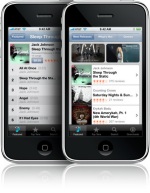
When the iPhone 2.0 software came out (which works on the old phones, not just the new sold-out ones), I dutifully downloaded and installed it on my own iPhone. Much of the system was unchanged. But the arrival of the App Store made all the difference, allowing the download and installation of applications that extend the functionality of the iPhone.

Two applications in particular were fascinating, in the context of broadcasting. One was AOL Radio, the other Pandora. Both of these services have existed at least for a few years online. But these are the first examples of full-bodied mobile implementations.

AOL Radio
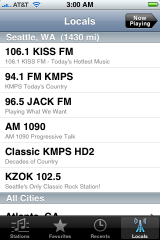
AOL Radio is pretty simple. It’s direct, live streaming access to the “AOL Radio” channels of music, sort of like satellite radio in that they aren’t local broadcast stations and are organized around tons of musical themes/styles. But it’s also an application that grants streaming access to hundreds of local terrestrial stations in the CBS collection. I can now listen, on the iPhone (with a live WiFi signal) to real-time streams of radio stations from coast to coast.

Since the iPhone goes everywhere with you, and given the near-ubiquity of WiFi signals, I now have hundreds of radio stations in my pocket. Sure, you could manage this before with several workarounds, but this is no workaround — this is a real implementation of a terrestrial transmitter threat that’s easy to use for mere mortals.

But that’s just AOL Radio. Forget that. That’s a threat we can obviate by getting our signals on the iPhone, too (not too hard — it’ll be done soon, I’m sure). Let’s get it on with Pandora.

Pandora

Pandora had interested me before, but only in an intellectual way. Now, presented again on the iPhone for free, I figured I’d try it again. It’s amazing, especially over WiFi. Let me say that again: it’s amazing.

A huge library of songs, all gathered for you with the backing of the Music Genome Project. You pop in a favorite album, artist or song and Pandora generates a complete “station” for you of music from that artist and stuff that’s musically similar to the album/artist/song you’ve identified. And it works.

Let me say that again, too: IT WORKS.

What’s surprising is the sheer speed in which tracks pop down to the iPhone and start playing.  If you skip ahead the next track pops up nearly as fast as your CD player would find something further down the disc platter.  Oh, and the audio quality is easily equal to good FM (over WiFi — less so over 3G or EDGE networks).

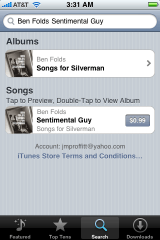
I’ve begun discovering music and artists again. I’ve started buying music again. Sunday alone I dropped $30 on new music, buying tracks both from the iTunes Store and from the Amazon MP3 Downloads service.  All $30 were spent on artists I’d never experienced before Pandora suggested them and I bought them using links presented by Pandora.

And get this… if the track or album is available on iTunes, you can buy it wirelessly right on the iPhone, no computer required.

Your own music discoveries can be broad or narrow based on how your “stations” are created and configured (which sounds a lot harder than it really is). And you can combine your stations into mix stations, granting you access to more eclectic recommendations.

Then there are more features on the regular Pandora web site. You can do the same thing via the full web that you do on the iPhone, but there are mild social networking features, extending the recommendation engine further. Plus, for more complex “station” operations, the full web site offers better tools. But it’s all one account, synchronized instantly back and forth as you use the service anywhere.

Why Listen to Music Radio?
Perhaps I’m already past the age where music radio makes sense for me, but I have to wonder what happens to music radio when this kind of access to music is virtually ubiquitous. Remember — the iPhone 3G sold 1 million devices in the first weekend and is sold out nationwide a week later. Pandora is a free service and free application — no advertising, no tricks — and it’s easy to use. (I began to wonder why I bothered syncing music to the iPhone — why not just live on Pandora recommendations alone?)

I’m curious if any music station programmers out there have a take on Pandora they’d like to share. I know there are things you can do with radio that Pandora will never match. And I know the Pandora catalog is limited by the licensing deals they can strike with publishers. But really… if you can listen to “stations” tailored to your preferences and discover new-to-you music in a hyper-efficient way, why turn to terrestrial radio for music at all?

If you’re human-hosting your music, you’d better be doing a better job than the Music Genome Project.
More BPP and innovation thinking

Earlier this week I was advised privately to wait for an announcement from NPR about BPP — without any hint of what said announcement might be — and I’m still waiting. I’d love to hear NPR announce a bold new plan to take the BPP straight to the web and change it up somehow. If anyone would care to shed additional light, I’m all ears (as are about 600 commenters on the NPR site).

In the meantime, there’s been some great pieces out there I’d like to point folks to (yeah, I know — you already saw these, but just in case…).

First up are two posts from Robert Paterson, a past NPR consultant and an avid BPP audience participant:

I’m not a fan of Paterson’s claim that the U.S. is heading into a full-blown depression (because that scares the bejesus out of me and I don’t know what to do about it), but the rest of it rings true, even if the economy were booming.

Next up is a post from Jeff Jarvis, one of my perennial faves:

(I love the title — talk about not burying the lede!)

The Jarvis piece is good, but the comments are even better.  When I visited, the first half of the comments were really insightful. And don’t miss Mindy McAdamscomment in there, too.

What worries me more and more is that Stephen Hill — that too-smart-for-his-own-good bastard! (and I say that with love) — is going to be proven right if we public media people don’t stop behaving like nitwits and face up to the Innovator’s Dilemma.

I’m not sure whether I have the energy to start my own public media company. Do I really have to? 😉

Web economics vs. Pubradio economics

The Bryant Park Project collapse at NPR sure has had the public media world a-twitter over the last 24 hours. I got one tip to wait for an announcement or something like that from NPR about the future of BPP. Okay. I’m waiting.

In the mean time, I just wanted to point to a simple example of how web economics differ so dramatically from traditional radio production and distribution economics. Because my central take is that the BPP could live on in a new web-focused model, one that it’s already primed to utilize. But to survive it would still need some NPR largesse — though less than it’s gotten to date.

The example I offer here is not a direct analog to the BPP situation, but it’s generally illustrative and great for fueling thought about how new media are different from old media. So here’s the post, by former Apple Computer evangelist Guy Kawasaki:

By the Numbers: How I built a Web 2.0, User-Generated Content, Citizen Journalism, Long-Tail, Social Media Site for $12,107.09

Now the $12k figure is a bit hopeful, as the founder himself was not paid for his time. That and other elements make the $12k more fanciful than real, but the point is still valid: it’s not that expensive to start and run a web-based company.

By contrast, NPR reportedly spent about $2 million on the BPP in the last year or so. For public media companies that’s a lot of money. An award-winning 1-hour-per-week radio program in my own shop in Anchorage costs around $350,000 per year to maintain (and we can’t even afford that). $2 million to NPR isn’t that much, but in real terms, it’s a lot.

In a lot of ways, it may have been better had BPP been given only $500,000 to get started.

As pointed out by Ken George in quotes he collected at WBUR’s The ConverStation, the BPP was probably destined to failure if the point was to make a radio-web hybrid. They should have made a web-radio hybrid instead, using web economics as the baseline organizing idea. Web economics scale from small to large. Radio economics, practiced by NPR and others, scale from medium to large only, and often only from large to huge.

Rob Paterson’s got the right ideas. They sound really revolutionary, and I like to think there’s a middle path of some kind where the old ideas and the new ones “can just get along.” But history will likely prove him right and anyone pushing a compromise wrong.

On the death of BPP

Well, the Bryant Park Project has less than a month left. Literally.

Was it too beautiful to live, perhaps? Hardly. I mean, can anyone really feign shock that well?

Let’s recount the strikes against this endeavor:

  • The economic downturn is hitting NPR like everyone else; news budgets are frozen and that’s just the beginning. Like any business looking to cut costs, whoever was hired last will be fired first, whether that’s a show or a person. That’s just the way it goes.
  • One of the original hosts (Burbank) — and let’s be honest, the host with real NPR cred — walked away just as the show was getting started. Talk about throwing off the rhythm.
  • The second host (Stewart) took off for maternity leave six months into the show. That can’t help.
  • Then the news anchor (Martin) left for a cush job at ABC News. (What is it with NPR people leaving a real news operation to go work for a fake news operation? Is it just the money?)
  • Plus the fill-in host (Pesca) has been splitting his time between BPP and NPR HQ the whole time.

I’m sure Matt Martinez was busting his ass every day trying to keep things rolling forward, but with a set of facts like these, what can you really do?

Add it up and can you imagine a show — any show in any format — making it to its first birthday without a hell of a lot of buy-in (political and cash) from the top?

But wait — there’s more!

  • This was fundamentally a Gen X show inside a Boomer network. What Boomer on the Board of NPR is going to protect a show they don’t air on their station, they don’t listen to and/or they don’t like?
  • This show never made it to the bulk of the listeners out there. The only people that knew about it were NPR junkies that took the time to browse the NPR web site, trolling for goodies. More might have liked it but never knew it existed.
  • In a risky economic environment, what local station program director is going to broadcast BPP instead of Morning Edition? Show of hands, please… yeah, that’s what I thought.
  • Assuming you’re a station with an HD Radio transmitter and you could program BPP onto a secondary channel, great! But who will hear it? Right: no one, because no one has an HD Radio. (BPP could be an Internet success because iPods and computers far outnumber HD Radios.)
  • Though BPP was successful on the web (something like 1,000,000 monthly uniques), we must remember that NPR is not a media company, it is a radio company. Arbitron numbers will always be bigger than Google Analytics numbers to a radio company. NPR may be trying to change to meet the challenges/opportunites of the web (and are making huge strides for a company that size), but it’s still a radio entity, so building a show specifically for the web is not a strategic option for them. At least not today.
  • Compared to an out-of-the-garage web startup, the cost of producing BPP was astronomical. Sure, web startups in Silicon Valley can devour $2 million at a power lunch, but for NPR and public radio that’s a huge sum, especially given all the other factors noted above. Web startups don’t need that much money, but to do BPP “the NPR way” requires big salaries and budgets. It was a radio economic solution applied to what was essentially a web economic problem — that makes it unsustainable on its face.

All in all, it’s a sad day for NPR. Not so much because it lost a program that was, in truth, faltering from the start, but because the Board appears to have missed a key opportunity here.

NPR could have taken a revised BPP straight to the web and made it the flagship show of a new web-scale innovation unit. BPP could have led NPR into a future not bound by the FCC, Arbitron, legacy stations, transmitters and more. For about $1 million a year they could have jump-started the next stage of their evolution.

I’m beginning to think Gen X and Gen Y need to band together and start their own national public media service — without the parochial split between radio and TV and web. Because PBS kills quality Gen X projects, too. Oh, and Fair Game was axed by PRI recently.

By the way, read the comments on the brief BPP blog post about the cancellation. There’s an audience there, to be sure. And it’s one that could easily sustain a web-based (and web-scaled) program and service. If I had $1 million to invest, I’d definitely put it into this audience.

Changing tires on the public media bus at 60mph

Pop quiz, hotshot. There’s a bomb on a bus. Once the bus goes 50 miles an hour, the bomb is armed. If it drops below 50, it blows up. What do you do? What do you do?

One of my favorite writers on matters of strategy, especially related to technology application in business, is Bob Lewis, a long-time columnist from InfoWorld and a popular business consultant as well. He writes a weekly column, shared via the web. Great stuff.

This week he wrote a piece (the second in a series) on business strategy: “A business change cornucopicolumn.” And it sounds like he’s talking about my specific public media company in Anchorage and the public media industry in general.

It’s spooky.

Check out this rather heavy quotation (sorry, I just had to) and see if it fits your strategic situation (added boldface is mine):

[Let’s] start with a framework for describing any business. It has ten dimensions — five external, five internal.

The external dimensions are:

  • Customers: The people who make buying decisions about what the company has to sell.
  • Product: What the company sells its customers.
  • Price: What the company charges for its products, along with margin goals, contract terms and conditions and so on.
  • Marketplace: The business ecosystem — suppliers, distribution channel, competitors and partners.
  • Messages: How the business explains itself and its products.

The internal dimensions are:

  • People: Employees and contractors — the human [beings] themselves, their skills, knowledge and experience.
  • Process: How people do the company’s work.
  • Technology: The tools people use when fulfilling their roles in the company’s processes.
  • Structure: How the company is organized — its reporting structure, [salary] structure, policies and guidelines, and internal communications.
  • Culture: How employees respond to common situations.

In healthy organizations, the ten dimensions are consistent, interconnected, and mutually reinforcing.

Companies don’t undertake strategic change just because one or two are a bit moldy. They undertake it … because the company’s business model no longer works. Perhaps the company’s products are no longer relevant, or the customer segment it serves is shrinking, or its pricing is no longer competitive in its marketplace, or its marketplace has changed in some serious way. It’s fallen behind.

Many companies enter a sort of vegetative state in which doing nothing at all becomes the strategy — they pare spending down beyond the minimum, hoping someone buys them before they’re completely [beat]. The alternative, though, is nearly as bad, because there is no such thing as changing just one of the ten dimensions of organizational design.

[For example:] Your competitive challenge is pricing. But you can’t change just the price. You need a [better] response than that, because … you’ll lose money on every transaction.

To cut prices while preserving margins you’ll need to change your processes. That means “changing” your people in some way too, because new processes wholly or partially invalidate old skills.

Most likely, you’ll have to change structure and culture as well, and reposition yourself in the marketplace (including, perhaps, bypassing your current distribution channel). All of which will require significant changes in technology.

That’s a lot to change all at once. You have to take an interconnected ten-dimensional model of the business that worked and redesign it into a new interconnected ten-dimensional model of the business that works.

Then you bet the farm, implementing the new organizational design as one massive process. And you don’t get to stop running your business during the change-over.

…[The] company’s executive team decides the basic shape of pricing goals, production strategy (process), and distribution. It also decides on any structural changes that will be required, putting the right people in charge of critical business responsibilities.

And, it will define the underlying cultural changes necessary for everything else to work.

The executive team will focus its attention on the cultural change. The rest of the company will use the 3-1-3-4 formula (3-year vision / 1-year strategy / 3-month goals / 1-week plan) to figure out everything else and make it happen in manageable increments.

Holy shmoly!

I don’t know about your company, but that fits my company, right this second, perfectly.

We’re grappling with these problems all at once:

  • Public TV’s audience is dwindling nationally and locally. That reduces advertising (sponsorship!) revenue potential and revenue actuals.
  • TV membership dollars are steady, but from a shrinking number of donors (per donor giving is up, total donor count is falling).
  • The cost of producing national-quality mass-media-style pubTV programming has risen beyond our ability to do it locally and it’s quickly becoming too expensive to buy it in national packs from PBS.
  • The cost of producing lower-end media has collapsed, allowing a flood of programming at the bottom-end of the market, and allowing the “audience” to produce (and consume) their own digital media, without paid gatekeepers like us.
  • Our TV fundraising model is based upon transactions with people that don’t usually like us or give us money — we sell them stuff. In so doing, we’ve painted ourselves into a corner: true believers hate us when we grab the money and cut off their favorite programs, yet we need that cash to pay for the true believer programs. When we attempt to raise money around regular programs, they tank, financially.
  • Our public radio audience has grown over the past 15 years, but has now flattened and may be starting a long backward slide if we can’t figure out how to grow our audience further or deepen our relationship with the audience we’ve got.
  • Our staff is composed almost exclusively of baby boomers and others that built and/or grew up with the public media system. They are approaching retirement and don’t seem to have another “revolution” in them. Internet models are curious, but unproven, for them, and since they largely eschew new media consumption models, they don’t know how to approach them from a business angle.
  • Government funding for public media in our state has fallen over the past 15 years. Using inflation-adjusted dollars, funding has dropped by more than 50% in 10 years. Plus, companies successful with fundraising activities are deliberately cut off from state funding. And federal funding has been flat or declining (in inflation-adjusted dollars).
  • Our strategic drift has led to an accumulation of drifting employees and a loss of innovating ones. If you’re a striver, a pusher, a mover-and-shaker, if you want to accomplish something, we offer a frustrating environment at best. Our culture says we should wait for a knight in shining armor to come along with bags of money a new and exciting crusade to save us.
  • Our product set, as currently deployed, does not compete well enough in a mass market well enough to draw the required revenue, and it doesn’t serve a niche market well enough to garner a rabid following of local support. In web terms, we’re too small to be Google, but too big to be 37signals. (What’s the opposite of a sweet spot?)

I could go on.

Our CEO has repeatedly likened our strategic situation to changing the tires on a bus while driving down the highway at 60 miles per hour. That feels about right.

Personally, I’d like to pull over, get this bus up on a lift and change the tires in a more controlled environment. Then we can get back on the road. But as soon as we drop below 50mph — KABOOM! …the bus explodes, and that’s it for Keanu Reeves and Sandra Bullock.

Which is why Bob Lewis’ 3-1-3-4 formula may be required for us on the mobile pit crew. And it’s why strategies built around a new understanding of the 10 dimensions of business are in order. Clearly, more than 1 or 2 of the 10 dimension have changed:

  • Our customers are moving online and expect on-demand access in addition to the streamed services. They also want to interact with us. (Ironically, in a hyper-connected world, they’re more “disconnected” than ever — they need more connection with people like us, people like themselves, people in their neighborhoods.)
  • Our marketplace has changed; it’s no longer “3 networks + PBS” and hasn’t been for years. And it’s getting worse as new platforms appear and the audience fractures.
  • Pricing models have evolved dramatically as the scarcity economic model dissipates in media markets.
  • Our people and processes were selected for legacy customers and markets, not the present day; they need to be retrained technologically and culturally or be replaced.
  • Our legacy technology is prohibitively expensive to maintain, doesn’t offer sufficient economic advantage and prevents investment in new technology that would enable new processes and services.
  • Our business structures and company cultures are unfocused at best and self-destructive at worst. We focus on “radio” and “TV” and “web” and we promote history over innovation. We need a culture that encourages and develops the best of what our public media “tribe” seeks to experience.

Can we still turn it around? I don’t know. Perhaps in smaller companies with a few lucky lightning strikes of vision and a philanthropic community that supports a positive vision of the future (a vision we must articulate). Or maybe in the largest companies with deeper pockets and tighter links to market forces.

We’re at the cusp of turning it around in Anchorage. Or at least I think so — I hope so. There’s still a great deal of fearless, tireless and perhaps even foolhardy leadership required. We might just have the kernel of what it takes. I think the rest of 2008 will likely set us up for ultimate success or failure. We’ll either get this right quickly or it will likely be too late to recover.

How are you doing with your public media bus?

NPR's Thomas goes to Etsy; Surprise — it's not a conspiracy

Recently I’ve told people I know, especially folks I meet via Twitter, that this here blog is really kind of an “inside baseball” thing for public media purveyors or supporters. It’s not a general interest kind of thing. Well, for this post, I’m going to kick up the inside baseball factor a notch…

In the wake of the Ken Stern departure from NPR, the rumblings in D.C. were audible all the way out here in Anchorage (it helps if you have a former NPR staffer working in the next office). Stations across the country were in a tizzy for a few days trying to read the tea leaves — what did it all mean?

Then a few weeks later we heard about the departure of Maria Thomas, NPR’s digital media guru. As one of the chief architects of NPR’s many digital initiatives, her exit fueled speculation that the elimination of Stern was a rebuke of online activities at the company and Thomas left because her days were numbered.

At least that’s the speculation I heard. But I didn’t believe it.

Thomas came to NPR with solid online / e-commerce experience. She did great work at NPR. But I suspected she basically had achieved all she could in a company that, for all its good intentions, cannot move too terribly quickly, given the distributed nature of its goals and relationships. Plus, her work would have gotten her continued attention in web circles. She was likely hit with a job offers repeatedly. 

Today venture capitalist (and uber-blogger) Fred Wilson announced Thomas’ installation as COO of the unique online retailer Etsy.com. While we knew the Etsy part of the story weeks ago, I think the warm welcome she’s being offered tells the real story — that hiring Thomas was a coup for Union Square Ventures and Etsy, not a housecleaning for NPR.

Be sure to check out the introductory video — great stuff. And note what Thomas says when asked why she likes Etsy: “I love that Etsy means connecting with something authentic.” Spoken like the new media veteran she is.

Of course, I could be wrong. Hit me in the comments if I’m missing anything.

HD Radio: A technology only an engineer could love

Okay, catchy headline, but I’m not actually that “down” on HD Radio per se. But I am against getting excited about it, for all kinds of strategic reasons. A new post by Mark Ramsey has a great kicker paragraph that sums up the state of affairs:

Finally, HD is certainly an “upgrade” from the perspective of the broadcaster and the engineer. But is it an “upgrade” from the perspective of the consumer, who already has more choices than they know what to do with — even if they’re not choices which are not under the control of the radio industry? After all, when the Internet is in my car, isn’t HD Radio actually a downgrade?

This reminded me of a recent instance in which I was on the receiving end of a talk from a broadcast engineer about HD Radio. Not an informative one, but, well… a lecturing one.

The lecture? Basically: “Hey, we’ve got this HD Radio stuff installed. When are we going to start broadcasting additional channels? Because, you know, the FCC grants us a license for community service, so we have an obligation to start using HD Radio to serve the community.”

I was floored.

First, the logic was so brazenly absent from this argument. Second, why is engineering directing public service strategy? Third, we are using the HD Radio gear, even if we aren’t multicasting. And finally, well… let’s list all the obvious market reasons that make multicasting a less-than-critical strategic focus:

  • virtually no one has HD devices and sales are not increasingly rapidly
  • most consumers don’t know about it
  • those that do know about it are not really interested
  • HD devices are too expensive for most listeners for casual situations
  • additional HD channel development requires additional effort (money), even in a heavily automated approach

…and so on, which makes developing additional HD Radio channels at this time an exercise in wasted money and effort for a regularly-strapped public radio provider. We’d be better off focusing on improving our existing services or forging ahead in new media / social media.

Let’s be clear: the HD Radio technology platform is not the mission of public service media (nor is FM radio or AM radio or analog TV or digital TV or web sites or DVDs or CDs or…). HD Radio is a tool.  It’s up to us to figure out when and how it makes sense to employ this tool in fulfilling our public service mission.

And if, down the road, we find that HD Radio was a waste of money, we should have the courage to scrap it and move on.

Congratulations PRX

The news today that PRX has received a half-million dollar MacArthur grant is fabulous. It’s such a great service in the public media world and it’s gratifying to see good work get rewarded.

They’ve posted all the details here.

Broadcast Law Blog

I’m assuming that everyone in the public media universe (especially those with FCC licenses of one kind or another) already knows about the Broadcast Law Blog published by law firm Davis Wright Tremaine, LLP.

If it’s not already in your RSS reader or list of sites to review regularly, be sure to get it in there.  The FCC, under the direction of telco-loving politico Kevin Martin, has been very busy in the last year proposing new rules on all kinds of stuff related to broadcasters.  And it’s not little niggling things — this is big stuff that will impact operating costs, reporting activities and more.

Naturally, you should consult with your own attorney before embarking on any changes or new plans, but this is sound coverage of FCC changes and how they relate to broadcasters.

Talk about required reading…