Update on NPR / Ken Stern

Current published an in-depth article on the NPR / Ken Stern story this week. I’ve updated my list of articles to include it, and it’s a great read on its own. It summarizes a large swath of the Stern history at NPR and points to several core reasons why things just didn’t work out.

I actually came away from this profile liking Ken Stern quite a bit. Did he fit well into the CEO slot? Perhaps not. But he did some great work for NPR. And to everyone’s credit — except a sour-grapes Bob Edwards — the comments from board members and others were incredibly even-handed.

It's high time for real-time community engagement

Geeks out there probably know Leo Laporte, the long-time commercial radio and TV host, made especially well-known via the now-defunct TechTV cable channel. He continues to develop media, having built the TWiT podcast “network” over the past couple of years, including the flagship This Week in Tech podcast, drawing some 200,000 listeners a week.

In a blog post this weekend, Laporte describes several changes he’s bringing to the core show, centered on live video streaming. I’m recommending the post because he describes both some Media 1.0 troubles he’s had lately and then describes the changes he’s about to make in his Media 2.0 company.

Why should public media folks care?

Because Laporte is doing what many of us in public media are not, and his strategy is especially well-suited to the Media 2.0 economy:

  • he’s engaging with his community in a two-way and multi-way fashion that’s meaningful, open and authentic
  • he’s increasing his real-time contact hours across multiple digital platforms (he doesn’t limit himself to one platform)
  • he’s doing it all himself, on the cheap — there’s no network or corporation pushing him forward or holding him back

Laporte’s example is inspiring. Imagine what a public service media company with a true local engagement mission could do, using similar methods and the same low-cost, low-risk, rapidly-developing technologies. Engaging your community, communicating with your “true fans” is not a matter of holding public meetings or taking pledge calls. I’m hoping to steal some of this TWiT model for use in my shop (assuming we can get past our difficult strategic planning process).

But we’d better move fast.

Because in a world where Content is a commodity with a value approaching zero (or as Robert Paterson described content recently: noise), all we have left is Contact and Context. PBS and NPR can provide content on a national scale and with unrivaled quality. They can even distribute it and gather financial support for it directly. So we, the locals, must do what they cannot: provide authentic contact and develop a contextual service in tune with our local communities.

Take a look again at Laporte’s example. He’s building out in service of his “tribe,” his community. He’s co-creating value with volunteers in his “TWiT army.” He’s using two-way platforms authentically. He’s got real-time contact with his audience. He’s doing it without transmitters or other oppressively heavy engineering costs. We should be so lucky.

We can be so lucky.

Paterson, Mundt, Carvin trifecta on KCUR

Great show today on Kansas City’s public radio station KCUR with guests Robert Paterson, Todd Mundt and Andy Carvin. The topic? Surprise! New media and public media.

Worth a listen, especially if you’re a little confused about how public radio and public TV can engage the world in an online context.

[audio:http://kcurstream.umkc.edu/UTD/UTD_3-20-2008.mp3%5D

Total time: about 51 minutes. Download the MP3 here.

(By the way, I’d link to the web page at KCUR, but it appears it won’t be available after this week due to the way it’s published using the Public Interactive CMS.)

Tending the Public Media Tribe

If you’re not reading Seth Godin, you’re not paying attention to the future of successful public media. Godin doesn’t address public media directly, but he does address issues of marketing and community and the economics of making money through the products or services a company provides in a new media world.

Godin talks a lot about tending to your “tribe” — that group of people that love your product/service and who share your values or perspectives and interests. If you’ve been in public radio or TV for any length of time, you know these folks. Most likely you’re already a member of this tribe yourself.

Recently Godin gave a talk at a music conference and his comments, while aimed at a music marketing audience, are applicable to all of us in public media — news, music, radio, TV, whatever — because the trends affecting the music business (disastrously) today are the same ones rewriting the rules for all media. And the rules for success in the next generation will be the same: serve your tribe; be indispensible; be the best.

Here are some highlights from Godin’s talk, pointed out by Gerd Leonhard and partially chosen by digitalwaveriding (the boldface highlights are mine):

if I asked you for the name and address of your 50,000 best customers, could you give it to me? Do you have any clue? [No?] Then what happens every day is you go to a singles bar and you walk up to the first person you meet and propose marriage and if that person won’t marry you, you walk down the bar to every single person until someone says “I do.” That’s a stupid way to get married. A better way to get married is to go on a date. If it goes well, go on another date. Wait to tell them on the third before you tell them you’re out on parole. Then you meet their parents, they me your parents, you get engage, you get married. Permission is the act of delivery. Anticipated, personal and relevant messages to people who want to get them.

… The next thing is what I call the Seinfeld curve. The Seinfeld curve shows us Jerry’s life. If you like Jerry Seinfeld you can watch him on television, for free, in any city in the world two or three times a day. Or, you could pay $200 to go see him in Vegas. But there is no $4 option for Jerry Seinfeld. This is death. You can’t make any money in here. Because if you’re not scarce I’m not going to pay for it because I can get it for free. And one of the realities that the music industry is going to have to accept is this curve now exists for you. That for everybody under eighteen years old, it’s either free or it’s something I really want and I’m willing to pay for it. There is nothing in the center — it’s going away really fast.

… The next thing is this idea that people care very much about who is sitting next to them at the concert. They care very much about the secret handshake. They care very much about the tribal identification. “Oh you like them? I like them!”

… It’s really important to people to feel like they are part of that tribe, to feel that adrenaline. We are willing to pay money, we’re willing to go through huge hoops, trampled to death in Cincinnati if necessary, in order to be in the environment where we feel that’s going on.

… I want to argue that the next model is tribal management. That the next model is to say, what you do for a living is manage a tribe, many tribes, silos of tribes. That your job is to make the people in that tribe delighted to know each other and trust you to go find music for them.

… There is a lot of music I like. There is not so much music I love. They didn’t call the show, “I Like Lucy,” they called it “I Love Lucy.” And the reason is you only talk about stuff you love, you only spread stuff you love. You find a band you really love, you’re forcing the CD on other people, “You gotta hear this!” We gotta stop making music people like. There is an infinite amount of music people like. No one will ever go out of the way to hear, to pay for, music they like.

Fortunately or unfortunately, the future for public media companies will involve considerable “tribe management” and will involve a smaller audience than we have today, either locally or collectively — all media will have far more fragmented communities than in the past. Now is the time to identify who’s in and who’s out of your tribe and figure out how best to serve the community that gathers around public media content and values.

This may sound elitist or even fatalistic to the traditional mass media thinkers out there: “But I want the biggest audience possible!” Well, you can’t have it. Large audiences of mildly engaged viewers or listeners or readers are the old model. The new model requires deep and authentic engagement with that “tribe” of people. You can still invite everyone into the tribe, and you should. But in a world of infinite tribes, folks will naturally gravitate to the tribes that best serve their needs and interests (and they will have multiple tribes, of course).

Personally, I think this is an incredibly exciting time for public media folks that embrace this new approach. There’s new opportunity not only for sustainable businesses, but for truly meaningful, impactful and interactive work. The only problem is developing the courage to let mass media thinking fade over time, even though it’s been tremendously successful for the last 40 years.

iBiquity: How a closed-source model is killing HD Radio


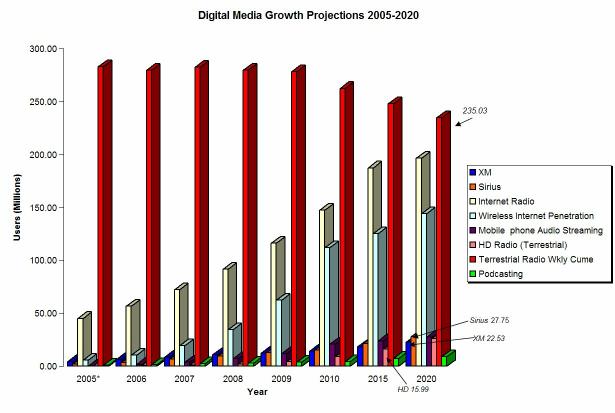
Chart created by Bridge Ratings (2006). Click for a larger version.

Last week on the PUBRADIO mailing list, the topic of HD Radio came up again. Commenters went one way, then another — all talking about programming and broadcasting as they usually do. Technology didn’t really enter into the equation, yet it’s one of the core issues in terms of consumer adoption patterns.

Why is HD Radio failing to catch on? Lots of reasons easily come to mind:

  • Broadcast audio streams aren’t something new — it’s called Radio and we’ve had it for 100 years; why bother to get a new radio when the old one works fine?
  • The higher quality audio possible with HD Radio is nice, but in most listening situations (cheap radios, cars in traffic, noisy offices) the improvement over analog FM is negligible
  • Multichannel service really hasn’t arrived at most HD-capable stations so far
  • While HD Radio signals are less prone to some types of interference, real-world experience suggests it’s a generally weaker signal, especially if you’re comparing devices with internal antennas (clock radios)
  • Though most consumers don’t know it, there are software revisions appearing with HD Radio right now, and most radios are not field-upgradable — it’s not “safe” to invest big bucks in receivers yet
  • Satellite radio has blunted the multichannel argument and still offers less commercialism than an HD Radio multichannel service would (admittedly, you have to pay for sat radio, but many are willing to do so)
  • Internet audio streams have a bigger audience already and are growing faster than all other streamed audio services

Continue reading “iBiquity: How a closed-source model is killing HD Radio”

Haarsager on NewsGang podcast

Dennis Haarsager, new interim CEO at National Public Radio (NPR), appeared on the NewsGang podcast this past Friday. He spoke fairly openly about the unusual CEO transition and about how NPR may change as it deals with an audience that’s moving to new media distribution channels and interaction platforms.

In addition to Haarsager, the guest list included Stephen Hill from Hearts of Space, Steve Gillmor (the host), and Doc Searls, who also appeared on a panel at the recent Integrated Media Association conference along with Haarsager and others.

UPDATE: Highly Recommended Listening. Haarsager and friends go into depth talking about new media economics and public media’s entanglements — or lack thereof — with new platforms. Money quote from Stephen Hill: “Show the stations how you’re gonna keep them in business and they’ll be very happy to cooperate with [NPR].”

Running time of the MP3 file is about 1 hour, 25 minutes.

[audio:http://www.gillmorgroup.com/media/NewsGangLive-2008.03.14.mp3%5D

The link to the NewsGang podcast has also been added to my (still growing) list of Ken Stern articles.

When a public radio lover turns hater

While searching for more NPR / Ken Stern articles today, I stumbled across a blog post that refers to the news, but spends much more time listing the crimes and misdemeanors of the current public radio landscape, especially as emanating from NPR and other national outlets (APM, PRI, etc.).

Written by Dave Slusher, Public Radio Fails Me explores at length the ways in which Slusher was first captured by public broadcasting and especially public radio many years ago. But it goes on to lambaste public radio for what he feels its become — populist when it comes to cash, elitist when it comes to control, and tired when it comes to programming.

Written by any person on the street, it’s a damning indictment of some of public radio’s (perceived) trends over the past 10 years or so. But this was not written by any random man on the street — it’s written by a man with experience inside the system as a producer as well as consumer.

While I’m not entirely in agreement with Slusher, I do think there are some truths in there with which public radio (and all of public media) must seriously grapple. Slusher’s comments on the changes in the flagship NPR newsmagazines in particular I find fairly accurate. Of course, those changes may account for the doubling in NPR’s weekly audience over the past 10 years. But it’s definitely changed, and for those with an interest in deeper news coverage, it’s not all positive changes.

In any case, it’s a long post but worth a read and a comment at his site, whatever your opinions.

Haarsager on NPR changes

Dennis Haarsager posted his response to the speculation about CEO Ken Stern’s departure from NPR this past week. It doesn’t present a “smoking gun” version of events. However, in the comments to his post, Haarsager lets loose three priceless notes that illuminate these events more than any other account to date:

  • “…Mr Stern chose the time and day when he left the building.”
  • “…no malfeasance or misfeasance should be imputed.”
  • “…transparency is an important ideal; [Stern’s] privacy is a right.”

These quotes are very important to understanding the events.

First, he blows the malfeasance idea out of the water. When the news hit about Stern’s departure, I know folks around my shop assumed there was something sinister about the change. Had there been embezzlement? Sexual harassment? Physical confrontation? Why else would the termination be so abrupt? Well, it wasn’t something like that. (And those with personal experience of Ken Stern couldn’t imagine such a scenario anyway.)

Second, Haarsager notes the mutually exclusive issues of transparency and privacy. We observers want transparency in these affairs, but the departed — Stern — has a right to privacy. Personal privacy trumps corporate transparency in this case, and rightly so.

If you’ve ever been in a managerial position, you know there are things you can and can’t talk about when it comes to hiring candidates and terminating employees. Indeed, mostly you can’t say anything. Even if you’re mad at the employee, even if you’d like to give them a swift kick on the way out the door, you say nothing. To say anything negative is an abuse of your power and opens the company up to lawsuits. Besides, the employee is gone now — it’s time to look ahead.

Third, and most importantly, the departure was abrupt, but the timing was Stern’s choice. In other words, Stern could have played this game entirely differently — even leading to a multi-month golden parachute process, I suspect — but he chose to go out this way and at this time. This tells us a tremendous amount without giving details (an excellent balance of transparency and privacy, I think).

Consider how most CEO departures play out: there’s usually a transition period, often a significant one. The Bill Gates departure from Microsoft has been in the works for more than 2 years and he even left the CEO role several years prior to that. Many nonprofits have written succession plans, allowing for smooth transitions either over time or in emergency situations. And even when a CEO departs to “spend more time with his/her family,” there’s at least some degree of hand-off, like a consulting gig with the company until the new CEO is seated. But not here.

So the fact that there’s no transition, that the change was so abrupt and surprising, and the fact that Stern more or less set the timetable speaks volumes. And not to Stern’s credit. In my experience, even if you’re disgruntled, you don’t walk out and cut all ties with the company instantly.

So Haarsager’s statement that the reasons for Stern’s departure were “multivariate” is probably the most accurate, albeit the least satisfying. And from what I’ve gathered privately, it really isn’t all about the new media angle (though that’s one of the variants to which Haarsager is likely referring). But the way this went down — the suddenness of it — suggests much of the problem existed inside the CEO’s office. It didn’t have to end this way.

Personally, I’m ready to move on — we’ve got so much to do in public media. But I’ll continue to update the articles list as needed.

Paterson on leadership (at NPR)

While I do appreciate Robert Paterson’s take on the leadership issue that’s likely below the surface of the NPR / Stern debate, I’m struggling to believe that that’s the core of this week’s story — that Ken Stern just ruffled too many feathers and it was time for a different leader. Sure, hard-charging generals are not the best leaders in all situations, and after 10 years of whip-cracking you might need a smooth operator. That makes eminent sense.

But in the shifting media environment about which so many of us write and ruminate, isn’t a hard-charging general needed at the top? Someone that has both the vision and the drive to push through to a new way of thinking and doing. The media environment changes in play today are not just operational in nature, where a COO might fix this, improve that — they’re strategic shifts. Seismic shifts. World-upside-down shifts. Only a CEO and her or his board of directors can handle those issues and realign the company. And given the time-to-market pressures of new media on old media, NPR probably didn’t (and doesn’t) have the time for all the required dinners and socials and private meetings, nor could it afford compromise after political compromise on the way to a new strategy.

NPR — like all media companies, for-profit or nonprofit, operating in any or all media formats — must grapple with the fundamental changes in progress. The relationship between producers, distributors and consumers is completely inverting.

Of course, this entire discussion could be moot. Public media’s future may have to be created outside the voluminous corpus of NPR (or APM or PRI or APT or PBS or …). Developing a new model with fundamentally different DNA may not be possible inside the system, either with a hard-charging general or a sweet-talking politician.

Jarvis on NPR

Well he’s not “on” NPR, but he comments on the NPR / Ken Stern thing, as you might expect. He even gives a shout-out to yours truly (blush!). I returned the favor by commenting on his post.

  • Trouble for NPR — BuzzMachine / 7 Mar 2008 (Update: Note Dennis Haarsager’s comment to this post at Jarvis’ blog)

In that post he also refers to a great year-old post about public radio, following a meeting he had at NPR along with other new media folks. This is the post that introduces the great new word “converstation”: