 NPR CEO Vivian Schiller appeared at the All Things D conference this week and made some waves. I know John Sutton noticed something she said and didn’t like it. And I was puzzled by it. But let’s be fair — there were several issues she covered while talking with Kara Swisher. A complete liveblog-style capture is here.
Radio towers gone in 10 years?
The most surprising comment she made was her assessment that the business of distributing audio programming via radio towers would be largely gone in 10 years. Though not a direct quote, here’s the transcript-like version:
Some smaller affiliates weren’t really set up for digital, so we had to provide tools for them so they could be part of the process. Some of this was tools for photos, etc. But fundamentally, helping them deliver audio streams. Radio towers are going away within 10 years, and Internet radio will take its place. This is a huge change and we should embrace it. Mobile will play a big part. [emphasis added]
I’m as big into new media as anyone, but even I was shocked that NPR’s CEO would make such a bold statement. Perhaps it was a heat-of-the-moment kind of thing. I don’t know.
Certainly Internet-delivered audio streaming and audio programming (not to mention, video, text, etc.) is gaining ground on old-school delivery technologies. But a 10-year countdown on radio transmission strikes me as a bit fast. This is a generational change, a slow process. Consider the strikes against this prediction:
- Audio programming, as practiced by NPR and her affiliates, is still a mass media experience — it’s not personalized or socialized to individuals. “We report, you decide” is the model. For that, mass distribution via radio makes a lot of sense. It’s more efficient for most use-cases in play today (listening during “down times” to and from work, running errands, at the desk, on weekends).
- Car-based Internet access remains experimental today. Yes, I can take the iPhone in the car, keep it hooked to the Internet and stream audio, playing it back on the car stereo. But that’s still a wonky process only geeks could love. My 70+-year-old mother has an iPhone and loves it. But she’s not listening to radio on it. And certainly not doing that while hooked up in the car.
- Mobile Internet access, especially at mass quantity, is getting more expensive, not less. AT&T’s repricing moves announced yesterday are part of that trend. Carriers, knowing the incredible capital expenditures required to build out towers, backhaul and more, can price their service in ways that lock out casual users. For those casual users, radio remains a free alternative.
And there’s more. But there are also factors that support Schiller’s contention from the user perspective:
- New cars are already starting to get live Internet and “sync” capabilities. It’s still rare and a little pricey, but it’s here and it will grow. When your car has a simple media center in it that syncs (downloads podcasts) via WiFi when it sits in your garage or driveway, new possibilities appear.
- The staggering majority of news is not real-time in nature and does not need live streaming. Therefore, a fast record/deliver model could supplant radio broadcast for almost all NPR programming. What if Morning Edition was delivered to the car very, very fast, and it was ready for you when you turned the key in the ignition for the morning commute? A super-fast podcast may be all you need 99% of the time. Local station? Not needed for transmission. Indeed, a local station would just get in the way.
- It’s easy to imagine a phone/car ecosystem that will unite the two in consumer-friendly ways. I’m not talking about hands-free speakerphones, but much more. Consider the possibilities when a car with WiFi, Bluetooth, media center and GPS functions unites with a WiFi/Bluetooth/3G smartphone and Internet access that’s both broadband (WiFi at home) and narrowband (3G) in nature. Non-live programming goes broadband. Live programming — when needed, which is rarely — comes in via narrowband on demand.
10 years sounds like a short time. But in the technology world, it’s a near-eternity. Consider what Google looked like 12 years ago (1998):
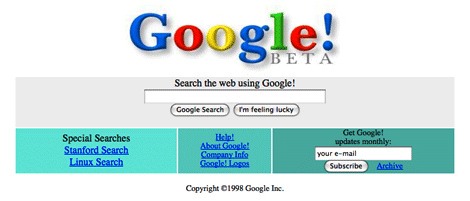
All in all, you can count me as a skeptic on the “gone in 10 years” idea. But I’m delighted someone in a powerful leadership position is thinking big. To me, the real question is when will we cross the line at which point radio technology investments become a liability rather than an asset?
The Battle Royale of Network vs. Stations
Aside from the user-centric and technology issues are the financial and “power” issues. Be sure to read John Sutton’s post where he starts to look at this. Though Schiller talks about collaboration in the news production and distribution business that includes local stations, those notions remain largely ethereal. Setting aside the Argo Project — it’s both too tiny to demonstrate meaningful results and it’s being done with Bryant Park Project-style largesse that cannot be sustained — what work is NPR preparing to do to bring station leaders along when it comes to mission and revenue? Not much that I can see today.
Because the problem isn’t with NPR. They’ve got the digital talent. They’ve got the lion’s share of reporting capacity. They can aggregate advertisers and listeners at scale. Though they couldn’t stay the same size, they could make it on their own without the stations. The problem is with the stations.
Stations have gotten fat and happy buying NPR stuff (even at highway robbery rates) because the audience loves the content and enough of them give money. Plus advertisers like pubradio demographics. It’s working. TV is struggling to survive while radio is largely doing okay. But stations aren’t doing what Schiller appears to want: significant local reporting that would allow for news collaborations network-wide. For her notions of a news network to work, someone outside NPR has to be producing news content and sharing it. Too many stations have too little capacity (or none at all) in this area. And many stations funded by CPB are music-primary or heavily music-based, taking them further from public service news.
So we’re left with a hinted-at battle between the network and the stations over money, power and mission. Or rather, it’s a re-ignition of an old battle that started when the Internet burst onto the scene 10 years ago. Given that NPR’s Board is largely populated with station management, Schiller could be in for some interesting conversations in the months to come.
All this said, readers should note a portion of the Q&A session from her appearance at D8:
Is there a way to support NPR without supporting the local station?
Schiller: No, not really. The lifeblood of NPR is the local station. You’ll note we always route the membership drives through the local station. However, we do have a philanthropic support through the NPR Foundation, but that’s not for small individual donations.But the listener can go directly to NPR in the Web model, and doesn’t need to go to the local affiliate. So what’s the local affiliate’s role in the new paradigm?
Schiller: The fact that so few journalists are covering state and local news is scary. We’re committed to providing that local coverage via the affiliates. “We’ve got to have that local coverage, and NPR can’t do it….To the extent that [local coverage] doesn’t suit your needs, then we have to work together to make it meet your needs.”
News Collaboration and Revenue Streams
While we’re on the subject of Schiller’s comments, be sure to check out this video clip in which she talks about collaborating on news content and on pubradio’s revenue streams:
http://s.wsj.net/media/swf/main.swf
Personally, I’m enamored of Schiller’s vision for the future, of a true news network in which the far-flung nodes are as active in the news process as the central, and to each his own strengths.
But I think that model, and the business operations required to make it go, look extremely different than what the system looks like today. So different that current station management will likely fight it with all their remaining power.
Because yes, the towers will go (too expensive), the middle management will go (too wasteful) and you’ll be left with journalist-bloggers focused on community news that operate local public service networks and both report and instigate reporting from others. Plus you’ll have some sales people and technical web people. In many communities it won’t look like public radio at all.
We just don’t know how fast all this will happen.
 Gravity Medium