Economics of Abundance

Here’s what most public media outlets still don’t get — especially in the corner offices. If you get this economic concept, you’ll understand why creating media and throwing it out there isn’t enough.

There are two scarcities that public service media firms can utilize immediately, and probably more that haven’t yet quickly come to mind:

  1. unparalleled-quality news / information / data / analysis, especially when coupled with excellent curation
  2. leadership and convening of tribes by geography and public service interest

News, even top-quality news, is not enough. Because once it’s released into the digital world, the price falls to zero or near zero, so you can’t monetize it directly. You can ask for donations to support your public service (sound familiar?), but the appeal to altruism — while it works to a degree — doesn’t achieve full financial support. (Look at the balance sheets of public media companies across the country; they don’t live by altruistic donations alone).

But just as the musician makes money from t-shirts and live events and other opportunities to “experience” the music beyond simple recordings, so too can public service media gather money via events and participation in limited-access tribes or communities of interest. Plus, the simple creation of those events and communities is a new service for most pubmedia outlets. The communities can be created online and the tribes can be led and organized offline.

I know — some of these terms may be confusing if you haven’t read Seth Godin or Jono Bacon. But that’s where public media has to go. Broadcasting is not enough. Publishing online is not enough. The public needs more, wants more and will part with money to get it.

"I'm in the Audience Business"

In addition to covering developments in the technology sector, This Week in Tech — the flagship of Leo Laporte’s podcasting network — often hosts guests directly participating in the media revolution that’s already in progress. And they often have illuminating conversations about what is and isn’t working in old and new media spaces, and in the spaces in between.

This week the conversation offered this little gem from Shira Lazar, a young pro in both new and old media (at time index 5:14):

“For me, I say I’m in the Audience Business.”

Bingo. This is the future for nearly all media (but not absolutely all). If you don’t have or can’t maintain control over media distribution in a 1-to-many distribution model, then you must learn to engage an audience.

This is also known as building and leading a Tribe.

Be sure to listen to TWiT 190 from about 3:20 to 13:00 for the complete old/new media and audience conversation. Plenty of relevant ideas for public media leaders.

Out of the mouths of (27 year old) babes

If you’re involved in public radio, this is required reading / listening.

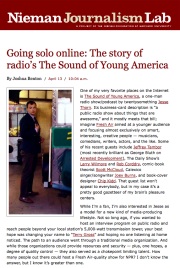
Jesse Thorn, host of public radio’s The Sound of Young America (which is really a podcast that happens to be on a handful of 25+ public radio stations nationwide), speaks with Josuha Benton (Nieman Journalism Lab / Harvard) about his notions of creativity, business, media scale, public radio economics, audience interaction, passion, awesome content and more.

In particular, he nails the problems of the public radio industry today: the saturation of the older, educated white market and the industry’s pull back from attempts to stretch into new market segments with old formulas. He also keenly understands and explains the financial models in “the system.”

Because what Thorn proposes is that public media programs, hosts, writers, and others do is, well… make great content and directly interact with the audience that gels around the content and experience. He’s suggesting you build a Tribe.

Take a listen…

While listening, pay special attention to his observations about how he pays himself for his work, how he interacts with his audience, and how small-scale his show’s production model is. Also pay attention to how he thinks programs in the future will work — using mass media as “calling cards” or “advertising” for the interactive media experience the programs are creating.

From a Tribes perspective and a mass media model perspective, there’s only one other major national project I know of that’s doing the same thing: Planet Money, in a tiny, experimental pocket of NPR. And that could be said to be an outgrowth of the defunct Bryant Park Project.

There will remain a place for mass-produced and mass-appeal general news production. But for everything else, and especially for any local station that wants to survive, your future is in building a community around awesome content and services, a la Jesse Thorn.

Bonus Listening: If you haven’t heard the SxSW presentation by Merlin Mann and John Gruber on creating content online, that’s your immediate next destination. Indeed, here’s your reading list for surviving in the 21st century media world:

Double-Bonus Listening / UPDATE 2009-04-19: Thanks to the unstoppable Jesse Thorn for stopping by with a comment (below) and sharing the link from the discussion at the 2009 Integrated Media Association conference in Atlanta. Highly recommended, too. Thanks Jesse!

Digital Public Media: From Broadcasting to Leading a Tribe

Thanks to @garyinalaska, I was invited to speak at the Alaskan Apple Users Group (AAUG) on March 4 in Anchorage, on a topic more or less of my choosing, but dealing with “digital media survival.”

I took that notion, applied it to public media, and tried to bring forth my current thinking about how we in the public media space — at least where I am these days — must change in order to better serve our original mission and do it in a sustainable and meaningful way. Broadly, I suggested we must move from being a purely broadcasting-focused firm to leading a “tribe,” as Seth Godin would put it.

Frankly, my presentation needs work. A lot of work. But the core ideas are there. We’re only just getting started on this in my firm, so I should be able to revise this in the future once we’ve got more experience. For now, however, here’s the presentation files as well as lots of links that are the foundational pieces of the notions presented. I’d love to hear your comments or suggestions, and if you take these ideas and expand upon them, drop me a link.

  • Tribes: We Need You to Lead Us, by Seth Godin (Amazon.com)
  • Tribes: We Need You to Lead Us, by Seth Godin (free at Audible.com)
    Godin’s book on the tribes notion isn’t perfect (there are complaints out there about generalities that aren’t backed up with examples), but it’s quite good and I suspect it will form the backbone of our strategy going forward. It is not a prescriptive book; it has no “instructions” — it’s more faith than religion, if you know what I mean. In any case, as I noted in the presentation at AAUG, if all we in the current public media are doing is talking at people instead of communicating with and connecting people with shared interests and values, we’re not likely to survive. Content is free. Distribution is free. Contact, context, connection and community are priceless.
  • Seth Godin’s blog
    Godin covers the tribes notion periodically and relates tons of next-generation marketing and communications concepts; highly recommended reading for just about anyone.
  • Seth Godin Talking About Leading a Tribe (YouTube, 6 min)
    Audio quality is a little weak, but crank it up and you’ll hear everything you need to hear. Godin succinctly hits the notion that companies are focused on interrupting you enough to trick you into buying their products or services, but they don’t care about you.
  • Seth Godin: Sliced bread and other marketing delights (TED / YouTube, 19 min)
    TED Talks are legendary and Godin does his typically masterful job talking about marketing. This one is not about tribes, but the notions covered are integral to understanding how our historic mass media model is failing. It’s 19 minutes, but it doesn’t feel like it — he’s a wizard of fast presentations that are smart, funny and revealing.
  • “No One Cares About You” (YouTube, 2 min)
    Short and to-the-point advice to companies that think they need to get into social media to tell the world about what they are doing. Surprise: people don’t care about your company.
  • Kevin Kelly / The Technium: Better than free
    This piece set off a ton of blogosphere and public media commentary last year because Kelly sets forth not only the notion that you can’t stop things (media) from being free, but that there are still ways for companies and individuals to create value and gather revenue. Brilliant stuff.
  • Kevin Kelly / The Technium: 1,000 true fans
    Godin refers to this piece in Tribes, and rightly so. It’s a seminal work in the new media world, as it proposes that an artist can surivive if only he or she can find 1,000 true fans/supporters. Godin suggests, rightly, that the number might be 1,000, but it also might be 100 or 10,000 or 1,000,000 — depending upon your situation. But there is a number, and you need those true fans.
  • The Cluetrain Manifesto
    Now 10 years old, the Cluetrain is still being studied as companies of all kinds try to understand how to behave in the new media, interactive world. The 95 Theses are priceless.
  • Clay Shirky: “Gin, Television, and Social Surplus”
    Shirky addresses the rise of television in concert with the industrial revolution and how it acted as a “cognitive heat sink,” yet now people are participating in media creation rather than simply passively consuming it. Critical to understand because it signals and explains how and why people are, more and more, rejecting
  • Clay Shirky: Here Comes Everybody (the web site)
  • Clay Shirky: Here Comes Everybody (Amazon.com)
    Subtitled, “The Power of Organizing Without Organizations,” this is a critical idea that public media companies must understand. There are aspects of running a public media service that require the power of a formal organization. But engaging with and leading a tribe cannot be achieved by a pure firm (or corporate) approach because it cannot scale. But if we can “organize without an organization,” we can get there. Of special note are his brief references to “cost of coordination” and how and when a firm (a formal organization) is useful and when it stands in the way of progress.
  • Umair Haque / Bubblegeneration Strategy Lab
  • Umair Haque / Harvard Business Publishing
    His writing is perhaps the most dense of any of the links here — it’s probably a half- or full-generation ahead of contemporary economic thinking, so it can be hard to follow. But if you’ve got an imagination to see a world that doesn’t quite look like ours and a world that operates on different economic principles, expectations and practices, you should be following Haque. Those in traditional mass media — especially commercial media — will ignore Haque at their peril. By the way, his PowerPoint slides on co-creation of content (at Bubblegeneration) are equally dense, but there’s a kernel of public media’s future in there: a collaborative approach to media capture, editing and distribution that we could never have considered in the past.

Thanks again to @garyinalaska for the invite. The crowd was great!

Tending the Public Media Tribe

If you’re not reading Seth Godin, you’re not paying attention to the future of successful public media. Godin doesn’t address public media directly, but he does address issues of marketing and community and the economics of making money through the products or services a company provides in a new media world.

Godin talks a lot about tending to your “tribe” — that group of people that love your product/service and who share your values or perspectives and interests. If you’ve been in public radio or TV for any length of time, you know these folks. Most likely you’re already a member of this tribe yourself.

Recently Godin gave a talk at a music conference and his comments, while aimed at a music marketing audience, are applicable to all of us in public media — news, music, radio, TV, whatever — because the trends affecting the music business (disastrously) today are the same ones rewriting the rules for all media. And the rules for success in the next generation will be the same: serve your tribe; be indispensible; be the best.

Here are some highlights from Godin’s talk, pointed out by Gerd Leonhard and partially chosen by digitalwaveriding (the boldface highlights are mine):

if I asked you for the name and address of your 50,000 best customers, could you give it to me? Do you have any clue? [No?] Then what happens every day is you go to a singles bar and you walk up to the first person you meet and propose marriage and if that person won’t marry you, you walk down the bar to every single person until someone says “I do.” That’s a stupid way to get married. A better way to get married is to go on a date. If it goes well, go on another date. Wait to tell them on the third before you tell them you’re out on parole. Then you meet their parents, they me your parents, you get engage, you get married. Permission is the act of delivery. Anticipated, personal and relevant messages to people who want to get them.

… The next thing is what I call the Seinfeld curve. The Seinfeld curve shows us Jerry’s life. If you like Jerry Seinfeld you can watch him on television, for free, in any city in the world two or three times a day. Or, you could pay $200 to go see him in Vegas. But there is no $4 option for Jerry Seinfeld. This is death. You can’t make any money in here. Because if you’re not scarce I’m not going to pay for it because I can get it for free. And one of the realities that the music industry is going to have to accept is this curve now exists for you. That for everybody under eighteen years old, it’s either free or it’s something I really want and I’m willing to pay for it. There is nothing in the center — it’s going away really fast.

… The next thing is this idea that people care very much about who is sitting next to them at the concert. They care very much about the secret handshake. They care very much about the tribal identification. “Oh you like them? I like them!”

… It’s really important to people to feel like they are part of that tribe, to feel that adrenaline. We are willing to pay money, we’re willing to go through huge hoops, trampled to death in Cincinnati if necessary, in order to be in the environment where we feel that’s going on.

… I want to argue that the next model is tribal management. That the next model is to say, what you do for a living is manage a tribe, many tribes, silos of tribes. That your job is to make the people in that tribe delighted to know each other and trust you to go find music for them.

… There is a lot of music I like. There is not so much music I love. They didn’t call the show, “I Like Lucy,” they called it “I Love Lucy.” And the reason is you only talk about stuff you love, you only spread stuff you love. You find a band you really love, you’re forcing the CD on other people, “You gotta hear this!” We gotta stop making music people like. There is an infinite amount of music people like. No one will ever go out of the way to hear, to pay for, music they like.

Fortunately or unfortunately, the future for public media companies will involve considerable “tribe management” and will involve a smaller audience than we have today, either locally or collectively — all media will have far more fragmented communities than in the past. Now is the time to identify who’s in and who’s out of your tribe and figure out how best to serve the community that gathers around public media content and values.

This may sound elitist or even fatalistic to the traditional mass media thinkers out there: “But I want the biggest audience possible!” Well, you can’t have it. Large audiences of mildly engaged viewers or listeners or readers are the old model. The new model requires deep and authentic engagement with that “tribe” of people. You can still invite everyone into the tribe, and you should. But in a world of infinite tribes, folks will naturally gravitate to the tribes that best serve their needs and interests (and they will have multiple tribes, of course).

Personally, I think this is an incredibly exciting time for public media folks that embrace this new approach. There’s new opportunity not only for sustainable businesses, but for truly meaningful, impactful and interactive work. The only problem is developing the courage to let mass media thinking fade over time, even though it’s been tremendously successful for the last 40 years.