Google sidesteps the commodity phone business

The second point that I think is key is the recognition that Google has the opportunity to play a bit of business model jujitsu against competitors with Android, noted in this sentence: “It could afford to do this because Google aims solely to protect the great business they already have in advertising, not to make money directly from the product (HW or SW in this case).” This is a point that we discuss in a variety of different business markets. It’s why we think that those who understand how to embrace the difference between scarce and infinite goods have a huge advantage. If you can make money by giving away a product for free that some legacy business relies on charging for — and then making your money up in an ancillary market (made bigger by giving your product away for free), then you have a massive advantage to disrupt the market.

Google doesn’t need or even want your handset money or your OS licensing money — those things have no margin and/or entail too much overhead cost in support. But if Google can build a vast lead in mobile device advertising (which is more than just display ads, by the way), then their core business is protected from new entrants.

In public service media, I’ve previously talked (and presented) about commodity news and how we should either be giving away the commodity product — even to our legacy “competitors” — or simply stop producing it altogether. Know what business you’re in. Let everyone else scramble for the commodity scraps.

Techdirt on the Cable TV vs. Internet battle

…both of these stories suggest a prime battleground for the next year: as the old TV businesses come to grips with the internet (finally). Just like other parts of the entertainment industry, it will be messy and annoying — and incumbent players are going to make a lot of really stupid mistakes. But, in the end, we should start to get some pretty cool stuff out of it — though, most likely not directly from the incumbent players, but from the upstarts and innovators on the margins.

2010: The Year of Skype?

Skype is finally spun off from eBay and owns its own intellectual property. They’re already expanding to integrate with business phone systems and now they’re working with TV manufacturers to put Skype into “smart” TVs.

Imagine: 720p live videoconferencing from your TV, no computer required. And let’s be clear: we’re talking about Skype being built-in to your TV as a feature that’s one button away, not through some set-top box. What will it mean when you can have a high-quality videoconferencing system easy enough for the grandparents and kids?

Check out this introductory video from Skype to get a sense of what they’re announcing:

http://download.skype.com/share/videos/player.swf

I already do occasional video chat sessions with family and friends thousands of miles away and it works pretty darn well (via both Skype and iChat). Make video calling a reality from home and traditional TV just met its latest threat to time that used to be spent passively consuming video media.

We already know 2010 will be the year of the tablet (via Apple and other players, but mostly Apple). It could also be the year Skype breaks past geek niche product into the mainstream.

Public Service Media requires decentralized action

Let’s start with an insightful quote from David Brooks writing in the NY Times this past weekend:

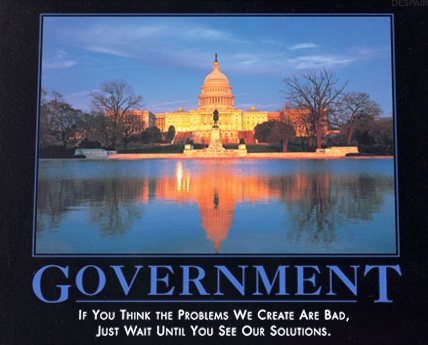
For better or worse, over the past 50 years we have concentrated authority in centralized agencies and reduced the role of decentralized citizen action. We’ve done this in many spheres of life. Maybe that’s wise, maybe it’s not. But we shouldn’t imagine that these centralized institutions are going to work perfectly or even well most of the time.

In this case, Brooks was talking about centralized agency performance in the face of terrorism threats, but his talk about the powers — or lack of powers — in centralized government agencies got me to thinking about public service media. It seems to me that if we’re serious about public service media, we’re going to have to act locally and work to deemphasize national content distribution, services and cash flows. We’ve gone too far into centralized, and we’ve lost our way in our hometowns.

It strikes me that, more than anything else, those who will successfully practice public service media in this new decade will rely upon themselves and their communities, rather than waiting for solutions or directions to arrive from national agencies or media producers. Local solutions can’t come from somewhere else (though ideas can). The age of centralization and top-down service is over for now. Such approaches don’t scale down to real problems and palpable action well, and they smack of paternalistic “do this and do it this way” directives. We’ve put too much faith and power into centralized systems, enfeebling our abilities to act in our own communities.

Serving community needs almost always must be done on a localized basis. Yet over the past 20 years the public broadcasting universe has concentrated more and more power, intelligence, money and experience in the core networks and stations: PBS, NPR, APM, PRI, WGBH, KQED, WETA, WNYC and so on. Donors to local pubcasting stations are really helping pay Paula Kerger (PBS) more than $500,000 a year and Steve Inskeep and Renee Montagne (NPR) more than $600,000 a year combined, not to mention so many others. Yet the services they individually provide, while nice, are not vital to solving community problems where we live (they don’t even solve problems in the Washington, DC metro area, for that matter).

Consider what could be done with the money spent on the centralized networks in a local area. In one market with which I have passing familiarity, with about 2.8 million people in the MSA, the local PBS station sends more than $1.2 million annually to PBS alone. That’s money leaving the community, going to PBS (and ultimately to program producers) and what that community gets back is national PBS content. I’m not sure that’s a good return on the community’s investment, not to mention the duplication of effort that happens across 300 cities nationwide — stations do pretty much the same thing everywhere: create a PBS station that looks like all the others, save for the logo.
Meanwhile, that’s $1.2 million that isn’t being spent to provide services that are locally relevant and useful to the community. What if that money paid for 12 people to write, shoot video, take pictures, interview people and gather and post information and host interactive communities that solve real problems? And what if those 12 people helped organize a community of 48 people that were actively and collaboratively involved in solving problems, multiplying the positive effect? That would be a major, real-world impact — well worth $1.2 million in local funding from a community of 2.8 million ($2.30 per citizen per year).

Now, I know what you’re thinking: “What do we do about Antiques Roadshow?” Well, that show can go to A&E. Oh, except they already have that show, called Pawn Stars. Zing! But seriously, I can address the restructuring of public TV funding and programming in a future post. For now, my point is that local public service media companies must focus on local needs and solutions. Leave the nationals to do their work (in new ways, in new funding models).

When the 1967 Public Broadcasting Act came along, there was a deep-rooted need for local media creation that served local needs in a noncommercial way. Over the years, the professionalism of the system has destroyed local capacity, concentrating capacity at the national level, where both PBS and NPR are competing with national media outlets and behaving in ways disconnected from local needs. In many ways, the dreams of the 1967 PBA writers were attained, but have been steadily lost.

It’s time to swing the pendulum back the other way.

Changing the rules of the game

I was catching up on some reading over the Christmas weekend and came across a fascinating post over at Reflections of a Newsosaur about Panorama — a fascinating project from McSweeney’s that puts a ton of new journalism out into the world… in print.

But what was just as interesting as the project was the reaction on the blog. Immediately the news pros out there ragged on the effort as “just a magazine” and derided the project’s ability to produce so much (admittedly great) content on a daily basis. Harumph! they cried out.

But thankfully one commenter had the right idea — who says all “real” news has to be daily? Who wrote these rules, and what if they don’t apply anymore, or shouldn’t apply?

Indeed.

If you goal is to change the world (for the better), then you have to… well… change the world. That means some things in your world will change.

Even amidst all the change in the media world, newspaper leaders and supporters would rather dump on an innovative new project on not meeting their imaginary “standards” than consider how they might change to do insanely great journalism. We don’t need daily print publications, we need engaging stories and information that help us solve problems in our lives and communities. Maybe you do that every day, maybe every other day, maybe weekly, monthly — whatever is the right process to fit your economic and storytelling capacity.

The worst thing we can do, if we want to make impacts as public service media companies, is to keep doing what public broadcasters have always done, without modification, without experimentation, without considering the needs of the community today, not the community’s needs from 1979.

Sign me up for a TV hooked to the web

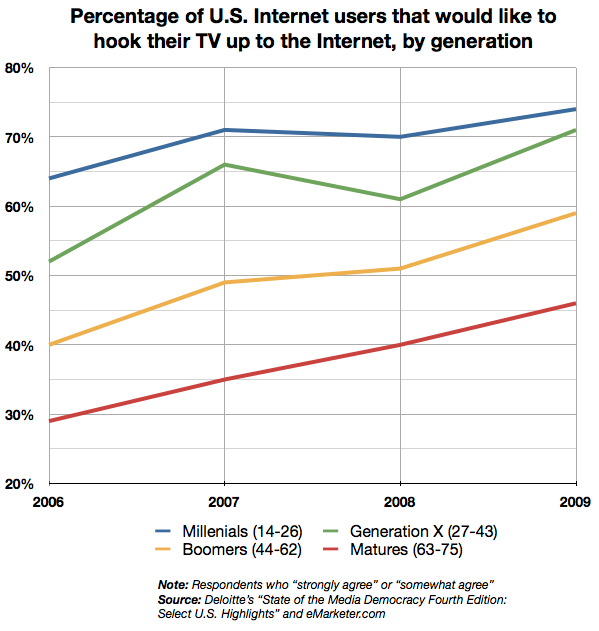
Interesting chart of some numbers published by eMarketer recently, taken from a Deloitte research report:

It’s remarkable to note how fast and consistently “matures” are getting interested in hooking their TVs up to the Internet. But everyone’s desires are rising, in all age ranges.

I’d like to hook up a TV directly, too. Of course, I’ve already got an Xbox 360, Playstation 3, Wii and Apple TV, and they’re all live on the Internet. But it’s still not quite the experience I’m looking for. I’ve considered setting up a Mac mini, but just don’t want the cost and the hassle.

And what happens when the interactive Internet — complete with social experiences — is on your big screen and “TV” is still a crummy, compressed image from your cable or satellite provider? That’s some tough competition for broadcast.

Seth Godin: First, organize 1,000

What’s difficult is changing your attitude. Instead of speed dating your way to interruption, instead of yelling at strangers all day trying to make a living, coordinating a tribe of 1,000 requires patience, consistency and a focus on long-term relationships and life time value. You don’t find customers for your products. You find products for your customers.

via sethgodin.typepad.com

This is a monumental challenge for public broadcasters.

You already have donors, but are they in your tribe? Do you have a tribe?

Are you ready to lead the tribe and not just find folks that want to give you money because they feel good about your broadcast schedule?

I know lots of folks think it’s the same thing. But it’s not.

GigaOM: 1999-2009 – How Broadband Changed Everything

From 1999 to 2009, the world changed dramatically. We destroyed an unprecedented amount, and yet thanks to technology, built an unprecedented amount, too. Indeed, like a man obsessed, I cannot help but look at our modern lives through the lens of broadband. Thanks to that technology, the world today is more closely knit than ever. From 9/11 to the Asian tsunami to the election of Barack Obama to the terror attacks in Mumbai to the uprising in Iran, broadband enabled us to experience such global events together.

A great look back at the past 10 years of Internet time. Well worth reading in full. And this is just the first of 3 parts.

MacBreak Weekly explores NPR/station disintermediation

On each MacBreak Weekly — a podcast focusing on all things Mac (and iPhone / iPod) — the host and guests make “picks of the week” in which they highlight hardware or software from every imaginable corner of the Mac and iPhone universe. Some stuff is small, some stuff is big, some is expensive and some is free. This week one of the guests — Alex Lindsay, a videography and special effects pro — picked the tremendously popular NPR News iPhone app (currently #4 in the free News apps category in the iTunes App Store).

In discussing the NPR News app, host Leo Laporte and Alex lavish praise on NPR itself for doing such a great job meeting the needs of Internet users that want access to NPR News and other public radio content and stations. They also rave about This American Life (currently the #2 podcast in the entire iTunes podcast directory) and the heavily revised NPR.org.

But then things get interesting.

Laporte and Lindsay don’t stop with reviewing the app or praising NPR. Together they demonstrate both tremendous insight and notable ignorance of how public radio is architected in the U.S. Here’s what’s right and what’s wrong in their discussion:

Right

  • The NPR News app, combined with the new NPR.org, is one of the most advanced distribution approaches in use by a major media company today.
  • Livio is offering an Internet-connected radio with built-in NPR branding and features ($200).
  • NPR was afraid to offer fully atomized programming elements via the web in an on-demand fashion for many years due to fears of station backlash, and resisted that through the early days of podcasting, despite prodding from Laporte and others in the tech world.
  • Donations from listeners are still primarily directed toward stations, not NPR itself, and national producers reinforce that notion currently.
  • NPR has done what many media entities have not done: face the future and make significant changes to the way they distribute content, answering the requests of listeners, even if it means stepping on local station toes.
  • NPR produces industry-leading audio programming; it’s the “gold standard” in audio production and other professionals use it as a benchmark for their work.
  • This American Life includes advertising in its podcast (it may be “sponsorship,” but it sounds to listeners like advertising). Laporte also realizes that advertising in a podcast gets around FCC regulations governing nonprofits and broadcast advertising.
  • This disintermediation — content flowing from producers to listeners directly, without local stations — could be “the beginning of the end” for NPR stations across the country.
  • Given the way content is produced and distributed in this new model, there needs to be a “reversal” of how the system works, in that NPR should pay local station reporters for news gathering (this is also listed below in the “wrong” section).

Wrong

  • Alex says the app is “either free or $0.99” — it’s free, no question about it.
  • All Things Considered is not produced by a network other than NPR — it’s not from APM, it’s not from PRI, etc.
  • Lindsay suggests that NPR should be paying local reporters for their reporting. What he doesn’t know is that NPR already does this, it just does it on a pay scale and frequency that’s not sustainable for local journalists.

Given how badly most people understand the public radio system in the U.S., they get a ton of this stuff right. And they instinctively know how the disintermediation game works — Laporte used to work on the defunct cable channel TechTV but today has built his own network of audio (and now video) podcasts and streams, amassing more than $1,000,000 in annual revenues for his 2-4 person multimedia production house. (For the record, he’s also a commercial radio broadcaster.)

“The Reversal”

I was shocked by Alex Lindsay’s suggestion that the economic model on which the network/stations system works should be turned on its head. That’s something I’ve been saying since about 2006, once I realized that the content power rests with NPR, but the radio distribution power and the social relationship power rests with geographically-bound stations.

I’ve been laughed out of more than one conversation when suggesting NPR should pay stations to distribute their content. Or at the very least, NPR should be passing its content to stations for free or for the cost of operating the distribution system (PRSS / ContentDepot).

Today, stations pay anywhere from tens of thousands to millions of dollars annually to NPR for the “privilege” to carry their content (depending on market size and lots of other factors). That’s the bulk of NPR’s income: fees collected from local stations. That’s why you pay your local station and not NPR (although NPR does sell advertising space nationally and they do seek high-dollar gifts from rich donors).

Some think the annual CPB operating grants go straight to NPR and PBS, but they do not. Only tiny bits go to a few specialized programs or services at the networks — the vast majority of CPB’s money goes out to 600 public radio stations and 350 public television stations every year (67% to TV). That model has been in place for decades.

But it’s time we rethink this model. Maybe we don’t need a total reversal of all the flows. But the balance of power has shifted dramatically into the hands of the major national producers at the same time they’ve sucked the life out of most local public media outlets in the country with their incredibly hefty (extortionary?) fees. Money collected locally keeps the lights on and pays the national producers, but it affords precious little local production of any sizable amount or quality.

This has to change. Or we might as well just nationalize the system, a la BBC, and get it over with. Either approach can be made to work, but the current model doesn’t match how the world works in the 21st century.

Listen for Yourself

In any case, check out the conversation to hear these comments and insights from outside the public radio universe. It starts around 1 hour, 20 minutes in the original podcast. Or just listen to the excerpt I’ve clipped here (or click the play button below). The excerpt is about 5 minutes long (MP3).