Tonight at 11… Sweeps can KILL you!

Found via Lost Remote, this Idaho Radio News post includes one of the funniest (and saddest) send-ups of local news promotions in commercial media.

[audio:http://idahoradionews.com/go/wp-content/uploads/2008/03/sweepscankillyou.mp3%5D

Can you imagine a public radio or public television station doing a promo like this? Of course not — it’s the polar opposite of the public media ethos.

Perhaps one of the ways to define public service media going forward is to declare what we are not.

Haarsager on NPR changes

Dennis Haarsager posted his response to the speculation about CEO Ken Stern’s departure from NPR this past week. It doesn’t present a “smoking gun” version of events. However, in the comments to his post, Haarsager lets loose three priceless notes that illuminate these events more than any other account to date:

  • “…Mr Stern chose the time and day when he left the building.”
  • “…no malfeasance or misfeasance should be imputed.”
  • “…transparency is an important ideal; [Stern’s] privacy is a right.”

These quotes are very important to understanding the events.

First, he blows the malfeasance idea out of the water. When the news hit about Stern’s departure, I know folks around my shop assumed there was something sinister about the change. Had there been embezzlement? Sexual harassment? Physical confrontation? Why else would the termination be so abrupt? Well, it wasn’t something like that. (And those with personal experience of Ken Stern couldn’t imagine such a scenario anyway.)

Second, Haarsager notes the mutually exclusive issues of transparency and privacy. We observers want transparency in these affairs, but the departed — Stern — has a right to privacy. Personal privacy trumps corporate transparency in this case, and rightly so.

If you’ve ever been in a managerial position, you know there are things you can and can’t talk about when it comes to hiring candidates and terminating employees. Indeed, mostly you can’t say anything. Even if you’re mad at the employee, even if you’d like to give them a swift kick on the way out the door, you say nothing. To say anything negative is an abuse of your power and opens the company up to lawsuits. Besides, the employee is gone now — it’s time to look ahead.

Third, and most importantly, the departure was abrupt, but the timing was Stern’s choice. In other words, Stern could have played this game entirely differently — even leading to a multi-month golden parachute process, I suspect — but he chose to go out this way and at this time. This tells us a tremendous amount without giving details (an excellent balance of transparency and privacy, I think).

Consider how most CEO departures play out: there’s usually a transition period, often a significant one. The Bill Gates departure from Microsoft has been in the works for more than 2 years and he even left the CEO role several years prior to that. Many nonprofits have written succession plans, allowing for smooth transitions either over time or in emergency situations. And even when a CEO departs to “spend more time with his/her family,” there’s at least some degree of hand-off, like a consulting gig with the company until the new CEO is seated. But not here.

So the fact that there’s no transition, that the change was so abrupt and surprising, and the fact that Stern more or less set the timetable speaks volumes. And not to Stern’s credit. In my experience, even if you’re disgruntled, you don’t walk out and cut all ties with the company instantly.

So Haarsager’s statement that the reasons for Stern’s departure were “multivariate” is probably the most accurate, albeit the least satisfying. And from what I’ve gathered privately, it really isn’t all about the new media angle (though that’s one of the variants to which Haarsager is likely referring). But the way this went down — the suddenness of it — suggests much of the problem existed inside the CEO’s office. It didn’t have to end this way.

Personally, I’m ready to move on — we’ve got so much to do in public media. But I’ll continue to update the articles list as needed.
Paterson on leadership (at NPR)

While I do appreciate Robert Paterson’s take on the leadership issue that’s likely below the surface of the NPR / Stern debate, I’m struggling to believe that that’s the core of this week’s story — that Ken Stern just ruffled too many feathers and it was time for a different leader. Sure, hard-charging generals are not the best leaders in all situations, and after 10 years of whip-cracking you might need a smooth operator. That makes eminent sense.

But in the shifting media environment about which so many of us write and ruminate, isn’t a hard-charging general needed at the top? Someone that has both the vision and the drive to push through to a new way of thinking and doing. The media environment changes in play today are not just operational in nature, where a COO might fix this, improve that — they’re strategic shifts. Seismic shifts. World-upside-down shifts. Only a CEO and her or his board of directors can handle those issues and realign the company. And given the time-to-market pressures of new media on old media, NPR probably didn’t (and doesn’t) have the time for all the required dinners and socials and private meetings, nor could it afford compromise after political compromise on the way to a new strategy.

NPR — like all media companies, for-profit or nonprofit, operating in any or all media formats — must grapple with the fundamental changes in progress. The relationship between producers, distributors and consumers is completely inverting.

Of course, this entire discussion could be moot. Public media’s future may have to be created outside the voluminous corpus of NPR (or APM or PRI or APT or PBS or …). Developing a new model with fundamentally different DNA may not be possible inside the system, either with a hard-charging general or a sweet-talking politician.

Jarvis on NPR

Well he’s not “on” NPR, but he comments on the NPR / Ken Stern thing, as you might expect. He even gives a shout-out to yours truly (blush!). I returned the favor by commenting on his post.

  • Trouble for NPR — BuzzMachine / 7 Mar 2008 (Update: Note Dennis Haarsager’s comment to this post at Jarvis’ blog)

In that post he also refers to a great year-old post about public radio, following a meeting he had at NPR along with other new media folks. This is the post that introduces the great new word “converstation”:

NPR / Ken Stern article links (updated)

Here’s a collection of Ken Stern / NPR article links for those interested in a curated list.
Updated 24 Mar 2008.

Older Articles (for context)

Feel free to share more links in the comments.

NPR stations vs. The Future

I commented on Robert Paterson’s blog this morning, and wanted to reproduce the full comment here for the record. And because it was kind of a long comment — it’s better suited to being a post, really.

I’m not sure if I’ll comment any further on the Ken Stern developments directly. Perhaps — it’s definitely disturbing to see this turn of events. But I’d rather wait to see what else comes out in the next day or so. NPR’s reporters have already lifted the veil further today than they did yesterday.

In any case, here’s the full comment left over at Paterson’s site…

Continue reading “NPR stations vs. The Future”

New Pew Internet reports

pial-mobile.jpg

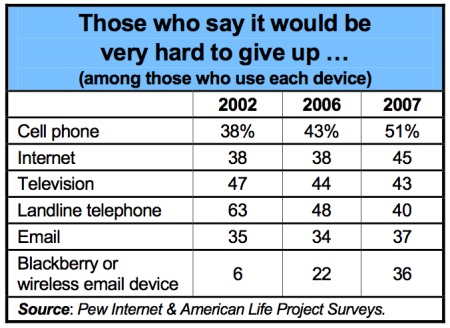
If you’re not already subscribed to the Pew Internet & American Life project reports, go ahead and get the RSS feed or add the site to your browsing plans. They’ve got two reports out this week:

The Pew Internet reports are great for survey data and some broad conclusions about trends of Internet usage in the United States, oftentimes broken down by demographics.

Is this your public TV station?

One of the things that’s interested me since I entered public media in the fall of 2004 was the relationship between public media today and public media as originally intended under the 1967 Public Broadcasting Act. I’ve wondered, are we still the institution we were meant to be? If not, is that good or bad?

Sparking more of this thinking today was a video linked by Gerd Leonhard. It was produced by Denver OpenMedia and explains the TV and mass media landscape of today and looks at how distribution, content and democracy are linked via mass media. It also focuses on Public Access television, a distinctly different style of television from public broadcasting, but one that shares at least some DNA with pubcasting’s origins.

It’s a great 30 minute introduction to understanding media — public or commercial. Highly recommended, mostly because it puts the economic model of historic TV into clear relief.

NOTE: The video is after the “read more” link because it auto-starts and I didn’t want to place it on my home page directly.

Continue reading “Is this your public TV station?”

The Paterson innovation series

Robert Paterson has begun a multi-part series on innovation in the public media space around the country. For anyone laboring on new media projects or working to promote new media (especially connective community media), this is a must-read series.

The posts so far…

I’m expecting more posts soon, probably on KETC‘s work in St. Louis (building community around shared media and history), WOSU‘s work in Columbus (bringing the online community into station engagement), and Ideastream in Cleveland (blending a dual licensee with fellow nonprofits and the community).