Steve Jobs changed my world and yours too. We’re unlikely to see anyone like him again in our lifetimes.
Author: @jmproffitt
tech nerd, media critic, snarkmaster
my hat tips and finger wags are my own
I’ve moved… to WordPress.com
 This blog has moved. Here’s the short update:
- Gravity Medium was started back in 2008 on a self-hosted copy of WordPress on a hosting provider.
- The blog has been pretty much dead since mid-2010 and I don’t really intend to revive it, yet I don’t want to take down the content, either.
- Keeping the content in a self-hosted solution was costing me money each month.
- Moving to WordPress.com is my preferred solution — leave all the updates and security to the pros and drop my monthly cost to zero.
- Meanwhile, in late April 2011, my self-hosted WordPress site — which was outdated a bit in versions — was hacked. I started to clean it up, but figured, “why bother?” and just pulled the trigger on the move to WordPress.com.
So here we are.
One important note — not all the content from the old self-hosted site is going to work perfectly here. Static images and photos moved, but a lot of embedded media (videos, audio clips) didn’t make it correctly. I’ll try to fix most of that in the coming weeks, but no promises — it’s a pain in the butt and all the posts are pretty old at this point.
If you run into a post that’s missing its media and you want to see it, just Tweet me and I’ll reconnect the media for you.
Thorium nuclear power: Let’s do this
It never ceases to amaze me how our political systems and the power of giant corporations consistently holds us back as a species.
Watch this fast-moving video to learn more about thorium-based nuclear power. It’s safe to operate, has a small environmental footprint, could be cheaply developed at large or small scales (including transportation platforms), and we could use it for millions of years at current energy consumption rates.
Imagine: all-electric transportation vehicles and systems driven by battery and/or hydrogen storage + fuel cells, with the power for hydrogen separation or battery recharges coming from thorium-based nuclear plants setup in highly distributed smart grids. Imagine a world without coal-fired power plants.
A final quote from the video:
In conclusion, this gives us options for inherently safe, proliferation-resistant, economic nuclear power that can last thousands if not millions of years. This really could be the silver bullet that enables us to power our industrial society. And this also offers real options for solving the long-term issues surrounding our existing spent nuclear fuel and ultimately preventing the formation of new transuranic waste.
Comment on “How sticky is Android?”
If you’re not reading Horace Dediu’s asymco, you’re missing out on the best mobile systems analysis and numbers in the business. I took the time to comment on his recent How sticky is Android article and I’m reprinting here for the record.
I appreciate the “sunk cost” notion [of smartphone stickiness], but I think for most users in most cases, that’s a non-issue beyond any given 2-year period. When the phone costs $100 to $300 subsidized but your monthly cost is already $75+, the hardware cost is not a barrier to switching. In fact, anyone that doesn’t upgrade their phone — and posisbly switch platforms — at the turn of their contract is leaving money on the table, based on the way carrier contracts work today. I routinely talk with friends whose contracts are coming up and they usually consider their options. Some are loyal to a platform, but most aren’t.
What seems to create loyalty or stickiness are only a few factors, and rarely are all at play for any single user:
- some number of platform-specific apps that the user considers critical to smartphone value
- a large number of platform-specific apps or media on which the user spent a lot of money and wants to retain that value
- direct ownership experience with both iOS and Android, after which the user has made a choice and plans to stick with it (so far, iOS is winning in this category amongst my peers)
- irrational love of or hatred of either iOS or Android based on emotional criteria (generally Android wins in this category because that torch burns particularly bright, similar to the way some people support Linux)
By the way, on #3, there hasn’t been enough time for most people to have owned both platforms yet. The first true smartphone was the iPhone in mid-2007. Android with comparable features didn’t come until much later. We’re only at the opening of 2011 — only 3.5 years into the iPhone and 2.5 or less into Android. Even if you bought an iPhone in July 2007 and bought an Android in July 2009, only this year would you be eligible to switch back. That’s not enough competitive time to draw conclusions yet on stickiness.
A response to the big Radio Survivor piece on NPR liberalism
I love how other people’s blog posts can get me going. The latest was the widely-ready Radio Survivor piece called Radio’s Fall – Part Two: NPR’s ‘Liberal’ Identity Crisis and it is an awesome read. Just go read it. I’ll wait.
At the end of the piece I decided I needed to comment, but then I went on and on, so I wanted to bring the comments back over here.
A bit of warning: I’m not in public media anymore, so biting my tongue is not required. To say I’m blunt would be an understatement.
The firing of Juan Williams was years overdue. He hasn’t been a journalist (if he ever was) for decades and has instead been an ass-clown for both NPR and Fox for a very long time. NPR kept him around because he gave the place color, if you will. But he offered no useful insights on anything. Good riddance, no matter the reason, and even if it was deemed a gaffe by the prigs of the PR world. Viva la Schiller for sticking it to Williams and even dancing on his grave a bit. He deserved it.
Sadly, Williams is just the latest in a long line of clowns given air time at NPR.
Mara Liaison, anyone? No insights, no reporting. Sleeping with the enemy. Guilty. Get rid of her.
Though she’s gone now, Cokie Roberts was paid $80k+ for years just to sit at home in her bathrobe and slippies with an ISDN line to chat with the Morning Edition hosts on bullshit Washington topics once a week. No reporting, no insight, just chatter from the wonderful DC cocktail parties she attended. Beltway all the way, baby. And NPR paid for it — happily.
Daniel Schorr (did you hear? he was on Nixon’s enemies list!) was on the air for at least 10 years longer than he should have been, dispensing no-duh commentaries. Bob Edwards was shown the door for some good reasons, but was replaced with comparative children as NPR attempted to spruce up the Morning Edition tent pole with a “lighter sound.” Now they pay Inskeep and company $350k+ each every year to dispense half-hearted, half-the-story news. Oh, and they’ll ship him abroad every so often — like that hack Brian Williams — to make him seem worldly. (It’s not working.)
But NPR is guilty of poor programming choices as well as poor talent choices. The once-compelling and even unpredictable Talk of the Nation — it would dig into an issue for a whole hour, if you can believe it — is now just a compendium of issues that get about as much in-depth coverage as any story on CNN. Barf. I remember when Ray Suarez hosted and he would get audibly pissy with callers that didn’t read the book or made asinine comments. You had to play hard or go home. That show mattered. You might not have liked a day’s topic, but if you did like the topic, man there wasn’t anywhere else you wanted to be.
There’s this notion in programming circles that public media has to serve the broadest possible audience in order to remain relevant or worthy of public funding. Moving from 30 to 50 million listeners is the goal to become more relevant. Too bad numbers don’t give you relevancy, they give you advertising dollars that pay for a lot of corner offices.
I would argue that the goal should never be numbers (dollars or listeners) — it should be well-researched news gathering throughout society and sharing that information the most technically accessible way, not the most demographically palatable way. How many people utilize their community library every week? Every year? Yet we fund them. How many people utilize their local fire department or police every year? Have you visited every public park in your town in the last 5 years? We still pay for all those things. I pay for National Parks I’ve never seen, never will, and so do you.
Being publicly funded means you serve a public service that we, as a society, deem worthy of shared-sacrifice funding, and it’s something that for-profit corporations can’t do, won’t do, or can’t be trusted to do. If NPR (and the public media universe) commits itself to a worthy mission — worthy of public funding — the money will come, the support will be there. There is a deep and abiding need for well-researched and reliable news as the corporate hold on news gathering and dissemination grows ever tighter. There’s even a need for intelligent analysis and commentary, or at least curation of said commentary.
But dumbing everything down and keeping no-talent talents on staff because you’re too scared to dump them is no way to provide a valid public service.
NPR and all public media outlets must double-down on their public service mission, and let the demographic chips fall where they may. We need missionaries, not whores.
—
One of the smartest people I’ve known in my life worked at NPR for a few years, and another major nonprofit news service before that. Insightful, funny, down-to-earth, deadly serious about journalistic ethics, but not blind to the limitations those ethics can have. I would love to be informed about the world from people like that, in conversational ways and in ways where I knew I could trust the information and the research that went into it. The best people will give you their information and tell you how they got it and what doubts they’ve got about it, too. They’ll also come back and tell you when they were wrong.
NPR and even some of the stations have incredibly smart people there, people that can fulfill my dream of getting news from a friend that I trust. But if I listen to an NPR station today, I don’t get to hear much of those folks. They’re the exception, not the rule.
Radiolab is an exception. Ira Glass’ work is an exception. A few of the journalists can be pretty good. But NPR on the whole has lost me. The stories are thin and thinning. The coverage is blindingly beltway and bland. The “sources” and pundits are the same corporate-funded think tank blabbermouths we’ve heard for years. NPR is getting slicker and dumber by the year.
I know there are smart people there. I know there are people I can trust; people I want to hear from; people that do their homework and know their stories. But it’s looking like the spin doctors and the station mechanics have taken over. On the road to 50 million listeners, educated people will apparently have to settle for less information, less trust, and more corporate-sponsored looking-the-other-way.
So here’s the deal, NPR: If you want to go for 50 million listeners and the advertising dollars that come with that, fine — dumb it down and slick it up. But when Fox News says you should be defunded, I’m not coming to your defense. Because if you’re dumbed down and playing the corporate safety game, you’re not worth funding with tax dollars anyway.
NPR working on fantastic new digital experiences
I’ve loved working in public media, but I gotta say there’s a lot of downtrodden and morose people out there just barely hanging on in this industry as it (and all media) undergoes tremendous changes. At least it’s felt that way to me.
But not at NPR. And good for them! They’re having a good enough time to laugh at themselves and share the jokes with us.
Others might consider this kind of tomfoolery a waste of resources, but based on my past experience in large companies, this kind of video is the mark of a company that’s firing on all cylinders and is being led by someone with a grounded sense of reality (not to mention a sense of humor).
There’s an unstated corporate culture message here: We work hard, we play hard; we enjoy our work and you should, too. I wouldn’t mind hearing — and seeing — that corporate culture at the office.
When you and your team are grounded like this, you’re much more likely to make good business decisions. Sadly, I’ve worked around some people in public media that take themselves way too seriously. For some, the media crisis times we find ourselves in are beyond our control. While no one asked to have their world disrupted, to believe you’re at the mercy of these times is debilitating and will lead, over the coming years to many public media failures.
So try a sense of humor. Work hard and play hard. And enjoy the video. I SAID ENJOY IT.
Note to any NPR web editors: I tried to use your embed code, but it wouldn’t work – the video wouldn’t show. So I’ve had to re-host the source video. If you get the embedding working again, let me know — I’d prefer to use your embed than host the video directly.
NPR CEO on towers, revenue and news collaboration
 NPR CEO Vivian Schiller appeared at the All Things D conference this week and made some waves. I know John Sutton noticed something she said and didn’t like it. And I was puzzled by it. But let’s be fair — there were several issues she covered while talking with Kara Swisher. A complete liveblog-style capture is here.
Radio towers gone in 10 years?
The most surprising comment she made was her assessment that the business of distributing audio programming via radio towers would be largely gone in 10 years. Though not a direct quote, here’s the transcript-like version:
Some smaller affiliates weren’t really set up for digital, so we had to provide tools for them so they could be part of the process. Some of this was tools for photos, etc. But fundamentally, helping them deliver audio streams. Radio towers are going away within 10 years, and Internet radio will take its place. This is a huge change and we should embrace it. Mobile will play a big part. [emphasis added]
I’m as big into new media as anyone, but even I was shocked that NPR’s CEO would make such a bold statement. Perhaps it was a heat-of-the-moment kind of thing. I don’t know.
Certainly Internet-delivered audio streaming and audio programming (not to mention, video, text, etc.) is gaining ground on old-school delivery technologies. But a 10-year countdown on radio transmission strikes me as a bit fast. This is a generational change, a slow process. Consider the strikes against this prediction:
- Audio programming, as practiced by NPR and her affiliates, is still a mass media experience — it’s not personalized or socialized to individuals. “We report, you decide” is the model. For that, mass distribution via radio makes a lot of sense. It’s more efficient for most use-cases in play today (listening during “down times” to and from work, running errands, at the desk, on weekends).
- Car-based Internet access remains experimental today. Yes, I can take the iPhone in the car, keep it hooked to the Internet and stream audio, playing it back on the car stereo. But that’s still a wonky process only geeks could love. My 70+-year-old mother has an iPhone and loves it. But she’s not listening to radio on it. And certainly not doing that while hooked up in the car.
- Mobile Internet access, especially at mass quantity, is getting more expensive, not less. AT&T’s repricing moves announced yesterday are part of that trend. Carriers, knowing the incredible capital expenditures required to build out towers, backhaul and more, can price their service in ways that lock out casual users. For those casual users, radio remains a free alternative.
And there’s more. But there are also factors that support Schiller’s contention from the user perspective:
- New cars are already starting to get live Internet and “sync” capabilities. It’s still rare and a little pricey, but it’s here and it will grow. When your car has a simple media center in it that syncs (downloads podcasts) via WiFi when it sits in your garage or driveway, new possibilities appear.
- The staggering majority of news is not real-time in nature and does not need live streaming. Therefore, a fast record/deliver model could supplant radio broadcast for almost all NPR programming. What if Morning Edition was delivered to the car very, very fast, and it was ready for you when you turned the key in the ignition for the morning commute? A super-fast podcast may be all you need 99% of the time. Local station? Not needed for transmission. Indeed, a local station would just get in the way.
- It’s easy to imagine a phone/car ecosystem that will unite the two in consumer-friendly ways. I’m not talking about hands-free speakerphones, but much more. Consider the possibilities when a car with WiFi, Bluetooth, media center and GPS functions unites with a WiFi/Bluetooth/3G smartphone and Internet access that’s both broadband (WiFi at home) and narrowband (3G) in nature. Non-live programming goes broadband. Live programming — when needed, which is rarely — comes in via narrowband on demand.
10 years sounds like a short time. But in the technology world, it’s a near-eternity. Consider what Google looked like 12 years ago (1998):
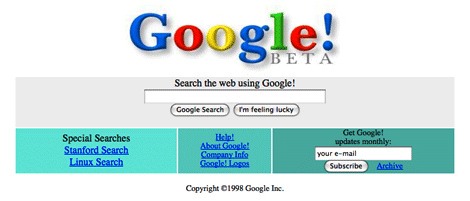
All in all, you can count me as a skeptic on the “gone in 10 years” idea. But I’m delighted someone in a powerful leadership position is thinking big. To me, the real question is when will we cross the line at which point radio technology investments become a liability rather than an asset?
The Battle Royale of Network vs. Stations
Aside from the user-centric and technology issues are the financial and “power” issues. Be sure to read John Sutton’s post where he starts to look at this. Though Schiller talks about collaboration in the news production and distribution business that includes local stations, those notions remain largely ethereal. Setting aside the Argo Project — it’s both too tiny to demonstrate meaningful results and it’s being done with Bryant Park Project-style largesse that cannot be sustained — what work is NPR preparing to do to bring station leaders along when it comes to mission and revenue? Not much that I can see today.
Because the problem isn’t with NPR. They’ve got the digital talent. They’ve got the lion’s share of reporting capacity. They can aggregate advertisers and listeners at scale. Though they couldn’t stay the same size, they could make it on their own without the stations. The problem is with the stations.
Stations have gotten fat and happy buying NPR stuff (even at highway robbery rates) because the audience loves the content and enough of them give money. Plus advertisers like pubradio demographics. It’s working. TV is struggling to survive while radio is largely doing okay. But stations aren’t doing what Schiller appears to want: significant local reporting that would allow for news collaborations network-wide. For her notions of a news network to work, someone outside NPR has to be producing news content and sharing it. Too many stations have too little capacity (or none at all) in this area. And many stations funded by CPB are music-primary or heavily music-based, taking them further from public service news.
So we’re left with a hinted-at battle between the network and the stations over money, power and mission. Or rather, it’s a re-ignition of an old battle that started when the Internet burst onto the scene 10 years ago. Given that NPR’s Board is largely populated with station management, Schiller could be in for some interesting conversations in the months to come.
All this said, readers should note a portion of the Q&A session from her appearance at D8:
Is there a way to support NPR without supporting the local station?
Schiller: No, not really. The lifeblood of NPR is the local station. You’ll note we always route the membership drives through the local station. However, we do have a philanthropic support through the NPR Foundation, but that’s not for small individual donations.But the listener can go directly to NPR in the Web model, and doesn’t need to go to the local affiliate. So what’s the local affiliate’s role in the new paradigm?
Schiller: The fact that so few journalists are covering state and local news is scary. We’re committed to providing that local coverage via the affiliates. “We’ve got to have that local coverage, and NPR can’t do it….To the extent that [local coverage] doesn’t suit your needs, then we have to work together to make it meet your needs.”
News Collaboration and Revenue Streams
While we’re on the subject of Schiller’s comments, be sure to check out this video clip in which she talks about collaborating on news content and on pubradio’s revenue streams:
http://s.wsj.net/media/swf/main.swf
Personally, I’m enamored of Schiller’s vision for the future, of a true news network in which the far-flung nodes are as active in the news process as the central, and to each his own strengths.
But I think that model, and the business operations required to make it go, look extremely different than what the system looks like today. So different that current station management will likely fight it with all their remaining power.
Because yes, the towers will go (too expensive), the middle management will go (too wasteful) and you’ll be left with journalist-bloggers focused on community news that operate local public service networks and both report and instigate reporting from others. Plus you’ll have some sales people and technical web people. In many communities it won’t look like public radio at all.
We just don’t know how fast all this will happen.
Parting (cannon) shot at WNET
Wow. Just wow.
When WNET’s Sam Toperoff retires, he really retires. Something tells me CEO Shapiro is pissed.
A brief excerpt of Toperoff’s full goodbye letter:
On my commutes to work on the E and F lines and occasionally on the Number 7 train, I’d ask people if they watched PBS. Almost no one does. They said there was very little on the air that spoke to their lives. The New York public is not merely the “Upper” East and West sides. It is these “Others” too, millions of them. And during those rare times we do program for this other New York , we do it embarrassingly, in stilted, patronizing “other” fashion. In spite of my left-wing bona fides and my high falutin’ Doctoral degree, I see our general programming for the wider public as elitist and offensive in the extreme. … But of course, when stations run on very rich people’s and Corporate money, how could it be otherwise? And when the corporation is directed by those very clever and very ambitious fellows whose careers will float them to good places no matter what, what else could we reasonably expect?
Gawker has the complete letter — well worth a read. Beautifully written, despite the dark content.
Two comments from me:
- I’d bet you real money that if you did a survey of employees at public radio and television stations across the country and got honest and accurate answers, you would find very little public television viewing. At one station I knew well, some employees who worked fervently every day to support public TV didn’t even own a TV themselves. Others just didn’t watch much TV of any kind, and if they did, public TV was a minor component of their viewing. I don’t fully understand why this is, but that’s been my experience to date. (If your experience is different, let me know!)
- I haven’t had tons of exposure to Boards, but those with which I have had contact have been filled almost exclusively with what I call “Rich White Folk” — generally the political and financial power base of the community. This is a deliberate thing, mind you. It’s intended to increase the fundraising capacity of the organization, both by bringing in well-to-do donors and their friends, and by bringing in corporate dollars those people influence or control. Sadly, it also means “public” views and needs are not well-represented; the ages of the Board members often match or exceed public TV viewing demographics, creating major programming and public service blind spots.
I often wonder what happens next, especially with public TV. Toperoff’s letter portends a difficult future. Two questions:
- Does Toperoff’s experience sound familiar or alien to you?
- If leadership is lacking, how do we fix this situation?
Digital media reaches a 'tipping point'
Digital media consumption has reached a tipping point; more average consumers are discovering all sorts of cool ways to get their media fix. And with radio’s final bastion – the car – quickly being penetrated by Internet radio and devices that make it easy to consume, traditional radio could have an uphill battle in 2011.
Bridge Ratings will soon publish its revenue projections for 2011 and the forecast is not as rosy as 2010.
2009 revenue was down 18%.
2010 traditional radio revenue will be up 4%.
2011 revenue will be down 2%.
I just bought a new car stereo a few months ago. I can hook up an iPod or iPhone no problem. Or any kind of USB memory device with audio on it. HD Radio was an expensive add-on option. Satellite radio was as well (not to mention the subscription fee).
So far, wireless data plans for cars or other non-phone mobile use still relatively rare, expensive and don’t really travel all that well due to variable coverage.
But give it 5 years. I’ll buy a new media and data center for the car by then, I’m sure of it.
Closed vs. Open: Why public media struggles with new media
Public broadcasting has always had trouble engaging in the new media world. Now NYU professor Jay Rosen has come up with an explanation that sheds light on media culture problems I’ve seen and experienced.
In a talk at the World Bank earlier this month, he offered “Rosen’s New Media Maxims,” a set of four rules or observations about the media world in which we now live. And the second maxim was particularly illuminating for me:
Open systems don’t work like closed systems; if you expect them to you’ll get nothing but misery and failure
In the case of public media, the “closed” system represents the old way of doing things: broadcasting from a single control point to a passive mass audience and allowing for virtually no feedback or participation. Or when there is a feedback channel, it’s narrow and tightly controlled. While there are regulatory reasons for controlling broadcast signals in this way, the notion of “we broadcast and you watch” pretty much permeates the culture I’ve experienced.
Online media function differently, however, because by their very nature, they’re two-way or multi-way systems. Top-down still works online, but that misses the point and the power of a networked media system. In an online world, media and conversations flow top to bottom, left to right and back again.
In moving online, most of the stations I’ve seen have done so either in a broadcast fashion or they’ve done tiny projects off to the side that don’t threaten the old system (and consequently can’t lead the company in a new direction). In many ways this makes sense — the money is still coming from broadcast-based memberships and advertising, plus the CPB is, well… the CPB and can’t put too much effort toward non-broadcast service.
Given the sturm and drang I’ve watched (and participated in) Rosen’s open/closed maxim stood out as exceptionally true. In this video excerpt, he makes a full explanation then goes into a lengthy answer to an audience question of how to bring openness to a company that’s always been closed:
Philosophical Differences
So it’s not a technological difference. It’s not a financial difference. Fundamentally, closed and open systems are philosophically different, possibly opposed. One embraces community, drawing in participation and “hosting” conversation and engagement. The other treats the public as a media receiver. Sure, there are some middle grounds here, but this is a big difference that has powered, silently, a lot of conversations in which I’ve participated, without realizing it.
No wonder we struggle with this. No wonder there’s both dismissal of the new as irrelevant to the mission and nevertheless pitched battles over who will control the social network engagements, who gets or shares in the online revenue, and how and when content will or won’t appear online. We’ve been experiencing the “misery and failure” of a closed system trying to adopt an open one, not understanding why it’s not working.
Rosen’s New Media Maxims
In addition to the open vs. closed systems maxim, there are three more Rosen rules, all in this extended excerpt from his talk at the World Bank. Recommended viewing.
The complete talk (more than 1 hour including audience Q&A) is available via YouTube here.
 Gravity Medium