When a PBS journalist attacks

NOTE: Updates added at the bottom of the post.

Late last week the host of a major PBS program took aim, in a pseudo-blog-post, at NYU journalism professor and innovator Jay Rosen because Rosen said he didn’t like that hosts’s program — a weekly talking-heads affair based out of Washington, DC.

I won’t link to the host or their complaint here because they didn’t bother to link to Rosen’s original piece in the Washington Post or his blog or his fascinating Twitter feed. And that host was deliberately ignorant of Rosen’s work, failing to do a shred of research. They didn’t even watch a video of Rosen appearing on PBS a little over a year ago.

But I will link to that insightful Jay Rosen appearance on PBS — with the now-retired Bill Moyers — in which he specifically critiqued the problem of Washington insider journalism, including the many insiders that appear on the outraged host’s program every week (I would have embedded the video here, but the video isn’t embeddable without stealing it). I encourage you to watch, despite the length, because Rosen shares a highly nuanced view of Washington journalists, politicians and their mutual interest in preserving status quo power.

In the reaction to Rosen’s appeal to put this particular insider show out to pasture, the host’s post (yeah, I know this is tedious, but I’m making a point) never referred to Rosen by name, never linked to anything he’s done, including the source article that ticked off the host in the first place, never addressed Rosen’s concerns and in fact reinforced his long-standing critique of beltway insider gamesmanship.

Only calling Rosen “the NYU professor” and failing to link to the source piece is an intentional slap in the face from an elder in what Rosen calls the “Church of the Savvy.” Dismissing his argument simply reinforces his point: that this program, the host and its guests are beltway insiders talking shop rather than helping the public hold politicians to account in meaningful, public-service ways. The host’s total mischaracterization of Rosen’s arguments also proves the prediction that beltway insiders reflexively dismiss outsiders, thus retaining their positions.

I defend anybody’s right to comment on the news of the day – whether it is Chris Matthews or Bill O’Reilly or Larry King or Jon Stewart. I even defend the NYU professor, however misguided he might be.

<sarcasm>How generous of you. Thank God you’re standing up for Jay Rosen’s free speech rights! And you know, you’re right… Bill O’Reilly and Jay Rosen are cut from the same cloth, aren’t they?</sarcasm>

In effect, the host played directly into Rosen’s analysis. But worse, the show’s audience has been denied a serious discussion about the mission of such programs. There may be valid reasons for having an insider show, perhaps as part of a larger programming strategy, but the claim that the show “saves marriages” (I’m not making that up — that’s in the reaction post) is utterly unserious and demonstrates the intense contempt this insider has for meaningful media criticism from a serious and even credentialed source.

What to do?

Look, I’m not on the “cancel this show” bandwagon. It makes viewers happy, which helps bring in the bucks. And for a talking head show, it’s a considerable step above what you get on cable channels. But the demonization of Rosen is breathtakingly ignorant and/or deliberately dismissive at a level unbecoming of a PBS-sanctioned “journalism” host.

I don’t think an apology is in order. I think the next show should have Rosen on as a guest. If you’re not a guardian of the Church of the Savvy, you’ve got nothing to fear. Bill Moyers didn’t shy away from this issue, why should you? And hey — this could be the equivalent of Jon Stewart appearing on CNN’s Crossfire.

Be More: Resourceful

[1] Here’s a brief example (video) of how “savviness” cuts off legitimate debate in the professional press:

http://www.youtube.com/v/ms548AkFP5s&hl=en_US&fs=1&rel=0

[2] And here’s a little more on what savviness is, directly from Jay Rosen.

[3] Meanwhile, if you like talking head shows examining national politics, forget the snoozy Friday evening PBS fare and go for something more entertaining and at least a little further outside the beltway. I highly recommend Slate’s Political Gabfest (also entertaining on Facebook), which has only 1 beltway insider (who also has appeared on the aggrieved host’s show). If you must stick to public media sources, go for Left, Right and Center, which has insiders, but at least it’s from California.

[4] And about linking… Why didn’t the host link to Rosen’s original piece at the Washington Post? Because the host was obeying old-media rules, in addition to being dismissive. Rosen explains the rules in this discussion of outbound linking:

http://www.youtube.com/v/RIMB9Kx18hw&hl=en_US&fs=1&rel=0

[5] And if you’ve never seen it, here’s the Jon Stewart appearance on Crossfire that pretty much ended the show. It exposed this extreme Church-of-the-Savvy example for what it was:

http://www.youtube.com/v/aFQFB5YpDZE&hl=en_US&fs=1&rel=0

UPDATE 1: There’s another great Jay Rosen piece, in which he refers to the unnamed PBS program: Audience Atomization Overcome: Why the Internet Weakens the Authority of the Press. And in this piece, he goes on to explain some concepts about how the mainstream press — especially the insiders — defines what ate and aren’t legitimate news and discussion points for consideration in public life.

UPDATE 2: One of my favorite firebrands, Michael Rosenblum, took our subject to task in a seething post that posits our dear host as a member of a doomed noble class.

How to fix Twitter's trending topics? Curation

So the web was abuzz yesterday over some articles focused on Twitter’s “trending topics” feature, in which the most popular words, phrases, hashtags and such are automatically listed in your sidebar, showing you what’s getting the most chatter on the service in near-real-time. In this case, the “trending blog post” was this one: Why Twitter Needs to Do More to Save Trending Topics.

The article goes into what trending topics are and how they’ve been heavily gamed in the past (and present) to get certain topics bubbled up to the top of the list. The writer, Adam Ostrow, also suggests some options of what Twitter could do to fix the situation, namely:

  • Make the topics less obvious throughout Twitter, so you don’t see the silliness
  • Automatically hide hashtags (the stuff with the # symbol at the start of a unique word or phrase)
  • Increase the size of the topics list to perhaps 50 or 100 items to expose more intelligent stuff

These are not solutions to the core problem.

The core problem is what Ostrow points to at the end of the article:

…as a company that’s stated goal is to “[ask] what’s happening and [make] the answer spread across the globe to millions” and has the power to shape public discourse, Twitter needs to do more to balance what its diverse set of users want with what it should see as a responsibility to be a comprehensive guide to what the world’s talking about.

Ostrow, however, points out in the paragraph before this one that editors should not have a hand in shaping the trending list — it should be an expression solely of the users, as calculated by algorithm, and that’s what makes Twitter (and other services) unique.

You sure about that?

Because here’s the list from late Monday night, with my own explanations…

  • Jick Nonas — a play on Nick Jonas, the teen singer
  • #thatswhyyoursingle — a viral joke-telling thing in which that’s the punchline
  • #pleaseexcusemy — another viral humor thing
  • #stoptalkingabout — yet another viral item, not so funny
  • Craig Sager — sportscaster at the Lakers / Suns game tonight
  • Mbenga — basketball player in the Lakers / Suns game tonight
  • Lakers won — outcome of the Lakers / Suns game tonight
  • Cerati — Argentinian singer that had a stroke
  • Game One — tonight’s big Lakers / Suns basketball game was the first in a series
  • Grant Hill — basketball player injured by Kobe Bryant tonight

Of these 10 items…

  • 40% are nonsensical wordplay games that may be fun, but aren’t particularly insightful as to what is being discussed on Twitter
  • 10% are about an injured popular singer
  • 50% are about the Lakers / Suns basketball game (and wouldn’t it be better to have 1 entry for everything related to the game? A sort of trending topic cluster?

A modest proposal: Editors

Trending topics lists today are sometimes interesting, but mostly useless because they get clogged with these nonsense games and deliberate attempts to reshape the topics or traffic around them. There’s limited newsworthiness or discussion dynamics. We need an edited list, crafted through a combination of algorithm and human review.

Twitter can continue to share a raw trending topics algorithmic listing for the public. That’s fine. It’s sort of mathematically interesting. But we also need an edited list, in which the trending topics raw numbers are passed through a human filter and lightly organized.

Using the list above, you’d get a cluster of Lakers / Suns basketball and the Argentinian singer, each with a corresponding list of tags or words that seem to be closely related. But then the editor would delve deeper into the data, exposing more human conversation and topical interest amidst the sea of “gamed” tweets.

The result? A rapidly-updated (though not real-time) listing of what people are discussing online, presented in a way that makes sense and shows the meaning behind the tweets (where possible).

How to do it

  • Hire editors/curators to maintain the service 24×7 in English (maybe other languages later)
  • Editors update the trending topics using the top 250 items out of the algorithm
  • Those topics are narrowed to perhaps 25 items, which includes very popular singular terms or clusters of related terms taken from the prior 15-minute interval
  • Each topic listed is a clickable link
  • A clicked topic link goes to a short-lived topic page in which the highest topic name and all related topics are listed and the most recent tweets are also shown
  • This topic page can include advertising that’s relevant to the keywords or topic involved
  • Topic listings are repeatedly updated every 15 minutes

You could also get fancier, with more sophisticated algorithms, a broad crowdsourcing process for topic analysis and aggregation and so forth. The advertising could pay for the editor costs and then some.

//

I know engineers want to code artificial intelligence into all the systems out there to make them scalable, but sometimes that just doesn’t get the job done.

Today, I ignore the trending topics because they’re useless and sometimes even offensive. But a well-curated / well-edited trending topics list would be fascinating. Twitter could make money from the listings, of course, and the service would be more relevant to more people more of the time.

Twitter: you can keep the raw numbers, but we need a useful listing of what everyone’s talking about.

Shales on 'Need to Know': Blech!

A couple days ago TV critic Tom Shales participated in an online chat with Washington Post readers in which he bantered about the Betty White appearance on Saturday Night Live last week and other topics. In the mix he took a few questions about the new PBS program Need to Know (produced by WNET), including this one:

…what does Need to Know need to fix?

Tom Shales: A whole new mindset. It’s just HORRIBLE. First the ridiculous idea that you’re very au courant if you somehow incorporate the internet in your show — oh please — and then that “incorporation of the internet” turns out to be not much more than EVERY SINGLE OTHER SHOW ON TELEVISION DOES, which means set up a stupid web site that hardly ever changes and paste some leftover junk on it. …

And if you think this comment is nasty, check out the full review Shales published in the Post this week, including this little gem:

PBS promises that this dreadful “Need to Know” show, which supplements vacuous televised drivel with fancily designed Web-page graphics, “empowers audiences to ‘tune in’ any time and any where.”

Meaning that you are free to supplement inadequate broadcast material with unsatisfying Internet material whenever you inexplicably get the urge.

Shales offers a decidedly harsh assessment. But I watched the first episode and had a similar — though less violent — reaction: it’s dreck.

But I’ll do what Shales didn’t: I’ll answer the question of “what do they need to change?”

Don’t Fake Me Out with the Web

The show was hyped as a web/TV hybrid, but it isn’t that at all. If the audience is getting an “open kimono” view of the production process, I can’t see it. Viewer participation in the editorial process is also nonexistent. NPR’s failed Bryant Park Project had more participation than this — and that was 3 years ago.

Sadly, to fix the show they’ll have to scrap it and start over. If the web is supposed to be a core part of the service, start there, not in the studio. Build a news service on the web, draw in the audience, feed smaller elements over to the NewsHour for exposure and find your editorial voice and rhythm. Don’t produce a TV show until this is working well. Otherwise you’re lying about the role the web plays in the production.

Do New TV

The most cringe-inducing parts of the show were when they copied commercial news conventions, whether with graphics or camera angles or the two-way interview shots of the nodding correspondent. If I didn’t know better, I’d have thought this was a Dateline parody at times.

Good God people, TV news is a plague upon the earth! DO NOT COPY THAT MODEL. If it looks and smells like commercial TV news, you’ve failed.

Get New Hosts

I know Alison Stewart has done some journalism along the way (even winning a Peabody), but I’m sorry… MTV News on the resume? That should be a disqualifier for serious news work in public media. I just can’t take her seriously, whether she asks “dorky” questions about GPS or not. But mostly she needs to go because she was hired as a mini-celebrity.

And Jon Meacham? He’s a passable stuffed shirt straight man when Jon Stewart is verbally goosing him on the Daily Show, but on this show he seemed incredibly stiff and “serious.” The false gravitas was annoying on a level almost equal to James Earl Jones saying, “This is CNN.” Sometimes I thought he was looking into the camera as if to say, “Get me out of here — I have a magazine to buy!

Get hosts that are virtual unknowns, just like the NewsHour did with their online and rundown host Hari Sreenivasan. Focus on the content, not the face. Start with the web to produce news. Start with real journalists to create the face of the program for TV. I know: corporate funders want big names attached to their dollars. But who are you serving here?

And We Pay for This?

Last but not least, if you haven’t read it already, videojournalist gadfly Michael Rosenblum addressed this new program back in March when he got wind of the project. He got several facts wrong, most notably the program length (1 hour instead of 30 minutes) and the fact that staff weren’t hired to work on the show until March or April of this year, but his rant is well worth it for entertainment alone:

The rent on Need to Know’s Lincoln Center studio is $1 million a year. The show’s annual budget is more than $10 million, according to sources.

Are you kidding me?

Are you all on drugs over there at WNET/13?

One Million Dollars a year… for rent? (and to yourselves!)

One Million Dollars a year for a studio from which you are going to produce one half-hour once a week!

And another (gulp!!!) Nine Million Dollars for some lousy website!

Are you all insane?

I don’t wanna make too big a point of this, but we over here produce 3 half-hour local news shows a day (for cable), and we do it 5 days a week for 52 weeks a year, and our TOTAL costs are a tiny fraction of your budget for one half hour once a week.

WNET’s CEO Neal Shapiro then replied on the blog and refuted several errors. But he didn’t rebut the core of Rosenblum’s idea: that $10 million a year for this kind of show is an insane amount of money. Shapiro points out it’s cheaper than network alternatives, but in a later reply Rosenblum makes this proposal:

Suppose we hired 25 of the very best journalists we could find in the country. Suppose we salaried them at $100,000 a year. I think they would like that. Now, we have spent $2.5 million. If we’re going to produce 52 hours a year, and each of them has to make 8 pieces a year (I think this is reasonable, no?). So, we have 200 pieces over our 52 hours or 4 pieces per hour. With me so far?

Lets give them video cameras and laptops and some travel budget. And they can work in a transparent way – on the web, so with wikis and citizen journalists and such, there can be lots of ‘curating’ and contributions to their stories. We can assemble this anywhere really. And we can do it live. Let’s rent a radio studio from NPR and simulcast the show or rent a studio from WNYC in NY. that’s the easy part. Or we can pre-tape the whole thing from my living room. I will rent it out for a lot less than a million a year. Is this do-able? Oh, I think so.

Would we get a great product? Oh, I think so. Let’s put the money in the journalism and not in the carpeting on the walls (which was my favorite feature at the old Hudson Hotel WNET). You don’t need offices any more. Or carpeting. Or receptionists. Or chyron people. Or camera crews. Put the money into the journalism and I will gladly open my checkbook and give all the support I can.

Next Wave TV News

We all know that local public TV stations across the country have basically no news capacity. Their relevance and impact is dwindling. But take on the Rosenblum approach and you’ll get something that looks and functions in new ways. And all for a bargain price compared to traditional TV.

The key for TV news success, to me, is to destroy most of the commercial TV conventions. Make sure the news product looks, feels, sounds and functions differently than commercial TV. Make sure everything starts on the web and lives there 95% of the time. Only go to the big screen as a wrap-up of the week or with stuff that just doesn’t function well on the web.

Imagine a team of 10 VJs hitting the streets to make video for the web and for broadcast each day. Imagine the results: new kinds and styles of stories. Topics covered that would never make it in traditional broadcast. No more ambulance, police and fire chasing. No more vacuous news anchors. Local stories told well and gathered at a rate and with a quality that’s unprecedented.

Need to Know could have led this revolution. It’s incredibly disappointing they didn’t.

Leaving KETC: It Was Just One of Those Things

Newsflash: I’m no longer working for KETC in St. Louis.

Following a quick 8 weeks in the shadow of the Gateway Arch, I’m left humming one of Ella Fitzgerald’s signature Cole Porter songs:

http://www.youtube.com/v/MoiLkCojxAM&hl=en_US&fs=1&rel=0

And with Ella reverberating through my head, allow me to share a bit of the story.

By the way, for anyone seeking dirty laundry: I’m going to disappoint you. But I will unpack what I’ve learned and perhaps that can help you in your career. Because I’ve got new insights into job situations I’d heard about, but hadn’t personally experienced until now.

Doubts

The trouble started in January.

I participated in a weekend project kick-off for KETC’s new immigration-focused public service media engagement, a follow-up to the successful Facing the Mortgage Crisis. I flew down from Anchorage to partially advise and pseudo-interview for an online media role in the project.

Sounded great. But from the get-go I had several intuitions things weren’t quite right, at least for me. And I promptly ignored every sign, assuming I was being excessively cautious or pessimistic or silly or… something.

Some of the early signs I ignored:

  • I was never excited by the project’s topic: immigration. Yes, immigration is a major national topic these days and it has interesting dimensions, but it’s not something that ignites a passion for me. I figured that didn’t matter because I was interested in the work, the methods, the tools and approaches, if not the topic itself.
  • Pure-play public TV stations make me nervous — I’m not a fan of the current programming or fundraising models (declining cultural relevance and revenue), yet that was the core nature of the host station. I figured this, too, didn’t matter because the project was something very new and it was isolated from the TV business.
  • I’m a huge fan of news as a public service, yet most public TV stations, including KETC, have no local news capacity. In this case I consoled myself with the knowledge that the St. Louis Beacon lived within the walls of the station, despite:
    • being a separate nonprofit;
    • having a written-word focus rather than video focus; and
    • having little to do with the project.
  • The project had funding only for 1 year. This created two concerns:
    • I’d likely lose my job in a year (though I was willing to absorb that risk for the opportunity).
    • I struggled with the conflicting ideas of building long-term community engagement online when the project has a definite end in the near future (i.e. please join us online, see ya later).

Any one of these doubts was minor and I easily rationalized them away. But I failed to see them as a whole. And the pattern of doubts continued.

I won’t go into every issue, because it doesn’t really matter now. But there were niggling concerns that popped up all along the way. Conversations ahead of my arrival felt either rushed or delayed. Project goals remained nebulous (which I thought was a good thing for a while). I felt “wanted” for the project, which was great, but then my concerns about fulfilling the outsize expectations grew.

On the Ground

Once I arrived the first week of March, I started to get settled, but never felt at home, either at the office or in my apartment after-hours. The team’s space wasn’t done. I was using my own computer at the office and had WiFi problems. I had a noisy upstairs neighbor at home. I was working on team collaboration stuff rather than public-facing web stuff (which turned out to be a big mistake). The project goals were still being defined. My wife and I were adjusting to the separation. I spent too much time making social media contacts in the area, looking too far down the road. I learned there were factions within the company that resented my hiring. Nothing felt grounded for me.

There was even personal stuff getting in the way. It began with the drive down from Alaska — my driving companion effectively started divorce proceedings via text messages, emails and phone calls in the car. That was odd. But I also took time to attend my mother-in-law’s funeral in April, while seeing my wife for the first time in 6 weeks. Then I fell ill while visiting CPB and was effectively out of commission for a week with strep throat — the first time since I was a kid.

All in all, from March 4 to May 6 I never felt safe, whether at home or the office. And let’s be clear — I’m just recounting my perceptions. I never felt anyone was “out to get me” or felt unwelcome. Indeed, my coworkers were delightful people and were sympathetic to the challenges I was facing.

Communication, Priorities, Goals

Meanwhile, in the project work, there were things that needed to be done. Quickly. Yet my communication with my supervisor seemed to skip a beat each time we talked. I’ve never had that experience before. Looking back now, I would call it what I’ve heard others say about other jobs and people: “it wasn’t a good fit.” I never really believed in that notion until the last couple of weeks. But it’s real, and it was disorienting. Whatever the reason — or maybe no reason at all — we talked past each other when it came to priorities or speed or goals, or maybe I simply wasn’t listening.

As I told my boss just last week: I’m not used to failing at things, I’m used to succeeding. My typical approach is to take on something new and delight people with better-than-expected results. But that didn’t happen this time. I felt horrible about it, which only compounded the situation.

At the end of the day, I was deeply unhappy with the job. And they were deeply unhappy with me. Sadly, I was starting to see ways forward in the final week-and-a-half. But it was too late to recover — the ship had taken on too much water.

Lessons Learned

As I shared a brief version of my story with a friend late last week he said, “When you get older, you’ll learn to listen to those voices in your head that warn you there’s something amiss.” Well, I’m older now. About 8 weeks older on the calendar, but a few years older in experience.

What have I learned that you might be able to use?

  • If you have doubts, don’t minimize them. Logically evaluate them as best you can, but keep in mind some doubts are not logical on the surface, relying instead upon subconscious cues linked to your values, perspectives and experience.
  • When you wager your career on a risky opportunity, you can, in fact, lose the game. Good intentions, though important, aren’t enough.
  • Know what levels of risk you can live with comfortably. If you stress yourself out over the risks you’ve taken, the situation actually gets riskier.
  • You cannot think creatively if you don’t feel “safe” in your life. Get to know what it is that makes you feel “at home” and get those things in order first.
  • Find out what is driving your boss and CEO forward. “Driven” people upstream from you can be a boon to your career if you share a common vision and communication style. Or they can be dangerous. Ignore their motivations at your peril.
  • Yes, there is such a thing as a “bad fit” in the working world, even between hard-working and otherwise successful, well-meaning people. Bad fits make everyone unhappy, and it’s better to figure that out and make changes quickly than to drag it out indefinitely.
  • It’s up to you to get specifics on desired work outcomes up front. Know how fast an employer wants things done, and to what level of perfection. Know how you will be evaluated. If you can’t figure these things out, skip the opportunity.
  • Never let anyone hire you if they think you walk on water. Because you don’t. And when you don’t walk on water, you’ll feel bad about it and they’ll be disappointed. Everyone loses.

What’s Next?

The first question I’ve gotten from close colleagues is, “Will you stay in public media?” The most honest answer: I don’t know. With dwindling budgets, drifting missions and more than a smidgen of drama here and there, it’s certainly an open question. I maintain my passion for public service media — there’s a need out there and a tremendous opportunity to serve community needs in new ways — but I may be able to serve in ways beyond employment.

For now, I’m focusing on opportunities in the Information Technology (IT) field, whether in nonprofits, healthcare or other businesses. I’ll remain open to public media options, but I have a much longer history in working with IT infrastructure projects and services (networks, servers, security, desktops, telephony, etc.). Not to mention I enjoy the work.

As for location, I’m in St. Louis at the moment, and I’m looking for work here, but I’m also looking at cities all over the place, including back in Anchorage, where my wife is still living and working. Other potential cities include (in no particular order):

  • WEST: Spokane, Boise, Denver
  • SOUTH: Austin
  • MIDWEST: Columbus (OH), Kansas City, Indianapolis, Minneapolis/St. Paul, Madison, Des Moines, Louisville
  • EAST: Asheville and Raleigh, NC

Just One of Those Things

As I look back over the past 8 weeks I’m realizing just how fast everything happened and I’m amazed. I’ve never moved from new hire to former employee in 2 months before. I’m disappointed with the way things turned out, but I’m also deeply relieved that the stress is over and everyone can move forward.

Plus, Cole Porter’s lyrics have a new meaning for me:

If we thought a bit of the end of it
When we started painting the town
We’d have been aware that our love affair was
too hot not to cool down

So goodbye dear and Amen
Here’s hoping we meet now and then
It was great fun
But it was just one of those things

I wish the team at KETC the best. They’ve got a great project on their hands, they’re good people and I’m sure they’ll pull it off.

Why Mobile DTV is DOA

This week I’ve been enjoying a private e-mail exchange with someone working in the Mobile DTV technology space. And since I’ve invested some time into shaping my thoughts, I wanted to include everyone in the conversation.

Of course, this is only my side of the discussion, as I don’t have permission to post the full thread.

In short, I was pitched on some points of why I’ve been wrong about Mobile DTV so far. Needless to say, I haven’t changed my opinions. But I have fleshed them out a bit…

On Spectrum Efficiency

Mobile DTV is often touted as being highly spectrum-efficient when compared to delivering video via the web and 3G/4G wireless networks, and technically I agree it is. But consumers don’t care. And carriers don’t care. Indeed, carriers would rather consumers “waste” their spectrum than allow usage to shift to broadcast spectrum — which is beyond their balance sheets.  Better to build out spectrum capacity and charge for it than allow free over-the-air broadcasts if you’re AT&T or Verizon or Sprint and so forth. The spectrum argument is attractive to engineers and engineering-minded bureaucrats. But it’s a non-starter in the broader market.

On Consumer Usage Patterns

Consumers use video in a fairly limited way when mobile — they consume it in little bites here and there, they don’t generally watch whole shows. You won’t watch a full episode of Judge Judy standing in line at the bank (hopefully!). To effectively serve that narrow niche, broadcasters would have to engineer new niche program streams separate from their core broadcast services. But local broadcasters don’t know how to do that efficiently and I would argue the business models of niche markets are so different they can’t do it. National third parties could do programming and distribute it, but they can do that via the Internet already, so why negotiate with hundreds of cranky terrestrial broadcast corporations already losing money? Bite-sized program streams and content snippets are tailor-made for web economics and direct distribution.

On Technology Changes

Broadcast companies are setup around long-term business models — buy your transmitter and run it for 20 or 30 years.  When I worked in public TV in Alaska I discovered this problem: the business leaders and engineers were repeatedly upset by the fact that they had to buy and re-buy equipment, software and services endlessly as the DTV and HD systems came in the door and were upgraded / replaced as fast as every 2-3 years (because those systems were built on rapidly-changing IT gear). Sure, those engineers are learning to cycle faster, but the balance sheets of these corporations likely aren’t keeping pace. Mobile DTV would be yet another rapidly-cycling technology cost depressing profits.

Furthermore, mobile devices are undergoing incredibly rapid development. The arrival of the iPad, the new iPhone (presumably in June), constantly-improving Android devices and so forth are changing the game far too rapidly for Mobile DTV — a niche technology — to keep up. Chipsets would have to change too fast, software would have to change too fast and that would affect both users and broadcasters. Consider the problem of adding H.264 to the ATSC standard — when will that reach consumers?

When there are already perfectly good ways to deliver video online to millions of users, making the argument for yet another layer of complexity and cost for manufacturers, carriers, software developers, broadcasters and users just doesn’t make sense. Mobile DTV is an awesome buggy whip for an age when cars are rapidly taking hold.

On Interactivity

My correspondent suggested Mobile DTV 2.0 (the next revision, not the current one) could bring interactivity to the mix. Stop right there — I’ve heard this before! It was one of many hyped ideas in standard DTV and it has never come true.  In an age of the web — the ultimate interactive platformthe notion that Mobile DTV can out-web the web is delusional. That’s what a salesman from a Mobile DTV vendor will tell you: “Wait until version 2!”  I’d give up on the interactivity notion right away because that platform is already built. It’s called the Internet (and you’re soaking in it!).

On Killer Devices and Use Cases

If Mobile DTV is to be useful to a mass audience, it’s likely to be as a supplement to the in-car DVD player we see today, assuming the chipset is cheap enough to add to these devices.  (HD Radio / iBiquity made a huge mistake by charging upwards of $50 per device for licensing, thus stunting adoption to this day.)  But if you can get “TV” on your in-car DVD player, that would make sense to me.  A combined DTV / Mobile DTV chipset would be ideal, to allow for stationary and mobile viewing. For an RV user, that would be great.

As for uses, anything real-time is ideal. Traffic, weather, news alerts, sports, etc.  Sadly, traffic updates are already available on GPS devices, which is where they’re more useful anyway (though some have suggested GPS and Mobile DTV functions could be merged in one device).  And weather would be nice, but it’s not critical because it’s rare that real-time weather alerts are all that important.  News alerts would be good, but that’s available via news radio programming, so you have built-in competition there.  Sports is okay, but again, there’s radio. Finally, at some point you’ll have a computer in the car hooked to the Internet that will gather and share ALL that information and more via voice command and display.

So while we can imagine some applications for Mobile DTV, the use-cases proposed are either too narrowly-defined to be market-relevant or are duplicated via web-based functionality.

On Smartphones

Mobile DTV has been heavily promoted as an add-on chipset and feature for smartphones. The resolution of Mobile DTV is so low (less than 480p currently) that’s not an issue. Indeed, the latest Android devices and the next iPhone have very high resolution screens, making native Mobile DTV images small enough to fit in a “window” on these devices! Indeed, on the next (rumored) iPhone you’ll be able to both shoot and watch HD video (720p) on an HD-capable screen (960×640).

For Mobile DTV to even approach viability for broadcasters and users, it will have to be ubiquitous in smartphones — the soon-to-be-dominant interactive platform for the next 10 years. But to really catch on, Mobile DTV broadcasters and programming would have to be ready on Day 1 across most of the U.S. (highly unlikely). Even assuming that feat were accomplished, just compare the coverage patterns of terrestrial TV and 4G/3G/2G wireless. I think we can already see the Internet will beat local terrestrial broadcast for smartphones.

Predictions

My own predictions in the mobile space related to Mobile DTV:

  • Smartphone devices (from iPhone-size to iPad-size) will be the central interactive communications platforms for a majority of the U.S. as laptop and desktop PCs begin to decline (Apple already knows this, HP just recently figured this out). Mobile media creation and consumption will be centered on these highly mobile devices. They will trend toward being smart devices hooked to data pipes with increasingly smart traffic management, prioritization and multicasting to profitably manage traffic growth.
  • In-car entertainment will remain dominated by radio (not HD Radio) for 10-15 years, but will have strong growth in 3G/4G-based Internet application platforms (Pandora, etc.) as car manufacturers spread those devices and subsidized connections (a la OnStar) to more car models. Entertaining kids in the car will be done via DVD and/or stored video on smartphone-lite devices (iPod Touch, iPad) because parents want control over what the kids watch and broadcast doesn’t offer that control.
  • Any other devices that gain wide adoption will be single-purpose simple devices that prove their value on their own, not in combination with other devices. Smartphones will be the primary multi-function devices (convergence devices). Everything else has to stand alone (divergence devices).
  • Satellite radio will survive, but will never be as dominant as terrestrial radio.
  • Internet radio — via mobile devices — will grow, but will not surpass terrestrial radio for 10-15 years and may never surpass terrestrial radio if programming evolves appropriately.
  • Mobile DTV will not gain significant traction with broadcasters (engineers love it, business people don’t) or users (the use-cases are too weak). At best it can hope for penetration rates similar to HD Radio.
  • Mobile interactivity (or interactivity in general) will be more important than mobile passive media consumption. That is, people would rather interact with social networks than passively consume media while mobile.

Conclusions

I have nothing technically against Mobile DTV. It’s a significant achievement in that sense. But I can’t see how it makes it big in this mediasphere. The stars are aligned against it. It’s Dead On Arrival.

Our TV engineering friends shouldn’t feel bad, though. Even the brilliant engineering minds working at Google make amazing technologies that just don’t catch on (Knol, Buzz, Wave, Profiles, Voice, Chat, etc.).

Sadly, this is getting to be a pattern in the TV world… DTV was a great idea 15 years before it was finally implemented. Now it’s mostly irrelevant because the vast majority of mainstream America is already on cable/satellite and has been for years. Mobile DTV is just a weaker echo of DTV: too little, too late.

Given this analysis, all I can do is hope public TV people out there avoid spending too much time or money on this distraction.

That said, if lobbyists get to Congress and force-feed you Mobile DTV via “free” CPB appropriations (that won’t cost you later), take the money and run! Hell, HD Radio was similarly “free” to most public radio stations in recent years — no harm done there (but no realization of HD Radio’s promise, either).

Of course, pull out this post and rub my nose in it 5 years from now if I’m wrong. I could easily be wrong. Wouldn’t be the first time.

Why RevolutionPBS should be engaged, not dismissed

1. Treat insularity as a weakness. If you don’t seriously consider your opponents’ best arguments, you’ll be unprepared to answer them. If you don’t engage people whose premises differ from yours, you’ll never learn to persuade them and broaden your movement. If you don’t heed changes in the country’s needs and political climate, you’ll fail to adapt and survive. A conservative who matches wits with the New York Times every day is stronger than one who mainlines Fox.

via slate.com

Great piece over on Slate from William Saletan focused on the notion of “echo chambers” and how to break out of the trap of groupthink. He focuses on the conservative / liberal thinking divide, but the 10 tips on how to escape the chamber apply to all fields of debate.

In the case of public media, and specifically public television, this is why I’ve advocated that we engage the conversation with Revolution PBS. Let’s keep the conversation going. Otherwise we’re just maintaining history without a thought given to why.

More on the Revolution

Upon arriving in Washington, DC this week conversation with my public media colleagues immediately turned to the new Revolution PBS blog. Two questions came up: “Are you behind it?” and “Then who is?”

I still don’t know.

We didn’t get much time to talk about the new blog while at CPB, as those proceedings moved very fast (thanks to awesomely energetic facilitator Allen Gunn) and we were focused elsewhere.

Nevertheless, the conversation continues as Revolution PBS posts more material and at least one freelance journalist has picked up on it for a proposed article in “Public Broadcasting Report,” a print-only publication (what’s that?) from the for-profit trade magazine publisher Warren Communications News. (NOTE: If the story appears, it will only be in print, so I’ll be unable to link to it and they don’t provide copies for digital distribution.)

Laura Norton, the freelancer writing for the Report, sent me some questions to answer, and I thought I’d share my complete responses here, since I took some time prepping the answers.

And here’s what you can do: How would you answer some or all of these questions?

Q1: Can an anonymous blog critiquing PBS have any traction? The intended audience appears to be PBS brass, but is the more-likely audience station managers, directors, etc? Does it make a difference?

Who knows? Odds are this blog won’t make a big difference. It’s easy for pubmedia leaders to dismiss it because it’s unsigned and — so far anyway — it’s not specific enough to allow for meaningful action.

However, if the blog continues to offers new ideas or points to consider, it might push more conversation. Public media folks *love* to talk, and maybe some of these ideas could be drawn into the conversations of the powerful and drive changes. It’s possible.

As for audience, I don’t know who will really pay attention over time. I suspect it might make it to executive suites at PBS occasionally. And a few GMs around the country might make note of it.  Probably the best audience, as with any blog, will be anyone that wants to see positive changes that preserve the core goals of public service media in an age when old broadcast media business models are under siege.

Q2: How curious are you about who is writing it?

Very curious.

The author (authors?) have already demonstrated an understanding of the construction of the public media world that far outstrips that of the average citizen or donor. Even major donors often don’t understand the relationship between the stations, the network, producers, CPB, Congress and so on.  That suggests — though by no means proves — the author(s) are from inside the system, either currently or formerly.

Knowing the identity of this new voice could lend the ideas more weight. Or the reverse.

Personally, I want to know more about the writer because I’m not a fan of anonymous commentary. I understand the need for anonymity in some circumstances, but I still don’t like it. Plus, if they remain anonymous, how can we put them on a panel at the next pubmedia conference? 😉

By the way, in talking with colleagues in the system, everyone that’s aware of the blog is curious to know who it is. And speculation to date is that it’s an insider.

Q3: Are the ideas proposed too far off target from where PBS is heading?

The ideas proposed so far are nowhere near where stations or PBS are heading — if in fact they’re headed anywhere in particular. It’s a radical rethinking of how the service is organized at pretty much every level. That kind of change is incredibly scary and would definitely result in job losses (and some new jobs, too). Corner-office types everywhere, in CPB, PBS and in stations, would be at risk.

Ideas like these could only come from people that either stand to gain from the changes or from people deeply committed to an ideal. Or both.

Q4: With lots of pubmedia groups out there talking, critiquing, etc, what makes this different?

It’s different because the changes proposed are more radical than anything in recent memory (at least publicly). Mostly those of us yakking in the pubmedia sphere talk either about smaller matters or more evolutionary changes. We may talk about new things (like expanding digital media efforts), but almost no one comes out and says “this system is messed up and should be destroyed to be saved.”

It’s also different because of the anonymity. To my knowledge, everyone else signs their work in the pubmedia commentary world.

Q5: How (if at all) do the critiques ring true?

DO the critiques ring true? That depends upon who you ask.

Some of them ring true from me, and, if asked privately, I suspect most people working in public television with a view of the whole system would agree there are points here that are spot-on.  On more than one occasion I’ve heard people in the system ask, “If you were going to build a public television system today, would you duplicate what we have now?” The answer is always “No way!”

There are so many things that are “wrong” with the public TV system you could write a book (and some have). But to me the inefficiency argument is the easiest target of them all. When each of the 300+ stations create virtually identical program streams (some of it dictated by PBS common-carriage rules), the argument that “we need a local station because our community has unique needs” just doesn’t hold up.

And local control of the broadcast schedule is pretty much the only defense left for the majority of stations out there. Most pubTV stations no longer produce meaningful local content because:

  1. it’s incredibly expensive to live up to national quality standards and make a program people want to watch in sufficient numbers to pay the bills
  2. funding of all types has been dwindling for years (membership, sponsorship, foundations, government)
  3. viewership is declining as new channels and platforms proliferate.

So if you’re not generating local value, why, exactly, do you need a local full-service station? Why not just run a “repeater” in your area, offering a national “feed” of PBS content?

That’s the apparent “Revolution PBS” critique (or at least much of it), and I think it’s a discussion worth having. Who knows — what if we found a solution that solved the problem just by talking it through?  What IF we had a “C-SPAN style” PBS with tiny local offices doing intensely local (and cheaper) work? What would that look like? Would it serve the public good better than what we’re doing today?

Q6: You say PBS should engage on these issues, how? to what extent?

It would be very easy for PBS to dismiss the blog, and I suspect they will, at least officially. PBS is a huge corporation and this is some anonymous blog with not-entirely-coherent (or at least incomplete) arguments, especially from the PBS perspective.

But this is a series of critiques that are new and nuanced. This isn’t some right-wing screed about how PBS isn’t relevant anymore in a world of 200 cable channels or Big Bird is a millionaire and doesn’t need public money or PBS is a liberal indoctrination system infecting our children. No, this is a critique about the construction and efficiency of the system and the split roles of local and national. If PBS dismisses this blog, and if the ideas gain traction (which can happen on the web very fast), this could be a new critique that maybe — just maybe — brings down the house because you can’t dismiss it as political invective.

How to engage?  I’d say at first you meet the blogger(s) on their turf — their blog, in the comments, and sign your name. Participate in the dialog where it makes sense. Correct statements or assessments that are wrong or miss the point or don’t address real concerns from stations, producers, the public, etc. Push the bloggers to be more specific, to back up their points.

Who would do this? It doesn’t have to be PBS CEO Paula Kerger, but mid-level and upper-level leaders in PBS would be great. Other bloggers in the pubmedia space should chime in occasionally.  Make it a robust — but honest and realistic — conversation.  That would show PBS is serious about doing the “right” things and the “best” things for the public as a public service organization. And it would show respect for the public in ways that would actually pay PR dividends for PBS leadership.

The blog so far has not been a screed, it’s not been a rant. It’s respectful. They’re saying they care about the future of public media. This is someone we can talk to, someone we might be able to learn from. So let’s do it.

On a side note… When I entered the public media world several years ago, I had picked up a book on the industry, one that was somewhat critical of the system, especially in terms of its insular nature, its unwillingness to collaborate with other nonprofit media organizations and its drift toward commercialism and away from the core notions of the 1967 Public Broadcasting Act.

One day my GM at the time saw the book and asked why I was reading it. I said I was trying to learn more about the industry. I was promptly told the ideas in that book were irrelevant because they were written by “outsiders.” I’ve never forgotten that.

I agree that “insiders” have a more insightful view on current practice and operational challenges. But insiders lacking outside views develop huge blind spots — how do you know if you’re serving the public’s needs if you never ask?

I’m hoping when thoughtful and respectful people come along with criticisms and suggested solutions, maybe now we can listen, think and offer conversation in return.

History Channel: Oh, SNAP!

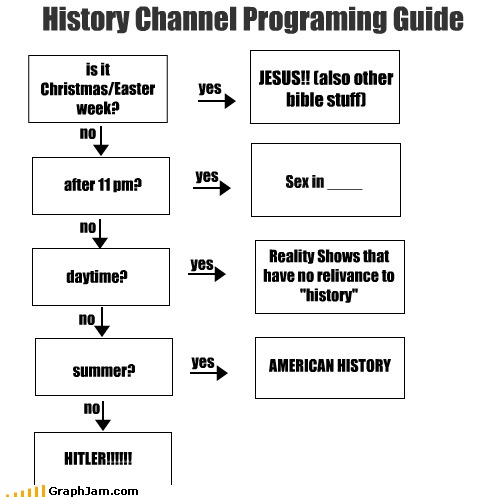
I’ve been known to rag on PBS programming at times for being boring or uncompelling, but some of the cable channels out there are guilty of something worse: manipulating the public and programming against the very name of their channel.

Thanks to our friends at GraphJam (from the folks that brought you I Can Has Cheezburger) they’ve broken down one cable channel’s programming strategy into an easy-to-follow flowchart.  (Click the chart for the original post over at GraphJam.)

Headed to CPB. Headed for community?

I’m headed to the CPB today for an all-day meeting tomorrow (Thu, Apr 15) at the mother ship, hosted and arranged by Rob Bole (aka @rbole).

Up for discussion amongst a small group of public media tech types? Collaboration and community, or at least that’s what I’m expecting.

Many of you can probably list conference after conference and presentation after presentation, especially in the digital media space, where we all swear to stay in touch and share project ideas and methods, but it just never seems to happen. And I’m as guilty as the rest!

Lots of smaller projects have popped up over the years, including the #pubmedia chats happening each Monday evening with the help of some public media Twitter luminaries. 😉

What each of the projects have lacked is either staying power or depth of collaboration, mostly driven by a lack of time to pursue collaborative work instead of individual (station-focused) digital production.

With the help of Allen Gunn, I’m betting on a great meeting and some sustainable work to benefit our communities and colleagues across the public radio, TV and web universe. Hopefully there will be more to report by the weekend.

A PBS revolution in the making?

A new blog and Twitter feed has appeared. And no, I’m not writing it.

Called Revolution PBS and @RevolutionPBS on Twitter, the writing so far calls for a radical reorganization of the broadcast assets of PBS at both the network and station levels, building a national program feed and elimination of much, if not all, of the local station effort to duplicate what could be a nationally-replicated service.

So far, the ideas are interesting, albeit threatening to the old model (deliberately, of course). The writer talks about the millions of dollars he or she suggests could be saved via this centralization effort.

What’s interesting to me is the writer shows a better understanding of the member station model than most “civilians” I’ve met over the years. Perhaps its someone that’s done their homework, or perhaps it’s an “insider” looking to anonymously get some ideas a little traction.

I’d love to know who’s writing it, but so far, no admissions of “guilt.” 😉

My recommendation to PBS and pubmedia thinkers: Engage.

Don’t brush off these ideas or the writer(s) as kooks or fringe elements. Take the ideas at face value (at least for now) and engage in exploratory discussions around some of the suggestions. Be open to thinking differently but also press factual points home so our new discussion partners are forced to wrestle with some of the messy realities we see in the “system” today.

I’m of the mind that the funding and operation models we’re pursuing — or we’ve fallen into — are untenable long-term, especially in the mid-market and small-market stations (the majority, by number). Change of some kind is inevitable, so openly bouncing some of these ideas around could help us find a better future.

For now, here’s the comment I offered to their first major post, Efficiency Idea 1:

What you may not know is that PBS has provided a fully-integrated program stream to stations via satellite for some time. Using that feed (called Schedule X, last I checked), a local station can do a direct pass-through of that signal right onto the local transmitter. However, for regulatory reasons, stations must insert local branding and broadcast details in their signals, and many want to sell local adverti… err… underwriting which must also be inserted into the program stream.

Similarly, PBS also supplies satellite TV providers with a non-local “station” for those areas of the country covered by satellite but *not* covered by a local broadcast signal. People in those areas can opt for the national feed or the nearest local feed.

I worked at a station that, for cost reasons, opted for the pre-programmed feed from PBS. We had tremendous fears that fundraising would suffer dramatically, as we essentially gave up a great deal of local control over our schedule and what programs were included in our stream. However, we found donations were stable for 2+ years under this model. We still had to do local “traffic” to localize the signal and insert some locally-produced shows, and our systems weren’t nearly as automated as they needed to be, but it worked.

The current local station model — as opposed to something more like C-SPAN — is a holdover from a past era, in which local stations actually produced a lot more local content using local talent and resources. As the cost of running these nonprofits has risen over the years (technology costs, aging workforce, healthcare costs, etc.) and as government support has fallen (especially at the state level), local capacity has dried up. Many stations (there are more than 300 nationwide) raise enough money to maintain a barely-local presence in the hopes that someone will save the day at some point in the future.

So far, no knight in shining armor on the horizon, but there are plenty of new threats to public television, the biggest being the disruptive effects of the Internet upon distribution and consumption patterns and ratios.

There are many of us in the public media world that look at this situation and believe there must be a better / smarter way, and the notion of centralized national programming has strong appeal for the efficiency gains alone.

But efficiency can’t be our primary goal. If all we do is make the public TV system more efficient with its cash, we’ll only postpone the truly troublesome problem, which is one of purpose or of mission. Why are we here? What can we do to serve our communities? Is broadcasting enough? If it’s not enough, what should we be retooling to do to make a 21st century difference?

If the call for efficiency in the old distribution model is combined with a call for new services tuned to the needs of our communities today, I’d say you’ve got a revolution worth joining.