How people behave as their ivory tower collapses

I have no vested interest the “old order” of journalism, be it at newspapers, in public radio or elsewhere. I don’t have a journalism degree (though I do have the kissing cousin degree: English). I’ve collected a paycheck from the media world for less than 4 years now, having spent many years before that in a variety of businesses.

But I would hope that even if I had studied journalism in college, spent a 20+ year career in the field, won awards and so on that I would show a hell of a lot more professionalism and simple human decency than the ugly curs trolling one newspaper intern’s blog this week.

Admittedly, it’s a volatile situation as people are losing their jobs at the Tampa Tribune and the newspaper company is confronting the facts: if they change nothing they’re definitely dead, and even if they change everything they might still be dead. That’s a tough situation for everyone.

It’s terrible to be laid off (it’s happened to me). Layoffs cast all reason out the window in favor of pain and fear. But come on. That doesn’t give you either the right or the moral authority to attack an intern as your personal scapegoat for everything that’s “wrong” with the media industry (in your eyes).

It’s been nearly 24 hours now since I read the post — a fascinating insider look that most journalists wouldn’t share with the public (oh, the delicious irony!) — and I’m still floored by the nasty and even threatening comments made in response to the post.

If your ivory tower is collapsing, shouldn’t you be looking for a safe way out or a safe place to land?

Can you imagine doing this in your public broadcasting company?

Michael Rosenblum — a perennial favorite writer of mine — has a series of posts this week about how the Travel Channel (a division of Discovery, the company vacuuming up viewers out of the PBS audience) is training all of their employees how to plan, shoot, edit and finish good video using the small cameras and laptop editing systems that are the hallmark of the Travel Channel Academy.

The best post is A Commitment to Literacy.

Imagine a world in which everyone in your public media company — your radio folks, your TV folks, your web folks, sales people, engineers, everyone — learned the pieces and parts of your craft, your public service. Everyone would have a basic, functional literacy about audio, video, text, photos, social media and so on. Wouldn’t that make your company smarter, faster, more dynamic, more engaged, more productive? Everyone would have a stake, an experience, that directly relates to the core mission and functions of your public service business.

I work in a public radio and public TV company in which several employees don’t even have televisions at home. Those that do have TVs mostly don’t watch them or spend very little time watching our own channel. I almost never watch our station — it doesn’t speak to me much. [To tell the truth, I haven’t turned on the TV to watch anything since Memorial Day. But I have watched a couple TV shows on Hulu.]

So what could make our media outlets more engaging — even for our own teammates? Contextual relevancy — meaning. It needs to be a meaningful thing to them. They need to feel involved. Same for the people formerly known as the audience.

The future of media companies will be focused not on distribution technologies (which will fade into the infrastructure background), but on meaningful media production and the social transactions that go along with it — the conversations, the sharing, the community, the Context. Imagine a company where everyone is immersed in media and community relationships.

I want my receptionist to know how to shoot and edit video. I want the membership people to be able to record and edit audio. I want to have a staff populated with smart people that can write, take a good photo, and sling digital media around without throwing up their hands in frustration.

Sure, there are day-to-day tasks that need to just get done, and they don’t involve video cameras or microphones or web sites and they aren’t always “fun.” (Believe me, I know — I have to go setup a bunch of stuff for a pledge drive starting right after this.) But if every job and every task were infused with the knowledge of why and how we do what we do, wouldn’t that make working in public media all the more meaningful for everyone involved? And wouldn’t that make for a better public service?

Mundt cuts the cord, lives to tell about it

Bravo to Todd Mundt on both “cutting the cord” from his cable company and writing in-depth about the process and experience of consuming media — up to and including HD video — without cable (or satellite) TV service.

The mix of technologies required today are a bit daunting to anyone that wants just a plain old “boob tube” experience, but for any moderately inclined hobbyist, this is pretty accessible.

Furthermore — and this is the kicker — there’s more content out there on the ‘Net than on PBS, as lots of sources distribute directly and PBS (for various reasons, many of them good) chooses not to carry the stuff.

Read all about it here.

(For the record, Todd reports that he still uses the cable company for Internet access, just not for TV. My own experience is that my local cableco won’t sell me high speed service without a TV bundle, so I can’t fully follow his example. However, I have stopped watching BSG on TV and instead watch exclusively via hulu and DVD).

Oh, and be sure to follow Todd on Twitter, if you aren’t already.

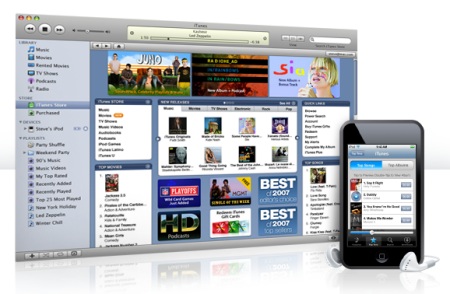
iTunes Store: Introduction to dominance in 5 years flat

Apple’s online media store turns 5 years old this week.

At launch in 2003 the store had around 200,000 music tracks and a handful of early-adopting customers. Today there are something like 10,000,000 songs, but there are also audio books, iPod games, video and audio podcasts, TV shows and feature-length movies.

I remember the early years, when Steve Jobs would talk up sales figures and the size of the library and would point out where Store sales were in relation to other music resellers, physical or digital. Wal-Mart was always at the top of the heap, followed closely by Target and Best Buy. In each annual update, iTunes would step up the chart, knocking off one competitor after another.

But in all those years, I never thought iTunes would become the #1 music reseller in the U.S. That came to pass earlier this month, based on studies published by industry monitors.

How many other companies have entered a long-established (perhaps stagnant) market and rocketed to #1 in just 5 years, shoving aside formidable competitors along the way? Moreover, who’s done that while simultaneously shifting the shopping, distribution and delivery system from physical to virtual?

Simply amazing.

New competition may be afoot, of course. Amazon recently (late 2006) added their MP3 store, which is pretty good (I’ve bought media through both outlets), and they’re growing quickly. But they aren’t yet threatening iTunes. Maybe someday, but not yet.

For public media, the message is this: people will go online for things they used to get other ways, if the overall value proposition is good enough. And they’ll pay gladly for the service.

Oh, and by the way… make sure all your podcasts are listed in the iTunes Store (it’s free). With some 50,000,000 customers, listing there is simply required.

What Kodak could teach public media

Below is a great little video I’d never seen before today. Had to share it. It concerns Kodak and while it starts out slow for the first minute, it rapidly picks up speed:

Kodak has for many years been the butt of innovation jokes, but it would appear they’ve survived, albeit changed in many ways. They found their way back to their mission: helping folks capture, store and share important images from life. Prior to the turnaround, they thought they were in the film business.

When I finished chuckling I wondered… What would a video similar to this one look like or sound like if it were being done for the public media industry, say 5 years from now?

Many seem to think we’re public broadcasters (I’ve been lectured on this more than once). Really? We only exist to fill FM frequencies or put pictures into living room boxes? That’s it? God, I hope not. I’d much rather be in the business of going out into the community, capturing stories and information, and sharing all that with the community in a thoughtful and community-developing way. I couldn’t give a rip about FM or TV technologies. Or the web for that matter. Those are all just tools.

In any case, thanks to Howard Weaver for blogging the video, but also blogging some great comments collected at a conference panel with Kodak, P&G and Owens-Corning executives. Weaver’s quick write-up is well worth a visit, especially for the killer quotes provided by the execs.

It's high time for real-time community engagement

Geeks out there probably know Leo Laporte, the long-time commercial radio and TV host, made especially well-known via the now-defunct TechTV cable channel. He continues to develop media, having built the TWiT podcast “network” over the past couple of years, including the flagship This Week in Tech podcast, drawing some 200,000 listeners a week.

In a blog post this weekend, Laporte describes several changes he’s bringing to the core show, centered on live video streaming. I’m recommending the post because he describes both some Media 1.0 troubles he’s had lately and then describes the changes he’s about to make in his Media 2.0 company.

Why should public media folks care?

Because Laporte is doing what many of us in public media are not, and his strategy is especially well-suited to the Media 2.0 economy:

  • he’s engaging with his community in a two-way and multi-way fashion that’s meaningful, open and authentic
  • he’s increasing his real-time contact hours across multiple digital platforms (he doesn’t limit himself to one platform)
  • he’s doing it all himself, on the cheap — there’s no network or corporation pushing him forward or holding him back

Laporte’s example is inspiring. Imagine what a public service media company with a true local engagement mission could do, using similar methods and the same low-cost, low-risk, rapidly-developing technologies. Engaging your community, communicating with your “true fans” is not a matter of holding public meetings or taking pledge calls. I’m hoping to steal some of this TWiT model for use in my shop (assuming we can get past our difficult strategic planning process).

But we’d better move fast.

Because in a world where Content is a commodity with a value approaching zero (or as Robert Paterson described content recently: noise), all we have left is Contact and Context. PBS and NPR can provide content on a national scale and with unrivaled quality. They can even distribute it and gather financial support for it directly. So we, the locals, must do what they cannot: provide authentic contact and develop a contextual service in tune with our local communities.

Take a look again at Laporte’s example. He’s building out in service of his “tribe,” his community. He’s co-creating value with volunteers in his “TWiT army.” He’s using two-way platforms authentically. He’s got real-time contact with his audience. He’s doing it without transmitters or other oppressively heavy engineering costs. We should be so lucky.

We can be so lucky.

Why innovation must be part of public media's DNA

If it seems like the world moves faster, technologically, with each passing year, you’re not imagining things.

Consider this chart:

Starting from its introduction, the simple telephone took 71 years to arrive in just 50% of American homes. Think about that. An entire generation was born, lived and died waiting for a telephone to arrive in their home, and only half of them got it!

Even electricity took 52 years to reach 50% of homes. Cell phones — that ubiquitous device most of us take for granted — took 14 years, but the MP3 player took less than half that time.

Basic Internet access — the new omnimedia connection — took 10 years to reach 50%, and in the early days it wasn’t even that much to talk about. Today, high-speed Internet access is in well over 50% of homes in the U.S. and average speeds are rising (though not fast enough for me).

There are two lessons here I can see:

  1. We cannot be transmitter companies (and indeed, we never were — we just thought we were because it was easier that way). Technology is a tool, not a purpose.
  2. The public naturally innovates as better tools arrive for information gathering, sharing and entertainment. We must innovate with them to serve them; innovation must be built into our DNA.

What other lessons can you see in this chart?

A good hockey player plays where the puck is. A great hockey player plays where the puck is going to be. –Wayne Gretzky

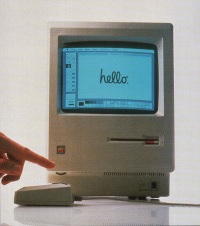
Apple II vs. Macintosh — Can public media follow this example?

Do you remember the Apple II series of personal computers? I certainly do. I got my first one in January 1983 (the Apple IIe) and it was a revelation. Back then the Apple II dominated the personal computer space (IBM was just introducing the first IBM PC). It was a serious cash cow for the new wonders of Silicon Valley: Steve Jobs and Steve Wozniak.

But even in 1983, in the peak of this tremendous success, Apple was reinventing the personal computer. They were secretly inventing the Macintosh, which was introduced a year after I got that Apple IIe in January 1984 (with the famous Superbowl ad).

Developing the Mac was a massively expensive proposition. New chips, new software, new case designs, a mouse, even a brand new 3.5″ floppy drive developed by Sony but still considered cutting-edge and risky. Everything called for clean slate development in order to get it all just right.

So what funded this engineering miracle? The successful and highly profitable Apple II series. And guess what — the Mac wasn’t profitable at launch. That first year was deadly. Apple introduced a $2,500 computer ($5,100 in 2007 dollars) that had two software programs: MacPaint and MacWrite, and it wasn’t compatible with the growing library of Apple II software titles.

Check out this brief video (43 seconds) of Guy Kawasaki recounting how the Mac team was funded by the Apple II team, and the considerable tension this created:

I often think of the Apple II / Macintosh example when conversations in public media circles turn to the question of how will we pay for this new media stuff that doesn’t make any money and takes money out of the profitable broadcasting business. Newspapers and the music industry are also great analogies for public broadcasting.

It takes real leadership, real courage to deliberately take cash from a profitable and successful unit and sink it into the next big thing, even if it takes years for it to pay off. Plus, you have to deal with the political pressures to stop funding this financial black hole from the “reasonable” business people all around you (on the board, on the management team, in the community, on the staff). As I look at my own public media business today, we’ve not even begun to seriously tackle the challenges of the new media world — chiefly because “Apple II” folks are in charge. I often wonder whether we should give up trying to reform the core of the company (a la Ideastream) and simply fund an external unit that can focus on the new media challenge without interference from the traditional “cash cow” part of our business.

The one example of “put it outside the core” I know of in the public media world can be found at Chicago Public Radio. Their Vocalo project (as described by Robert Paterson), is an external unit in every sense of the word. They have separate facilities, a new name unaffiliated with the old name, a separate budget, different leadership, different content and business models, etc. It’s a fascinating approach, and it mimics the Apple experience.

But I’m wondering… is anyone else in public media doing this? Who else, if anyone, is creating distinct subsidiaries for innovation? Is anyone else willing to spend their Apple II money on their Macintosh project?

When a public radio lover turns hater

While searching for more NPR / Ken Stern articles today, I stumbled across a blog post that refers to the news, but spends much more time listing the crimes and misdemeanors of the current public radio landscape, especially as emanating from NPR and other national outlets (APM, PRI, etc.).

Written by Dave Slusher, Public Radio Fails Me explores at length the ways in which Slusher was first captured by public broadcasting and especially public radio many years ago. But it goes on to lambaste public radio for what he feels its become — populist when it comes to cash, elitist when it comes to control, and tired when it comes to programming.

Written by any person on the street, it’s a damning indictment of some of public radio’s (perceived) trends over the past 10 years or so. But this was not written by any random man on the street — it’s written by a man with experience inside the system as a producer as well as consumer.

While I’m not entirely in agreement with Slusher, I do think there are some truths in there with which public radio (and all of public media) must seriously grapple. Slusher’s comments on the changes in the flagship NPR newsmagazines in particular I find fairly accurate. Of course, those changes may account for the doubling in NPR’s weekly audience over the past 10 years. But it’s definitely changed, and for those with an interest in deeper news coverage, it’s not all positive changes.

In any case, it’s a long post but worth a read and a comment at his site, whatever your opinions.

The Paterson innovation series

Robert Paterson has begun a multi-part series on innovation in the public media space around the country. For anyone laboring on new media projects or working to promote new media (especially connective community media), this is a must-read series.

The posts so far…

I’m expecting more posts soon, probably on KETC‘s work in St. Louis (building community around shared media and history), WOSU‘s work in Columbus (bringing the online community into station engagement), and Ideastream in Cleveland (blending a dual licensee with fellow nonprofits and the community).