
Can you imagine doing this in your public broadcasting company?

Michael Rosenblum — a perennial favorite writer of mine — has a series of posts this week about how the Travel Channel (a division of Discovery, the company vacuuming up viewers out of the PBS audience) is training all of their employees how to plan, shoot, edit and finish good video using the small cameras and laptop editing systems that are the hallmark of the Travel Channel Academy.

The best post is A Commitment to Literacy.

Imagine a world in which everyone in your public media company — your radio folks, your TV folks, your web folks, sales people, engineers, everyone — learned the pieces and parts of your craft, your public service. Everyone would have a basic, functional literacy about audio, video, text, photos, social media and so on. Wouldn’t that make your company smarter, faster, more dynamic, more engaged, more productive? Everyone would have a stake, an experience, that directly relates to the core mission and functions of your public service business.

I work in a public radio and public TV company in which several employees don’t even have televisions at home. Those that do have TVs mostly don’t watch them or spend very little time watching our own channel. I almost never watch our station — it doesn’t speak to me much. [To tell the truth, I haven’t turned on the TV to watch anything since Memorial Day. But I have watched a couple TV shows on Hulu.]

So what could make our media outlets more engaging — even for our own teammates? Contextual relevancy — meaning. It needs to be a meaningful thing to them. They need to feel involved. Same for the people formerly known as the audience.

The future of media companies will be focused not on distribution technologies (which will fade into the infrastructure background), but on meaningful media production and the social transactions that go along with it — the conversations, the sharing, the community, the Context. Imagine a company where everyone is immersed in media and community relationships.

I want my receptionist to know how to shoot and edit video. I want the membership people to be able to record and edit audio. I want to have a staff populated with smart people that can write, take a good photo, and sling digital media around without throwing up their hands in frustration.

Sure, there are day-to-day tasks that need to just get done, and they don’t involve video cameras or microphones or web sites and they aren’t always “fun.” (Believe me, I know — I have to go setup a bunch of stuff for a pledge drive starting right after this.) But if every job and every task were infused with the knowledge of why and how we do what we do, wouldn’t that make working in public media all the more meaningful for everyone involved? And wouldn’t that make for a better public service?

New Video: Social Media in Plain English

I love the Common Craft series. This one seems like the longest of all of them, which is understandable, given the complexity of a huge topic like “social media.” It’s a good intro, as usual.

http://blip.tv/scripts/flash/showplayer.swf?enablejs=true&feedurl=http%3A%2F%2Fthecommoncraftshow%2Eblip%2Etv%2Frss&file=http%3A%2F%2Fblip%2Etv%2Frss%2Fflash%2F951180%3Freferrer%3Dblip%2Etv%26source%3D1&showplayerpath=http%3A%2F%2Fblip%2Etv%2Fscripts%2Fflash%2Fshowplayer%2Eswf

Get more Common Craft videos at their web site. You can even buy them for use at the office.

Mundt cuts the cord, lives to tell about it

Bravo to Todd Mundt on both “cutting the cord” from his cable company and writing in-depth about the process and experience of consuming media — up to and including HD video — without cable (or satellite) TV service.

The mix of technologies required today are a bit daunting to anyone that wants just a plain old “boob tube” experience, but for any moderately inclined hobbyist, this is pretty accessible.

Furthermore — and this is the kicker — there’s more content out there on the ‘Net than on PBS, as lots of sources distribute directly and PBS (for various reasons, many of them good) chooses not to carry the stuff.

Read all about it here.

(For the record, Todd reports that he still uses the cable company for Internet access, just not for TV. My own experience is that my local cableco won’t sell me high speed service without a TV bundle, so I can’t fully follow his example. However, I have stopped watching BSG on TV and instead watch exclusively via hulu and DVD).

Oh, and be sure to follow Todd on Twitter, if you aren’t already.

Video on KPBS' use of Google Maps

Those of us that follow public media already know the story of the San Diego wildfires last fall and how KPBS online staff rose to the occasion with a quick usage of Google Maps and Twitter to keep the public informed. It’s a great story.

Now Google, in a lightly self-promotional way, has posted a video starring the team from KPBS that made it all possible. It’s wonderful to see new media folks in the public media world getting some credit. And now you’ll be able to spot them at the next conference you attend!

For more from the KPBS team — and others that have used social media in disaster situations — be sure to listen to the Disaster Relief and Emergency Preparedness session from IMA 2008:

The wildfires in southern California, the bridge collapse in Minneapolis, the bombing in London. Hear the experiences of our colleagues faced with these crises: what tools they used, how they deployed their staff; what collaborations helped them deliver effective service.

Moderator: Andy Carvin, NPR

Panelists: Leng Caloh, Senior Online Editor, KPBS; Peter Horrocks, Head of the Multi Media Newsroom, BBC; Julia Schrenkler, New Media Interactive Producer, Minnesota Public Radio

[audio:http://wowzaweb.streamguys.com/~ima/2008audio/using-social-media-for-disaster-relief-and-emergency-preparedness.mp3%5D

Download the original MP3 audio file here.

Latest podcasting study is out

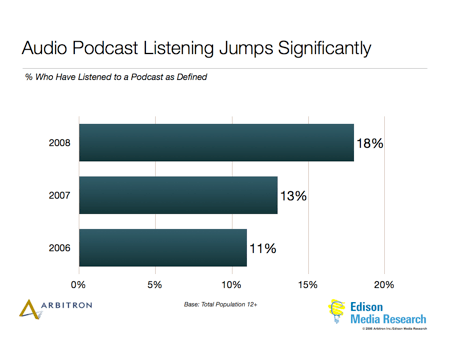
I know, it’s probably already in your RSS reader, right? But if not, be sure to check out the new (2008) podcasting study by Edison Media Research. This year shows a solid bump upward in consumer adoption of podcasting and it’s always great to get new charts for wallpapering the office and showing your pals how quickly these newfangled media things are catching on.

Check out the intro and download the report PDF here.

Broadcasting stocks? Sell, Sell, Sell!

Caddyshack, a favorite movie from my teen and college years (oh, who am I kidding — it still cracks me up!) includes a scene with the late Rodney Dangerfield in which he’s on the phone with his stock broker. Dangerfield plays an obnoxious nouveau riche land developer by the name of Al Czervik.

Excitedly Czervik shouts into the phone: “Buy, buy, buy!” and after a pause to listen, “They’re all buying? Then sell, sell, sell!

That last piece of advice now appears to apply to stocks in the broadcasting sector, according to a report in BusinessWeek, which includes this ominous quote:

Meanwhile, traditional broadcasters will probably remain challenged by secular factors such as audience fragmentation, as advertisers shift more spending to the Internet and other new media platforms, Amobi says. A terrestrial radio recovery could be impeded by a continued supply and demand imbalance, while the satellite radio companies have also seen anemic retail sales, even as they await a likely imminent regulatory decision on their pending merger proposal. However, TV advertising offers a bright spot, in our view, with a relatively strong 2007-08 upfront and scatter market for the networks, and a specter of record political dollars for local stations with the upcoming Presidential elections.

To be fair, this isn’t exactly breaking news. Audience fragmentation has been the hallmark of the 21st century as media outlets and platforms proliferate and the old media companies actually accelerate their decline by reflexively going for ratings with sensationalist and over-commercialized programming.

And on the matter of TV advertising, what happens after the 2008 election cycle? That’s not a pretty picture, even if it does come in HD.

Podcasting in Plain English

I remain amazed at how misunderstood the notion of “podcasting” is. It’s been nearly 4 years since it arrived on the scene yet folks in public media remain baffled — along with the general public.

Perhaps Leo Laporte was right a couple years ago when he suggested that the “pod” in podcasting be eliminated and replaced with “net” to make “netcasting” the word. Of course, that might have confused things with various forms of streaming.

In any case, here’s yet another Common Craft video you can share with your public media clients to explain podcasting a bit. You can even contact Common Craft to get the video branded with your own company name.

I would also recommend Apple’s introduction to podcasting, which is iTunes-specific, but iTunes is a really great choice for most listeners due to the integration of their podcasting directory / subscription system.

J-Week 2008: Web Extras Toolkit

Welcome Journalism Week 2008 visitors from Anchorage, Alaska! If you’re looking for the “Web Extras Toolkit” handout from Saturday, April 19, 2008, you’ve come to the right place.

And feel free to recommend your own toolkit additions or corrections via the site comment feature.

Congratulations PRX

The news today that PRX has received a half-million dollar MacArthur grant is fabulous. It’s such a great service in the public media world and it’s gratifying to see good work get rewarded.

They’ve posted all the details here.

Near-future of TV, via Mossberg

Great little summary of the present and near-term tech developments related to TV and video distribution technologies by Wall Street Journal tech columnist Walt Mossberg.

Found via Gerd Leonhard

http://blip.tv/scripts/flash/showplayer.swf?tabType3=none&tabUrl3=undefined&tabTitle3=undefined&tabType2=none&tabUrl2=undefined&tabTitle2=undefined&tabType1=none&tabUrl1=undefined&tabTitle1=undefined&enablejs=true&feedurl=http%3A%2F%2Fbeettv%2Eblip%2Etv%2Frss%2Fflash&file=http%3A%2F%2Fblip%2Etv%2Frss%2Fflash%2F801182&thumb=http%3A%2F%2Fpanther2%2Evideo%2Eblip%2Etv%2FPlesstv%2DFTCShouldStopVerizonFromCallingDSLBroadbandWaltMossberg532%2Epng&brandlink=http%3A%2F%2Fwww%2Ebeet%2Etv%2F&brandname=Beet%2ETV&showguidebutton=false&showplayerpath=http%3A%2F%2Fblip%2Etv%2Fscripts%2Fflash%2Fshowplayer%2Eswf