Favorite BPP reaction comments (so far)

When the announcement went out about the cancellation of the Bryant Park Project, the comments on the NPR site numbered in the hundreds. The counts I saw stopped around 600, yet there may be more (who wants to count?).

Now the comments are piling up in reaction to interim CEO Dennis Haarsager’s posting about the cancellation. I already gave my comments. What I find remarkable is that so many in the audience “get it.” Making NPR’s decision here all the more puzzling / frustrating.

Here’s a selection of comments and comment excerpts that I found compelling and instructive (they’re numbered here for reference, but are not numbered at the NPR site):

Continue reading “Favorite BPP reaction comments (so far)”

Haarsager on BPP, plus reactions

Well, I guess the NPR shoe I’d been warned about has dropped, with respect to the cancellation of BPP.

It was not a satisfying thud.

The comments on the BPP blog site, reacting to the memo, have begun rolling in. They are not, one would expect, positive. There’s some respectful language in there, but the overall feeling is that this formal response missed the point(s).

My own comment, submitted to NPR (and it may be up by the time you read this):

For all those saying NPR should have raised money directly for BPP, there’s a political mess you’re not aware of here.

If NPR openly attempted to raise money for any program, with large or small station carriage, the nationwide collection of stations would revolt. And please note the Board of NPR is majority-controlled by stations.

In short, it would never be attempted and would certainly be killed if it were.

There are indeed structural and cultural problems within NPR that make a project like BPP fail and put all forms of new media engagements at risk. But never forget that many of NPR’s most anti-new media anti-innovation qualities are inherited from the codependent relationship with the stations. In a sense, it’s no one’s fault, yet it’s everyone’s fault. And that’s the center of the problem.

The entire system is trapped by its own success in the radio medium — not the web. Asking it to change in fundamental ways (e.g. embracing direct funding, using the web innovatively and as a medium of first resort, building real community) is asking for a revolution in which heads would most certainly roll.

But public radio has not historically been a head-rolling collection of institutions.

If you want to change public media for the better, focus on your local station — volunteer, get on the Board, ask tough questions, demand new services, and prove to your station there’s money to be saved and made in engaging the community in new ways, especially online. And tell your station to let NPR grow and mature — even if that means audiences want direct relationships with the network rather than the station.  Local stations need a reason to exist beyond rebroadcasting NPR anyway.  It’s time they learned how to be local (again).

Or, failing all that, strike out on your own and create a new media entity with the soul of a public radio station but the structural DNA of a Google.

There’s a future for public media, to be sure. But only time will tell whether NPR will participate in it fully and faithfully.

Naturally, I have more thoughts, but didn’t want to post them at NPR’s site.

Overall review of the memo? Disappointing.

Haarsager’s memo language does not, as so many commenters already noted, ring true. There’s something wrong here; something out of place.

Canceling BPP doesn’t bother me per se (this kind of thing happens from time to time for many reasons, and BPP was cursed with bad luck from the start). But NPR’s handling of the cancellation has the feeling of political talking points about it, and that won’t fly in a new media era.  Words like “misdirection,” “willful ignorance” and “politically convenient” come to mind very easily here, and they shouldn’t. That’s not what I want to think about NPR.

But if you think my take on the situation is harsh, head over to the Huffington Post where Daniel Halloway has his way with the story.

For me, the upshot is that NPR is fundamentally flawed due to the nature of the relationships between stations and network. There’s no long-term-successful way forward unless that flaw is corrected, either by renegotiation of the relationship or by breaking free of the relationships entirely.

While it’s not an exact analog for where newspapers were 10 years ago, it’s close enough: a medium…

  • trapped by its own success
  • unable to innovate into a new model, even in small ways
  • finally dismantled by market forces beyond its control

I really hate this. This isn’t what I want for NPR specifically or public media broadly. Will someone please tell me I’m wrong? I don’t want to lose NPR!
More BPP and innovation thinking

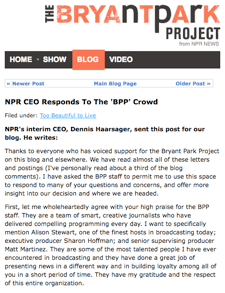
Earlier this week I was advised privately to wait for an announcement from NPR about BPP — without any hint of what said announcement might be — and I’m still waiting. I’d love to hear NPR announce a bold new plan to take the BPP straight to the web and change it up somehow. If anyone would care to shed additional light, I’m all ears (as are about 600 commenters on the NPR site).

In the meantime, there’s been some great pieces out there I’d like to point folks to (yeah, I know — you already saw these, but just in case…).

First up are two posts from Robert Paterson, a past NPR consultant and an avid BPP audience participant:

I’m not a fan of Paterson’s claim that the U.S. is heading into a full-blown depression (because that scares the bejesus out of me and I don’t know what to do about it), but the rest of it rings true, even if the economy were booming.

Next up is a post from Jeff Jarvis, one of my perennial faves:

(I love the title — talk about not burying the lede!)

The Jarvis piece is good, but the comments are even better.  When I visited, the first half of the comments were really insightful. And don’t miss Mindy McAdamscomment in there, too.

What worries me more and more is that Stephen Hill — that too-smart-for-his-own-good bastard! (and I say that with love) — is going to be proven right if we public media people don’t stop behaving like nitwits and face up to the Innovator’s Dilemma.

I’m not sure whether I have the energy to start my own public media company. Do I really have to? 😉

Web economics vs. Pubradio economics

The Bryant Park Project collapse at NPR sure has had the public media world a-twitter over the last 24 hours. I got one tip to wait for an announcement or something like that from NPR about the future of BPP. Okay. I’m waiting.

In the mean time, I just wanted to point to a simple example of how web economics differ so dramatically from traditional radio production and distribution economics. Because my central take is that the BPP could live on in a new web-focused model, one that it’s already primed to utilize. But to survive it would still need some NPR largesse — though less than it’s gotten to date.

The example I offer here is not a direct analog to the BPP situation, but it’s generally illustrative and great for fueling thought about how new media are different from old media. So here’s the post, by former Apple Computer evangelist Guy Kawasaki:

By the Numbers: How I built a Web 2.0, User-Generated Content, Citizen Journalism, Long-Tail, Social Media Site for $12,107.09

Now the $12k figure is a bit hopeful, as the founder himself was not paid for his time. That and other elements make the $12k more fanciful than real, but the point is still valid: it’s not that expensive to start and run a web-based company.

By contrast, NPR reportedly spent about $2 million on the BPP in the last year or so. For public media companies that’s a lot of money. An award-winning 1-hour-per-week radio program in my own shop in Anchorage costs around $350,000 per year to maintain (and we can’t even afford that). $2 million to NPR isn’t that much, but in real terms, it’s a lot.

In a lot of ways, it may have been better had BPP been given only $500,000 to get started.

As pointed out by Ken George in quotes he collected at WBUR’s The ConverStation, the BPP was probably destined to failure if the point was to make a radio-web hybrid. They should have made a web-radio hybrid instead, using web economics as the baseline organizing idea. Web economics scale from small to large. Radio economics, practiced by NPR and others, scale from medium to large only, and often only from large to huge.

Rob Paterson’s got the right ideas. They sound really revolutionary, and I like to think there’s a middle path of some kind where the old ideas and the new ones “can just get along.” But history will likely prove him right and anyone pushing a compromise wrong.

On the death of BPP

Well, the Bryant Park Project has less than a month left. Literally.

Was it too beautiful to live, perhaps? Hardly. I mean, can anyone really feign shock that well?

Let’s recount the strikes against this endeavor:

  • The economic downturn is hitting NPR like everyone else; news budgets are frozen and that’s just the beginning. Like any business looking to cut costs, whoever was hired last will be fired first, whether that’s a show or a person. That’s just the way it goes.
  • One of the original hosts (Burbank) — and let’s be honest, the host with real NPR cred — walked away just as the show was getting started. Talk about throwing off the rhythm.
  • The second host (Stewart) took off for maternity leave six months into the show. That can’t help.
  • Then the news anchor (Martin) left for a cush job at ABC News. (What is it with NPR people leaving a real news operation to go work for a fake news operation? Is it just the money?)
  • Plus the fill-in host (Pesca) has been splitting his time between BPP and NPR HQ the whole time.

I’m sure Matt Martinez was busting his ass every day trying to keep things rolling forward, but with a set of facts like these, what can you really do?

Add it up and can you imagine a show — any show in any format — making it to its first birthday without a hell of a lot of buy-in (political and cash) from the top?

But wait — there’s more!

  • This was fundamentally a Gen X show inside a Boomer network. What Boomer on the Board of NPR is going to protect a show they don’t air on their station, they don’t listen to and/or they don’t like?
  • This show never made it to the bulk of the listeners out there. The only people that knew about it were NPR junkies that took the time to browse the NPR web site, trolling for goodies. More might have liked it but never knew it existed.
  • In a risky economic environment, what local station program director is going to broadcast BPP instead of Morning Edition? Show of hands, please… yeah, that’s what I thought.
  • Assuming you’re a station with an HD Radio transmitter and you could program BPP onto a secondary channel, great! But who will hear it? Right: no one, because no one has an HD Radio. (BPP could be an Internet success because iPods and computers far outnumber HD Radios.)
  • Though BPP was successful on the web (something like 1,000,000 monthly uniques), we must remember that NPR is not a media company, it is a radio company. Arbitron numbers will always be bigger than Google Analytics numbers to a radio company. NPR may be trying to change to meet the challenges/opportunites of the web (and are making huge strides for a company that size), but it’s still a radio entity, so building a show specifically for the web is not a strategic option for them. At least not today.
  • Compared to an out-of-the-garage web startup, the cost of producing BPP was astronomical. Sure, web startups in Silicon Valley can devour $2 million at a power lunch, but for NPR and public radio that’s a huge sum, especially given all the other factors noted above. Web startups don’t need that much money, but to do BPP “the NPR way” requires big salaries and budgets. It was a radio economic solution applied to what was essentially a web economic problem — that makes it unsustainable on its face.

All in all, it’s a sad day for NPR. Not so much because it lost a program that was, in truth, faltering from the start, but because the Board appears to have missed a key opportunity here.

NPR could have taken a revised BPP straight to the web and made it the flagship show of a new web-scale innovation unit. BPP could have led NPR into a future not bound by the FCC, Arbitron, legacy stations, transmitters and more. For about $1 million a year they could have jump-started the next stage of their evolution.

I’m beginning to think Gen X and Gen Y need to band together and start their own national public media service — without the parochial split between radio and TV and web. Because PBS kills quality Gen X projects, too. Oh, and Fair Game was axed by PRI recently.

By the way, read the comments on the brief BPP blog post about the cancellation. There’s an audience there, to be sure. And it’s one that could easily sustain a web-based (and web-scaled) program and service. If I had $1 million to invest, I’d definitely put it into this audience.

On advertising market shifts

Recently, Robert Paterson pointed out a Diane Mermigas piece talking about shifts in the advertising market, especially in relationship to network TV sales. According to the Mermigas analysis, network TV stands to lose up to $1.5 billion during this season of “up fronts” alone. That’s a lot of dough for any industry to lose nearly overnight, even if it is spread across several mega-media corporations.

I commented on Paterson’s site, but realized I liked my response so much I wanted to elevate it to my own blog in the process. Here’s Paterson’s question and my own response:

Is this the problem stated in Money terms?
Here is Diane Mermigas talking about the commercial networks — is this the same for NPR and PBS?

I would say Public Media are not impacted as directly by advertising losses like this, nor do the losses/impacts happen in phase with commercial media.

But the losses are there or soon will be (depending on the size and sophistication of your advertising clients).

But what’s worse — much worse — is that revenue from advertising (sponsorship!) is not managed as professionally in public media as it is in commercial media. This means that trends in ad spending are not understood as well in public media as they are elsewhere. So as changes ripple through the ad space, public media won’t figure it out for several cycles. Blunted reaction times will lead to lost opportunity and lost money.

Commercial outlets have a firm, financial bottom line and they calculate where that line lies every day, every week, every month, every quarter. Public media is not so fastidious. Our bottom line is the soft concept of “public service” (imagined in many different ways) and revenue is only a means to that end. We don’t have hard measures of public service, we don’t analyze so deeply or accurately, as a group (I’m sure there are some exceptions, of course).

Indeed, as nonprofits, we tend to downplay “overhead” costs like sales analysts or “management” functions that could lead us to higher revenues and better customer relationships in the underwriting space. We don’t really operate like a business where it matters most — where money intersects with mission.

On top of all that, then there’s the problem of TV. All TV outlets have fewer and fewer viewers as the mass media model breaks down in a flurry of new outlets and platforms. And then there’s the demographics of PBS generally, which are less-than-desirable for many marketers.

In short, the money is moving where it can get greater impact, and public media outlets are pooly prepared to sense the change or alter course to meet the advertisers at their new destinations.

The solution? Get engaged locally in a way that’s unassailable by national trends. Build deep relationships that, yes, can be “monetized” in both corporate and individual realms. Develop relationships with sponsors that have historically not played in local media. Plus, get your butt online in a real way, not with business card web sites. Oh, and be sure to have some hard-nosed analysts on board that keep the business honest on the numbers — avoid the doe-eyed optimism that sometimes overtakes “soft” nonprofits like ours.

News: Our most important edge

There’s been a lot of chatter this week about NPR’s coverage of the earthquakes and their aftermath in the Sichuan province of China, and for good reason. Reporting, especially by Melissa Block from Chengdu, has been remarkable: it’s immediate, detailed, dispassionate, and yet so completely human and humane. Lots of folks in public media have noted how proud they were to be professionally associated with just this kind of public service, and I felt the same way.

Indeed, I felt about NPR’s coverage exactly the opposite of what I feel every time I see or hear commercial media reporting on, well… anything. I’ve cited before my disgust for all things TV news and especially cable news. The disasters that are CNN, MSNBC, Fox, CBS, ABC, NBC and so on would be laughable if they weren’t so fundamentally damaging to our democracy. They’re a cancer, not a public service, as they make our nation dumber with each minute of air time. They’re part of what I call the “bread-and-circuses” media. (And I’m not saying this for dramatic effect — I’m literally angered and saddened with each appearance of Wolf Blitzer and the army of morons that make up commercial TV news.)

Which leads me to a positive point, rather than just a rant.

Continue reading “News: Our most important edge”

NPR's Thomas goes to Etsy; Surprise — it's not a conspiracy

Recently I’ve told people I know, especially folks I meet via Twitter, that this here blog is really kind of an “inside baseball” thing for public media purveyors or supporters. It’s not a general interest kind of thing. Well, for this post, I’m going to kick up the inside baseball factor a notch…

In the wake of the Ken Stern departure from NPR, the rumblings in D.C. were audible all the way out here in Anchorage (it helps if you have a former NPR staffer working in the next office). Stations across the country were in a tizzy for a few days trying to read the tea leaves — what did it all mean?

Then a few weeks later we heard about the departure of Maria Thomas, NPR’s digital media guru. As one of the chief architects of NPR’s many digital initiatives, her exit fueled speculation that the elimination of Stern was a rebuke of online activities at the company and Thomas left because her days were numbered.

At least that’s the speculation I heard. But I didn’t believe it.

Thomas came to NPR with solid online / e-commerce experience. She did great work at NPR. But I suspected she basically had achieved all she could in a company that, for all its good intentions, cannot move too terribly quickly, given the distributed nature of its goals and relationships. Plus, her work would have gotten her continued attention in web circles. She was likely hit with a job offers repeatedly. 

Today venture capitalist (and uber-blogger) Fred Wilson announced Thomas’ installation as COO of the unique online retailer Etsy.com. While we knew the Etsy part of the story weeks ago, I think the warm welcome she’s being offered tells the real story — that hiring Thomas was a coup for Union Square Ventures and Etsy, not a housecleaning for NPR.

Be sure to check out the introductory video — great stuff. And note what Thomas says when asked why she likes Etsy: “I love that Etsy means connecting with something authentic.” Spoken like the new media veteran she is.

Of course, I could be wrong. Hit me in the comments if I’m missing anything.

TWiT tackles news, blogs, NPR, podcasting, new media

This Week in Tech (TWiT) is a great little tech-oriented podcast with a broad international following (somwhere north of 200,000 weekly listeners). But on the March 31 show they went off the tech industry track and tackled issues related to news, newspapers, news radio, NPR, podcasts, blogs, Twitter, reporting and more.

Public media folks may be interested to hear how folks that work in media — but outside our industry niche — talk about what we’re doing and the major trends affecting everyone publishing everything.

You can listen to and/or download this week’s episode here.

Update on NPR / Ken Stern

Current published an in-depth article on the NPR / Ken Stern story this week. I’ve updated my list of articles to include it, and it’s a great read on its own. It summarizes a large swath of the Stern history at NPR and points to several core reasons why things just didn’t work out.

I actually came away from this profile liking Ken Stern quite a bit. Did he fit well into the CEO slot? Perhaps not. But he did some great work for NPR. And to everyone’s credit — except a sour-grapes Bob Edwards — the comments from board members and others were incredibly even-handed.