Om Malik posted the following video by Jesse Schell and raved about it over on Giga Om. And rightly so. It’s a 30-minute roller coaster ride of ideas about the “experience economy,” authenticity, gaming psychology, Facebook, and the future of social media and possibly even society.
I still need some time to wrap my head around this. It’s such a new way of thinking for public service media, yet it’s so crucial we start thinking about media as an “experience,” not just something to be passively consumed. If we’re serious about creating positive outcomes for people and communities, immersive and “authentic” experiences will be much better suited to reaching our goals than simply giving people information and suggesting they consider changing their behaviors.
In my particular case, I’m wondering what kind of “gaming” elements can be added for readers of the St. Louis Beacon to keep them more engaged, get them more informed and connect them to each other and positive outcomes for the community. Or how might we offer “points” for participants in upcoming public service media projects we’re going to do at KETC?
In any case, this is a MUST SEE VIDEO. Take the time. It’s well worth it.
One thing I cannot abide is prevarication. It’s why I’ll never be a successful politician (or an unsuccessful one, for that matter).
So it irks me every time a public broadcasting leader gets up in front of a crowd and trots out the old chestnut of how public broadcasting — especially public TV — is so much better than commercial broadcasting because we produce “Masterpiece Theater” and they produce “Dog the Bounty Hunter.” Recently PBS CEO Paula Kerger took to one of these many stages and talked about how PBS kids programming is so much better than the commercial kids garbage out there, especially since PBS doesn’t attach kids merchandising to the broadcasts.
And please, let’s not slice-and-dice this story into “well, it wasn’t PBS that did it, it was WGBH, the producer…” yadda, yadda, yadda. The public does not understand these distinctions and we all know it. The conservative blogger also busts out the old Sesame Workshop example, which has dogged the network for years because no one has had the guts to speak the truth without blushing (which I’ll get to in a minute).
Separately, the issue of PBS buying Nielsen ratings data came up in this Washington Post column (scroll to the bottom), in which Kerger attempts to politically sidestep the fact that the network bought the access to help it sell air time to sponsors. The columnist said Kerger’s explanation of the Nielsen deal “sounded suspiciously like a CBS sales exec at a pitch with potential advertisers.”
Good grief. The problem isn’t that Kerger sounded like a CBS sales exec, it’s that she sounded suspiciously like a CBS sales exec! It’s suspicious because her language was deliberately double-talky. We’ve been taught to be apologetic for operating like businesses, and her roundabout language gives away our cultural discomfort with bottom-line considerations.
I’m tired of the song-and-dance promoted from the tops of our public media ecosystem. Our leaders attack commercial media and praise noncommercial despite the fact that the differences are not so stark; there are good programs in commercial media, and we have some dogs of our own. We rag on “Ice Road Truckers” but secretly sit transfixed for hours during a weekend marathon. We despise the rampant commercialism of kids programming but align ourselves with companies that participate in the same TV-industrial complex.
Let’s get real. Here’s some of what I would like to see in print and hear from our leaders when they talk to the public:
Nonprofits are still businesses. If they’re run without good business practices, they will fail. If a nonprofit corporation fails, the public good they were organized to pursue will be lost. So it’s good to operate like a business. Stop acting like this is a bad thing!
Sesame Workshop makes money from character licensing? Good for them! Money they make in that way offsets the cost to PBS and stations. Without that separate income, that show would cost stations a metric ton more to produce, meaning that show or others would be canceled. Nonprofits are specifically allowed to make unrelated income — they just have to pay taxes on that income. So guess what happens…
kids get “Sesame Street” products they like, attaching them to a program with great educational value
people are employed in making, transporting and selling the products
taxes are collected on the profits, helping pay for government programs (like public broadcasting)
actors, directors, producers, writers and other artists are paid a fair wage
the cost to PBS and stations is reduced for a beloved program
…and this is bad how?
Corporations used to be more openly philanthropic, but now they want something for their money — we can’t change that. So we can either take their money and create “advertising lite” options for them, or leave the money on the table. Maybe it is wrong to take the money and add corporate messages to our content. If you’ve got a better idea, we’re all ears.
Yeah, we don’t like the slide toward advertising either. But watch 1 hour of PBS and 1 hour of Discovery and compare the number, frequency, length and stridency of the commercials you see. There’s a difference and you know it.
Buying Nielsen data is standard practice in the TV world. It helps us get sponsorship dollars. Frankly, you should be shocked it took us this long.
Don’t like our mild commercialism? Push for legislation to fund public media at a level where corporate sponsorship isn’t needed, BBC-style. We don’t like selling ourselves anyway.
We produce “Antiques Roadshow” because it gets ratings (and dollars) not because it’s programming that consistently lives up to our mission.
We broadcast “Lawrence Welk” because old people like it and we want their money when they die.
There’s quite a few programs on commercial media we like and respect — it’s not all garbage. For example, we’re mad we didn’t think of “Mythbusters” first.
Sometimes we will use marketing tactics to make people aware of our programs. Deal.
Would I phrase all the messages exactly this way? No, of course not.
But the messages must be clear: we’re businesses, we do good things for our communities and we use a variety of tactics to achieve our goals, some of which involve trade-offs of mission and sustainability.
And if you can suggest ways in which we never have to make trade-offs, let’s talk.
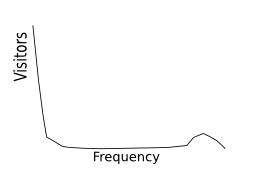
I recently told public broadcasters, er… I mean public service media folks, to ignore the paywall option. Don’t do it. And while I stand by that assertion generally, the invaluable Steve Yelvington has a much more nuanced take in his piece Thinking about a paywall? Read this first.
It involves this little chart, and there are lessons for those that would create both a popular general web destination and an online community, all in one. Highly recommended.
Awesome new entrant in the online advertising biz. And their debut self-promotion piece does more than promote — it actually teaches. Are you paying attention old-school advertisers?
How about you public media? Do you understand how the web isn’t broadcast? There are a few at NPR that get it. What about the local stations?
If you want to get your product noticed going forward, you may just have to do something bold, original and — surprise! — long-form. No 30-second TV ads here.
The gift is predictable. Even mundane. But the delivery of the message is innovative, entertaining and hilarious.
I just met with a true innovator in public media this week, someone that’s a bit of a hero, really, and in this brief conversation I was surprised to hear a comment about the web that was, well… stunning. (And I’m not going to divulge the identity of this person because it’s irrelevant to the story.)
When asked by a colleague of mine whether this public media company was currently selling online advertising via their web presence, the answer was not only “no,” but “no, and we don’t plan to.” This person went on to say that the cost of putting together and managing an online advertising system would outweigh the advertising revenue that could be gained. Their take is that careful cost analysis must be done before they do any new projects and right now the web doesn’t look like a good cost bet.
Fair enough. That’s actually the tack I’ve taken at our shop in Anchorage. Why bother with the rules, the systems, the web redesigns required when the payback would be so small on sites with comparatively low traffic numbers? I’ve avoided it to date.
But the comments didn’t stop there. This person further said they were going to wait until they had created a “scarcity” in the market for web advertising (on their properties) and then set prices for online ads when companies are “begging” to get their ads on the target site(s).
You’re going to create scarcity? On the web? Really?
I almost started to counter this idea right there, but out of respect left it alone.
Later I checked my RSS feed subscriptions and discovered a blog post from Google talking about how many pages there are in their index of the online world. Their numbers:
1998 — 26,000,000 pages (26 million)
2000 — 1,000,000,000 pages (1 billion)
2008 — 1,000,000,000,000 pages (1 trillion)
And presently the index grows by several billion pages each day.
But you’re going to create scarcity. Mmm-hmmm.
Okay, snarkiness aside… you can create scarcities online, I know. And public media entities are in a fairly good position to do that if they can gather their comparatively rarified audiences in the online space in large numbers and on a regular basis.
But there are two problems with this notion:
You’re not the only property online with desirable demographics for advertisers, because your web audience also visits lots of other sites and other sites can offer more targeted demographics.
Public media sites, especially for local stations, are… well… pretty bad as core web destinations. You’ll never be able to profitably sell such small and fairly broad audiences to advertisers in a market where #1 is true.
For the most part our public media (station) web sites are sorry shadows of our on-air presentations (there are, of course, a few exceptions where real investments have been made, mostly in the largest markets). Why?
Our web services are typically afterthoughts.
We do them because we “have to.”
They are not must-see daily destinations.
They are not valuable social networks.
They have a fraction of the news presented by any local newspaper site.
They are often unattractive and hard to navigate or bland, boring and so on.
The site visitor counts are understandably low.
And I level that charge against myownsites as well as the sites of other public media companies. They’re just not worth visiting regularly unless there’s something you heard/saw on air that you needed to hear/see again or you want to make a pledge online.
Further, if you did sell online advertising, how would you do it? You’d use your existing development / sales staff, wouldn’t you? Commissions, salaries, healthcare costs, etc. all loaded up on top of the sales. And then there’s the overhead costs of the rest of the organization as well. No wonder web advertising isn’t worth it — it works on a different scale.
And thus we return to the same point made recently about the Bryant Park Project failure at NPR: you cannot expect broadcast economics success from a web economics property. Web properties work on a different scale than radio or TV. It’s a smaller, lighter scale. It supports fewer overhead costs and requires less staff.
Two solutions:
Create a web property that works on a web scale and draws its own audience and community. Make something that is a must-see daily destination, or create a site that solves people’s problems or provides a core service they need every day.
Create your web property in an economic “bubble” outside the normal expectations of staffing and profitability of broadcasting — at least to start. If you want your web property to help pay your transmitter bills, you’re dreaming now and probably forever.
So I agree — don’t bother selling advertising on bland sites with low traffic. I wouldn’t try to “monetize” most station sites today.
Instead, discover how network economics can work for you and build something compelling outside the expectations of the legacy properties. This might even be — or probably should be — a spin-off property, a la Mark Fuerst‘s recommendation, captured on video here:
Recently, Robert Paterson pointed out a Diane Mermigas piece talking about shifts in the advertising market, especially in relationship to network TV sales. According to the Mermigas analysis, network TV stands to lose up to $1.5 billion during this season of “up fronts” alone. That’s a lot of dough for any industry to lose nearly overnight, even if it is spread across several mega-media corporations.
I commented on Paterson’s site, but realized I liked my response so much I wanted to elevate it to my own blog in the process. Here’s Paterson’s question and my own response:
I would say Public Media are not impacted as directly by advertising losses like this, nor do the losses/impacts happen in phase with commercial media.
But the losses are there or soon will be (depending on the size and sophistication of your advertising clients).
But what’s worse — much worse — is that revenue from advertising (sponsorship!) is not managed as professionally in public media as it is in commercial media. This means that trends in ad spending are not understood as well in public media as they are elsewhere. So as changes ripple through the ad space, public media won’t figure it out for several cycles. Blunted reaction times will lead to lost opportunity and lost money.
Commercial outlets have a firm, financial bottom line and they calculate where that line lies every day, every week, every month, every quarter. Public media is not so fastidious. Our bottom line is the soft concept of “public service” (imagined in many different ways) and revenue is only a means to that end. We don’t have hard measures of public service, we don’t analyze so deeply or accurately, as a group (I’m sure there are some exceptions, of course).
Indeed, as nonprofits, we tend to downplay “overhead” costs like sales analysts or “management” functions that could lead us to higher revenues and better customer relationships in the underwriting space. We don’t really operate like a business where it matters most — where money intersects with mission.
On top of all that, then there’s the problem of TV. All TV outlets have fewer and fewer viewers as the mass media model breaks down in a flurry of new outlets and platforms. And then there’s the demographics of PBS generally, which are less-than-desirable for many marketers.
In short, the money is moving where it can get greater impact, and public media outlets are pooly prepared to sense the change or alter course to meet the advertisers at their new destinations.
The solution? Get engaged locally in a way that’s unassailable by national trends. Build deep relationships that, yes, can be “monetized” in both corporate and individual realms. Develop relationships with sponsors that have historically not played in local media. Plus, get your butt online in a real way, not with business card web sites. Oh, and be sure to have some hard-nosed analysts on board that keep the business honest on the numbers — avoid the doe-eyed optimism that sometimes overtakes “soft” nonprofits like ours.
One of the things that’s interested me since I entered public media in the fall of 2004 was the relationship between public media today and public media as originally intended under the 1967 Public Broadcasting Act. I’ve wondered, are we still the institution we were meant to be? If not, is that good or bad?
Sparking more of this thinking today was a video linked by Gerd Leonhard. It was produced by Denver OpenMedia and explains the TV and mass media landscape of today and looks at how distribution, content and democracy are linked via mass media. It also focuses on Public Access television, a distinctly different style of television from public broadcasting, but one that shares at least some DNA with pubcasting’s origins.
It’s a great 30 minute introduction to understanding media — public or commercial. Highly recommended, mostly because it puts the economic model of historic TV into clear relief.
NOTE: The video is after the “read more” link because it auto-starts and I didn’t want to place it on my home page directly.

 If you want to get your product noticed going forward, you may just have to do something bold, original and — surprise! — long-form. No 30-second TV ads here.
 Gravity Medium