via blog.twitter.com
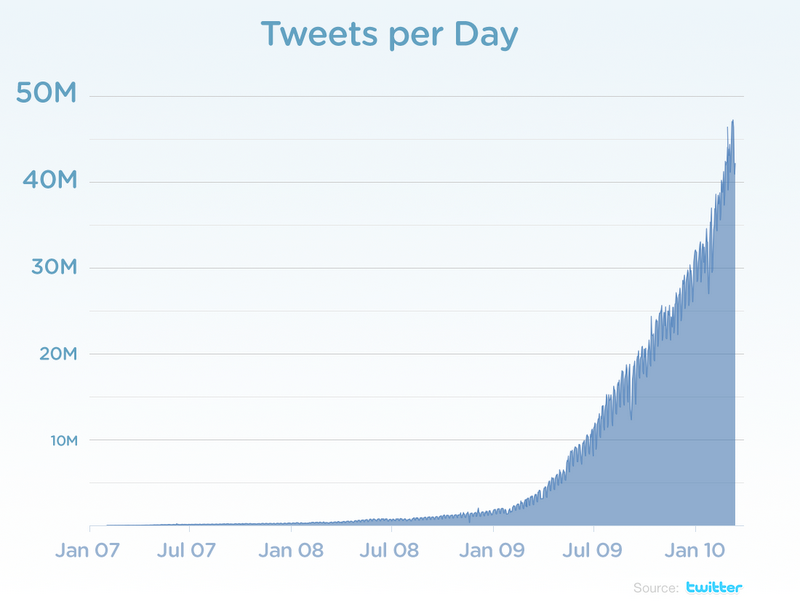
So Twitter is up to 50 million tweets per day. I read about half of them. I write the other half. Zing!
Wait… what?
Tech / Media / Strategy / Culture
via blog.twitter.com
So Twitter is up to 50 million tweets per day. I read about half of them. I write the other half. Zing!
Wait… what?
Om Malik posted the following video by Jesse Schell and raved about it over on Giga Om. And rightly so. It’s a 30-minute roller coaster ride of ideas about the “experience economy,” authenticity, gaming psychology, Facebook, and the future of social media and possibly even society.
I still need some time to wrap my head around this. It’s such a new way of thinking for public service media, yet it’s so crucial we start thinking about media as an “experience,” not just something to be passively consumed. If we’re serious about creating positive outcomes for people and communities, immersive and “authentic” experiences will be much better suited to reaching our goals than simply giving people information and suggesting they consider changing their behaviors.
In my particular case, I’m wondering what kind of “gaming” elements can be added for readers of the St. Louis Beacon to keep them more engaged, get them more informed and connect them to each other and positive outcomes for the community. Or how might we offer “points” for participants in upcoming public service media projects we’re going to do at KETC?
In any case, this is a MUST SEE VIDEO. Take the time. It’s well worth it.
 Announcement Time!
As of this week I accepted an exciting new position with public service media company KETC in St. Louis, Missouri. Starting in early March, I’ll be their new Director of Digital Engagement.
Historically KETC has been, and to this day is, a public television station in a TV market of roughly 3 million, broadcasting national PBS programming as well as locally-generated shows, some of which are distributed nationally on occasion. Amongst public TV stations, KETC is one of the oldest on record. Seriously — check out their amazing timeline going back to 1954, a full 13 years before the Public Broadcasting Act. Now that is history.
Yet for all that rich history, KETC is becoming something very new today: a public service media company, not simply a broadcaster. Over the past few years they’ve embarked on a remarkable transformation, developing closer relationships with their community and using media to solve problems.
It started with outreach around The War, in which KETC set the national standard for gathering local veteran stories and integrating it with the Ken Burns documentary.
This new way of working and thinking culminated with the local, then national, Facing the Mortgage Crisis, in which the station literally networked nonprofits, government agencies, banks and homeowners in a united effort to slow or even stop the wave of foreclosures hitting the area following the financial meltdown. The project included social media, broadcast, old-fashioned networking, live events and lots of online work. The accomplishment in St. Louis were so impressive the CPB expanded the program to selected stations nationwide.
 Now a new project is beginning; one focused on issues around the topic of immigration. They’re even remodeling part of the building to house the new local nonprofit news service — the St. Louis Beacon — and the cross-functional multiplatform digital media team… all together in the same space. And I’ll be there to help.
I can’t tell you how exciting this is. I’ve watched KETC from afar, oftentimes through consultant Rob Paterson‘s postings. This is an opportunity for me to put up or shut up on digital engagement and public service media. And I will do my best, for the good of St. Louis (a town I knew as a child, as it turns out), and hopefully for a broader public broadcasting community looking to understand how to move into what CPB’s Rob Bole calls “public purpose media.”
Sadly, this means I will be leaving Alaska very soon indeed, having lived on the Last Frontier for the past 9 years. The departure is made all the harder because I must leave behind a vibrant social media community I helped create over the past year. That community has gone on to raise money for a friend in need, form a local Ignite chapter and, from what I’m told, a wedding may be in the works. 🙂
So farewell Alaska. I will miss your Chugach mountain skyline and the warm embrace of entertaining and thoughtful friends all too soon.
And hello St. Louis! Let’s make something meaningful together.
These “revolutionary” videos are always fun — seems like everyone makes them these days.
This one is a little over-the-top for my taste (some of the statistics are taken out of context) and it’s clearly a calling card for the author of Socialnomics. But it’s still well-done and contains lots of little tidbits to get you thinking. Enjoy!
If Clay Shirky is right about Here Comes Everybody, then this social media counter is simply the latest proof.
Two astonishing things:
The conclusion? Mass media is shrinking rapidly at the hands of participatory media. It’s not absolute (one kills the other), but it is a complete reshuffling of the deck.
Are you connecting in your public media practice, or are you broadcasting?
I’m out of the nonprofit world these days, but I’ve spent some years in it, so I’m not at a total loss as to how things work and how cultural norms accrue. I’ve got my opinions, to be sure.
So when I saw, via FriendFeed, a post from Beth Kanter — Seth Godin’s Non Post About Nonprofits: Deers in the Headlights? — I was curious. I like both Kanter’s and Godin’s work and this seemed to be generating some buzz. So I clicked over to both Kanter’s post and to the original Godin post: The problem with non.
Quite a bit of the conversation was on Kanter’s site, so I joined the fray with the following post-length comment…
I was, until recently, trying to develop engagement media practices inside a public media company. It was a disaster, but not for the reasons most nonprofit managers would point to.It wasn’t about the tiny budgets or the excessive time required. It was about EXACTLY what Godin was talking about: resistance to change and slothful, good-enough-for-a-nonprofit management practices. It was also because the traditionalists liked their ivory tower positions; they liked speaking from on high to the little people in the audience. I was told we didn’t want to get the public involved in public media — that’s too messy.
Godin has nailed it and the reason for the violent response is precisely because he nailed it.
Lots of nonprofit workers, after a while, develop a sort of victimization mythology that serves the stagnation problem. “I don’t have enough money, so I can’t do this, so I can’t make more money… woe is me. But I’ll keep at it because I’m such a nice person. And maybe someone rich will come along and notice me. It could happen!” I saw that all the time.
Is it all nonprofits? Nope. But it’s a lot of them. Of the 2 million out there, how many are really creating engaging relationships with donors or their constituents regularly? Maybe 10,000? Whatever the number is, it’s not enough.
Here are the key nonprofit organization questions you have to answer:
charity:water is just the beginning. There’s a new generation of donors growing up right now and they won’t take your call or your e-mail or your mass mailing. But they will respond to an earnest call for help, especially from a friend they know. The next-gen trick is to be that friend first.
Nonprofits had best start making new friends. Because the old ones are dying and the broadcast campaigns (e-mail blasts, newsletters, appeal letters) will largely die with them. There’s still a place for building awareness, but action will come via relationships.
Godin’s pointing all this out through this post, his recent Tribes book and plenty of other posts. It’s a tough message, especially if you’re a “victim” inside a change-averse nonprofit (or a for-profit, for that matter!).
From here, you can deal with it — seeking new ways to engage your community — or just hope he’s wrong.
Frankly, I think it’s more fun to engage with your community regardless of what Godin says. But if proving Godin wrong sounds more fun to you, enjoy.
What I didn’t mention in my comment was my own immediate experience with fundraising for a cause via social media — via connections built across my own “community.” It was a small, first effort. But it was the collective action of a group of people with no nonprofit organization whatsoever. We came together to help a friend we’d literally never met.
For my generation and especially for Generations Y and Z, the old impersonal “broadcast” approaches used in public media and across the nonprofit spectrum will have diminishing returns.
But if I know you and you know me and we know we care about one another in some meaningful way — if we’re engaged in each other’s lives — the support will be there.
This week a friend sent a link to an AP story — Is your Facebook ‘charity work’ doing any good? — focused on how nonprofits can’t expect social media/networking. This prompted one of my patented long-winded replies. I figured I’d share it with a broader audience here.
These articles alternatively amuse and frustrate me. They group all “social networking” together in one phrase, and then spend all their time talking about Facebook and annoying ad campaigns. Then the article is over 500 words later and you feel dumber for it — you have no idea what to do next.
To me, social networking is not a fundraising system or method. It’s part of an ecosystem of relationship management, co-creation and social participation. And there’s no “one way” or system or technology or platform to make it work for you. Moreover, not everything WILL work for you.
Consider… go back and read the article and wherever it talks about “social networking” substitute “direct mail.” Is anyone suggesting that direct mail, on its own, is the savior of fundraising operations? Does anyone propose that direct mail is a way to reach everyone you want to reach? Is it the only way to maintain a relationship?
We have a spectrum of tools available to us today that weren’t available 10 years ago and certainly not 20 years ago. It requires that we learn some new techniques along the way, but the baseline fundraising proposition must remain the same: “we do X (something good) for you and for the ‘community and we deserve your financial, emotional and public support, please help us and your fellow man.” That’s it.
What I would say about social networking is that it’s different from all prior fundraising technologies in one fundamental — and market-changing — way: It allows donors to find and talk to each other. Rather than being a one-to-many communications model, it’s many-to-many.
Just think about that for a bit. This offers tremendous upsides, but also tremendous downsides. If, for example, your nonprofit is not behaving well in the world (in the eyes of some donors), they can spark a revolution against your current leadership, strike out on their own to create a competing service and so on. Because they can find one another now, they can use the social networking fabric against you.
Scary? Well, yes. But so long as you behave in a way that’s engaging, open, supportive and so on in your public communications, tribe leadership and interactions, you likely have little to fear. The nonprofits that put old-school fundraisers on the social media bandwagon will regret it — because those folks will use it as a bullhorn / bully pulpit, and that will fail gloriously and publicly.
Social media is, more than anything else, a leveling of the playing field and the productive networking of a formerly passive audience. What happens next is up to the people that use it — both in the nonprofits and in the philanthropic community (which now includes tiny players, not just the rich).
Transparency, openness, honesty, creativity, fun, sociability, seriousness of purpose, and tribal leadership are required to make social media work for you / with you. Anything less and the results will likely be unpleasant.
 If you’re involved in public radio, this is required reading / listening.
Jesse Thorn, host of public radio’s The Sound of Young America (which is really a podcast that happens to be on a handful of 25+ public radio stations nationwide), speaks with Josuha Benton (Nieman Journalism Lab / Harvard) about his notions of creativity, business, media scale, public radio economics, audience interaction, passion, awesome content and more.
In particular, he nails the problems of the public radio industry today: the saturation of the older, educated white market and the industry’s pull back from attempts to stretch into new market segments with old formulas. He also keenly understands and explains the financial models in “the system.”
Because what Thorn proposes is that public media programs, hosts, writers, and others do is, well… make great content and directly interact with the audience that gels around the content and experience. He’s suggesting you build a Tribe.
Take a listen…
While listening, pay special attention to his observations about how he pays himself for his work, how he interacts with his audience, and how small-scale his show’s production model is. Also pay attention to how he thinks programs in the future will work — using mass media as “calling cards” or “advertising” for the interactive media experience the programs are creating.
From a Tribes perspective and a mass media model perspective, there’s only one other major national project I know of that’s doing the same thing: Planet Money, in a tiny, experimental pocket of NPR. And that could be said to be an outgrowth of the defunct Bryant Park Project.
There will remain a place for mass-produced and mass-appeal general news production. But for everything else, and especially for any local station that wants to survive, your future is in building a community around awesome content and services, a la Jesse Thorn.
—
Bonus Listening: If you haven’t heard the SxSW presentation by Merlin Mann and John Gruber on creating content online, that’s your immediate next destination. Indeed, here’s your reading list for surviving in the 21st century media world:
Double-Bonus Listening / UPDATE 2009-04-19: Thanks to the unstoppable Jesse Thorn for stopping by with a comment (below) and sharing the link from the discussion at the 2009 Integrated Media Association conference in Atlanta. Highly recommended, too. Thanks Jesse!
 Thanks to @garyinalaska, I was invited to speak at the Alaskan Apple Users Group (AAUG) on March 4 in Anchorage, on a topic more or less of my choosing, but dealing with “digital media survival.”
I took that notion, applied it to public media, and tried to bring forth my current thinking about how we in the public media space — at least where I am these days — must change in order to better serve our original mission and do it in a sustainable and meaningful way. Broadly, I suggested we must move from being a purely broadcasting-focused firm to leading a “tribe,” as Seth Godin would put it.
Frankly, my presentation needs work. A lot of work. But the core ideas are there. We’re only just getting started on this in my firm, so I should be able to revise this in the future once we’ve got more experience. For now, however, here’s the presentation files as well as lots of links that are the foundational pieces of the notions presented. I’d love to hear your comments or suggestions, and if you take these ideas and expand upon them, drop me a link.
Thanks again to @garyinalaska for the invite. The crowd was great!
 Gravity Medium