All a-Twitter

For those of you still not using (or at least trying) Twitter, or if you’d like to learn about some resources that can make your Twittering more interesting or useful, check out this comprehensive post by digital media professor Kathy Gill (University of Washington). Good history, good explanations, great list of resources.

Plus, don’t miss the Twitter Fan Wiki for even more tweety goodness.

I’m still not a constant Twitter user myself — it kind of happens in batches for me — but it’s still a lot of fun. I’ve met people in my own area that use Twitter and maintained some interesting pseudo-connections with people very, very far away.

My experience:

  • it’s better than IM, because it’s asynchronous in nature — like e-mail
  • it beats blogging every thought that comes into your head
  • it’s highly mobile — via iPhone with web or any cell phone with SMS
  • it offers a fascinating stream-of-consciousness view of the world
  • it actually informs me about the world — it’s faster than RSS feeds, far faster than web sites and the news I capture via Twitter friends is much more relevant to me (most recent example was learning about the midwest earthquake before I heard about it anywhere else)
  • my wife won’t sign up, so I can say whatever I want! 😉
Get that account, and I’ll see you on the Internets!

J-Week 2008: Web Extras Toolkit

Welcome Journalism Week 2008 visitors from Anchorage, Alaska! If you’re looking for the “Web Extras Toolkit” handout from Saturday, April 19, 2008, you’ve come to the right place.

And feel free to recommend your own toolkit additions or corrections via the site comment feature.

TV News: Just die already

I hate TV news and TV “journalists.” Local, national, cable, network — you name it, I hate it and them. CNN, a once-proud innovator in quality news, is now even less than a joke. It’s no longer a laughable service, it’s one that should make every self-respecting democracy-loving American weep. CBS, already a shameful service, now wants to buy news from CNN? Well, sure — what the hell’s the difference at this point, anyway?

(The one exception, of course, is most of the stuff distributed via PBS. The pubcasting news/public affairs shows have their own problems, but integrity or seriousness of intent is not one of them.)

Thank God there are so many smart people in the world that are as outraged by (commercial) TV news as I am. The reaction to Wednesday night’s Clinton/Obama debate in Pennsylvania was instantaneous, nearly universally negative and — bonus — entertaining to boot.

Check out these Twitter posts (tweets) regarding the debate, from a variety of users…

  • 45 minutes into the debate and I’m thinking this is exactly why network TV must die. Not one real issue – just flag pins, Wright, and Bosnia
  • And should a former Clinton campaign manager be one of the two people conducting the debate? Doesn’t ABC have any real journalists?
  • ABC’s debate was a bigger joke than CNN’s compassion forum. it’s good the newseum in dc is now open because real journalism is cold and dead
  • hehe Charles said “fascinating debate”. What debate was he watching?
  • Just wrote a letter to my local affiliate complaining about how bad the Debate was handled. I felt bad for both candidates
  • Reddit-fueled debate backlash nearing 10,000 complaints on ABC website: http://ping.fm/aTKoi (wait til Digg kicks in)
  • 50 minutes into the democratic debate and yet not one question of substance. No policy, all bullshit.
  • terrible debate. ABC News sucks.
  • Almost 10,00 comments on abcnews.com http://is.gd/6KM detesting the debate questions as tabloid and irrelevant. And they were.
  • What the hell is wrong with ABC? Effing flag pins and fake scandals? Well done. You’d have been better off letting The View run the debate.
  • the real question about tonight’s debate…will the press cover how bad abc news handled it???
  • tried giving feedback on the debate on the abc news site but couldn’t register. site is probably overloaded. comment count is now over 9500!
  • just under 4 hours since the debate and the abc news site has received almost 9400 comments, almost all negative!
  • to me, the big news of the debate is how terrible the moderators were. they were trying to create news. they were debating the candidates.
  • Josh Marshall of TalkingPointsMemo says that after tonight, they need to give the debates back to the Women League of Voters?

Let’s set aside the new media topic for a moment and address journalism, ethics and trust. Public media purveyors: Your job is to be everything that ABC, CNN, CBS and others are not. Do that, on any platform, and the support will follow.

What Kodak could teach public media

Below is a great little video I’d never seen before today. Had to share it. It concerns Kodak and while it starts out slow for the first minute, it rapidly picks up speed:

Kodak has for many years been the butt of innovation jokes, but it would appear they’ve survived, albeit changed in many ways. They found their way back to their mission: helping folks capture, store and share important images from life. Prior to the turnaround, they thought they were in the film business.

When I finished chuckling I wondered… What would a video similar to this one look like or sound like if it were being done for the public media industry, say 5 years from now?

Many seem to think we’re public broadcasters (I’ve been lectured on this more than once). Really? We only exist to fill FM frequencies or put pictures into living room boxes? That’s it? God, I hope not. I’d much rather be in the business of going out into the community, capturing stories and information, and sharing all that with the community in a thoughtful and community-developing way. I couldn’t give a rip about FM or TV technologies. Or the web for that matter. Those are all just tools.

In any case, thanks to Howard Weaver for blogging the video, but also blogging some great comments collected at a conference panel with Kodak, P&G and Owens-Corning executives. Weaver’s quick write-up is well worth a visit, especially for the killer quotes provided by the execs.

HD Radio: A technology only an engineer could love

Okay, catchy headline, but I’m not actually that “down” on HD Radio per se. But I am against getting excited about it, for all kinds of strategic reasons. A new post by Mark Ramsey has a great kicker paragraph that sums up the state of affairs:

Finally, HD is certainly an “upgrade” from the perspective of the broadcaster and the engineer. But is it an “upgrade” from the perspective of the consumer, who already has more choices than they know what to do with — even if they’re not choices which are not under the control of the radio industry? After all, when the Internet is in my car, isn’t HD Radio actually a downgrade?

This reminded me of a recent instance in which I was on the receiving end of a talk from a broadcast engineer about HD Radio. Not an informative one, but, well… a lecturing one.

The lecture? Basically: “Hey, we’ve got this HD Radio stuff installed. When are we going to start broadcasting additional channels? Because, you know, the FCC grants us a license for community service, so we have an obligation to start using HD Radio to serve the community.”

I was floored.

First, the logic was so brazenly absent from this argument. Second, why is engineering directing public service strategy? Third, we are using the HD Radio gear, even if we aren’t multicasting. And finally, well… let’s list all the obvious market reasons that make multicasting a less-than-critical strategic focus:

  • virtually no one has HD devices and sales are not increasingly rapidly
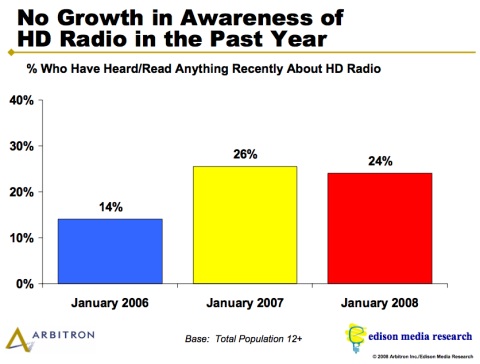
  • most consumers don’t know about it
  • those that do know about it are not really interested
  • HD devices are too expensive for most listeners for casual situations
  • additional HD channel development requires additional effort (money), even in a heavily automated approach

…and so on, which makes developing additional HD Radio channels at this time an exercise in wasted money and effort for a regularly-strapped public radio provider. We’d be better off focusing on improving our existing services or forging ahead in new media / social media.

Let’s be clear: the HD Radio technology platform is not the mission of public service media (nor is FM radio or AM radio or analog TV or digital TV or web sites or DVDs or CDs or…). HD Radio is a tool.  It’s up to us to figure out when and how it makes sense to employ this tool in fulfilling our public service mission.

And if, down the road, we find that HD Radio was a waste of money, we should have the courage to scrap it and move on.

Required Reading: 2008-04-11

I’m starting a new feature called Required Reading. I already offer what I call the Media 2.0 Reader (in the sidebar) that tracks selected reading from around the web (via Google Reader). Required Reading will represent the best of the best. Frankly, I wish I’d written these pieces!

Today, two pieces of Required Reading with an economic perspective:

The Declining Power of the Firm
I’m already a big Umair Haque fan, and in this post Wilson pulls from a recent Haque piece and then extends it into issues swirling in the Microsoft / Yahoo! / Google / AOL story. What does it mean to public media? Well, the economics of the emerging edgeconomy are fundamentally what’s shattering the foundations of the mass media market in which we historically operate.

Microeconomics
Rosenblum’s writing is provocative and intelligent. You don’t have to agree, but you do have to confront his ideas. In this case, Rosenblum takes on the notion that new media services only pull in a fraction of their old media forerunners. He acknowledges the situation, but points out how new media also costs far less to produce than old media, in particular with respect to overhead costs. Given that many in public media work in large and expensive legacy facilities — especially in pubTV shops — this lesson will be increasingly critical to learn and then to turn into real-world practice.

If you’re interested in wider-ranging readings across the web, you can follow my Media 2.0 Reader via RSS or by e-mail subscription. By the way, I’m always on the prowl for more and better sources of ideas and material related to new media, social media and public media, so be sure to share your recommended links.

Near-future of TV, via Mossberg

Great little summary of the present and near-term tech developments related to TV and video distribution technologies by Wall Street Journal tech columnist Walt Mossberg.

Found via Gerd Leonhard

http://blip.tv/scripts/flash/showplayer.swf?tabType3=none&tabUrl3=undefined&tabTitle3=undefined&tabType2=none&tabUrl2=undefined&tabTitle2=undefined&tabType1=none&tabUrl1=undefined&tabTitle1=undefined&enablejs=true&feedurl=http%3A%2F%2Fbeettv%2Eblip%2Etv%2Frss%2Fflash&file=http%3A%2F%2Fblip%2Etv%2Frss%2Fflash%2F801182&thumb=http%3A%2F%2Fpanther2%2Evideo%2Eblip%2Etv%2FPlesstv%2DFTCShouldStopVerizonFromCallingDSLBroadbandWaltMossberg532%2Epng&brandlink=http%3A%2F%2Fwww%2Ebeet%2Etv%2F&brandname=Beet%2ETV&showguidebutton=false&showplayerpath=http%3A%2F%2Fblip%2Etv%2Fscripts%2Fflash%2Fshowplayer%2Eswf

If 'newspapers' can die, then 'public broadcasting' can die, too

I’m so glad the newspaper industry is blazing the trail to either self-transformation or self-immolation in this new media world. Public media companies are being given a very close look at an industry in gut-wrenching transformation just before our own will undergo the same. The trail before us has been blazed, and we should be thankful.

Recently in Online Journalism Review, Robert Niles wrote a great link-bait article — It’s time for the newspaper industry to die — in which he explains why newspapers need to dump the word “newspaper” from their internal lexicon and psychology. He offers several reasons for this.

But the best reason centers on that favorite word of mine: Community. And the reason applies to public media, too.

Niles recognizes a fundamental shift in newspapers over the last decade: they’ve cut back on real community service while maximizing shareholder profits.

Great content and great tools are not enough to build the large, habitual audience that content publishers will need to maximize their opportunities to make money online, through advertising and sales. Even more than those two things, a website needs great engagement with its readers. And engagement with the public is something that’s been budgeted out of too many newsrooms over the past generation.

It’s time to bring that back. It’s time to do that online. And if a beloved label needs to be sacrificed to inspire the innovation that will enable this effort, so be it. It’s time for the “newspaper” industry to die. Because we all need the news industry to survive.

I would submit the term “public broadcasting” can take the same route to oblivion. One-way broadcasting can no longer be the point, even if that’s the most comfortable thing to do. Community engagement, public service, gathering, convening, whatever — that’s got to be the goal. Broadcasting is a tool, a means to an end of public service.

What we want from a “newspaper” isn’t fish wrapping or bird cage lining, it’s news, information, connection to events. What we want from broadcasting is pretty similar. But let’s not confuse the delivery system with the purpose. And let’s not believe for a moment that retransmitting someone else’s non-local, marginally-relevant content is something worth preserving in a world of on-demand access to all content anywhere.

Since entering the public media world professionally almost four years ago, I’ve always thought the Corporation for Public Broadcasting (CPB) was ripe for transformation (and not because of that Bush administration weasel Kenneth Tomlinson). Why? Because they need a name change and a mission reevaluation. It’s too bad the purpose of the CPB — funding and fostering public Broadcasting — has its instructions enshrined in law.  It’s making it difficult, if not impossible, to fund new projects. Consider this Q&A between IMA’s Mark Fuerst and CPB’s current president, Pat Harrison, at the recent IMA 2008 conference in Los Angeles (audio clip, about 1 minute):

[audio:https://gravitymedium.com/wp-content/uploads/2008/04/harrison-on-funding2.mp3%5D

Harrison gets it. Sure, she’s referring to reauthorization for CPB in Congress, but that’s just cover for avoiding talk about shifting funding out of pure broadcasting and into community engagement. (In fairness, the CPB has spent millions over the past several years on new media research and projects, but as I’ve noted before, we haven’t really seen any transformations.)

This is really too bad. Because while newspapers are stuck with an old term and a psychology that’s hard to shake, we have those challenges plus actual laws that govern a significant portion of our funding. To change the laws or create new ones to foster and fund community building and interaction via all available media may be politically impossible.