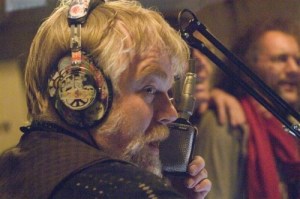
 At the end of Thanksgiving weekend I went out with friends to see the new movie Pirate Radio.
For those that don’t know, British radio was pretty tightly controlled just at the time that British rock and roll artists exploded onto the international pop music scene. Youth and music enthusiasts were basically deprived of rock on the radio. So a natural reaction appeared: enterprising young scallywags set up radio transmitters on ships floating in international waters off the British coast, beaming prohibited rock music and youth culture back into the mainland.
It’s not a great “film,” but it is a fun movie. And it reminded me of what I see so little of in public media circles today: Passion and joy and revelry. More on that in a minute.
Meanwhile, back at the office, I read the new column by IT strategy writer Bob Lewis: Legless Dog Syndrome. In it he asks the provocative question: What if you had no authority, as a manager, to make any of your employees do their jobs? What if you were a leader, but you weren’t “in charge?” He then goes on to talk about how, in a well-run organization, you don’t need control, because why you’re there and what you need to do are so patently obvious to everyone. To wit:
In well-run organizations, everyone understands:
- What the organization exists to accomplish — the mission.
- How the business works and how it connects to the external marketplace — the business model.
- How the organization is supposed to evolve over time — the vision.
- How the organization is supposed to get there — the strategy.
- How they fit into the mission, business model, vision and strategy.
- How to do their jobs exceptionally well in order to make it all happen.
And in well-run organizations they buy into all of this, have good reasons to want it to happen, find it energizing, and have no “perverse incentives” to take them in different directions.
Put together, these two scraps of media — Pirate Radio and Lewis’ take on the old legless dog joke — spell out to me what’s missing in much of the public media universe today: Passion and Purpose.
Passion
 The “pirates” of Pirate Radio were there for the love of the music. They didn’t care about the privations of living on a rust bucket in the middle of the North Sea. Their mission — bringing the joys of a new age of music to millions across Britain — sustained them, gave them purpose, kept them engaged. They had a shared view of the inherent value of cultural expression through music (even if they’d never describe it that way) and were willing to do almost anything to participate in that process.
Passion gave them power, made them real to the people listening hundreds of miles away on land. Sure, there were advertisers and money involved, but these folks loved their work because they believed in it, not because they were getting rich (which they weren’t).
Is this true of most people working in most public media firms in the country today? Are they (or we) passionate? Really passionate?
It’s hard — if not impossible — to measure, but I’d wager that folks working in startup public media firms, like spot.us or the Texas Tribune or even specialty pubmedia firms like WXPN have more passion than most, and it gives them power. Maybe the passion will last for them, maybe it won’t. But they’ve got something that the average town’s local NPR affiliate isn’t likely to have: deep-rooted affection for the change they’re bringing to their world. They’re making a difference, an impact. They’re not working on the status quo; they’re creating something new.
How much change can you bring into the world by inserting local weather into Morning Edition? How much passion does it take to rearrange PBS programs into a broadcast schedule that’s virtually identical to 300 other stations around the country? Sure, the biggest legacy stations have pockets of creativity where old-school media types get to make media the way they always have. That’s a passion pursuit.
But for a wide swath of professionals working in public broadcasting today (some 40,000+ people), I’ll bet most are going through the motions at this point. Too many are fixated on a proud legacy (and there are still things to be proud of today, of course); many have lost their way and don’t know how to make “big media” on eviscerated budgets (because you can’t). One year you have a staff of 150 people and do all kinds of crazy projects that you love. A few years later your staff of 75 is shell-shocked and just hanging on to what vestiges are left of a passion borne of a long career in the old media world.
Under circumstances present in most (by number) public broadcasting outfits, it’s hard to muster passion when you’re watching your work diminish in scope, impact and value. And it must be especially galling to see your high-craft work disappear into the ether as new media forms get so much more buzz — buzz beyond their “real-world” value.
But here’s the deal: Passion will almost always beat proficiency. And in an age where old-school media economics are collapsing (as less advertising spreads across an expanding media universe), the New is sustainable because of its passion, but the old is not because of its baggage. The asteroid has hit, and the small mammals have a distinct advantage over the dinosaurs.
Of course, you can’t win on passion alone. The radio pirates still had to broadcast their work. They still had to keep the ship afloat. They still had to buy fuel and food. But had Rupert Murdoch started a pirate radio operation with PR, accounting and lawyers on the payroll, it would never have made it. Passion powered those boats, not cash.
Public media people need to find their passion.
What is it? Making good video? Great! Then you need to find a way to make video, even if that leads you away from your career at the local PBS affiliate. Are you all about kids education? Awesome. Then dig in where you are if you can, but if you can’t, move on. Is creating trustworthy news and information, to help educate the electorate, hold officials accountable and sustain democracy your passion? Fantastic! Get to it, and keep in mind your best work might be achieved outside the legacy public media companies — some of the most innovative work in journalism isn’t happening at established companies.
It’s not that public media needs a talent exodus. But we do need those that are just biding their time until retirement to move along early, along with those that just wanted a “safe” job where little is expected of you and no one is ever fired. We need a passion explosion. And it’s not about age. You can be passionate at any time in your professional life.
But the passion argument demands more than just ecstatic devotion — there must be a reason for it. We need to work passionately on something together…
Purpose
 I’ve told this story more than a few times…
When I moved into the public media world a few years back, I felt like I was joining a company, and a national community, composed of people on a mission. I’d worked in nonprofits before, and I’d always liked putting mission above sheer profitability, but this was the first nonprofit where I felt like there was a real underlying purpose.
These were the days, however, when the web was so ascendent that even the old school public broadcasting managers were realizing that a generation was growing up with less of a need — or maybe even no need at all — for public radio and public TV. The iPod came out in fall 2001. By the time I joined public media just 3 years later, podcasting was introduced soon after, broadband penetration in the home passed 50% and it was clear the world was not the same.
So I, and so many others around the country, began to ask…
Well, okay… there are new media outlets appearing all the time now, so maybe we need to go back to the drawing board and ask ourselves: “Why are we really here?” Because if we can answer that question, then we’ll know what things we should bother doing and which things we can ignore as new media outlets and formulas develop. Because we can’t sustainably be all things to all people. We need a clear mission so we know what’s in and what’s out.
With that in mind, I started to ask my colleagues — most of whom had worked for decades in public media — Why are we here? What’s our true mission? Who are we here to serve? If there were only one thing left we could do, what would it be?
I thought these were marvelous questions. We could all read the 1967 Public Broadcasting Act again, with fresh eyes, and envision a present and future that’s reimagined, probably staying true to core principles from 1967, but without being bound to 40-year-old technologies or notions of public service. What freedom!
Yeah. It didn’t work out like that.
Instead, my questions were irritating to those that literally built their careers over the same time span in which public broadcasting developed so successfully.
“What’s our mission?”
“Our mission is public broadcasting!”
“Right. But what does that mean, especially now — now that everything is changing?”
“It’s public broadcasting! Look, you just haven’t worked here long enough to understand. But the rest of us know what it means.”
“Then why can’t you explain what it is, simply, clearly, and without using the words public or broadcasting? Can you tell me what the mission is without listing what the company does?”
“! ! !”
I never intended to frustrate, but I did intend to provoke, to start a deep conversation about Purpose. I feel my questions remain unanswered to this day.
Coming out of that experience, I think there are three critical questions for public media companies (and any company, really) to answer for themselves:
- Who are you? (identity, not branding)
- Why are you here? (mission or purpose)
- Why do you deserve my — or anyone’s — support or participation? (case for support, call to participation)
And the challenge isn’t getting some disengaged committee trapped in a conference room for half a day to give any old answer; the challenge is giving good answers to these questions. Simple, clear answers in human-scale English; answers that are inspiring, trustworthy, honest and needed.
We need Purpose. Shared purpose. Reasons for getting out of bed in the morning. Reasons for showing up at work early and working late. A purpose to power us when it feels like the ship is sinking.
Is continuity enough?
In The Art of the Start, Guy Kawasaki says that one mission a startup can have (among others) is, “Prevent the end of something good.” It feels like that’s much of the Purpose out there in public media land today. Budgets shrink. Staffs shrink. Advertising income shrinks. And so on. So pubmedia professionals are working doubly hard to keep the ship afloat.
But I would say Kawasaki misses a point: Continuity of something old, something anachronistic, is not enough to keep people energized; it’s not something many people can get Passionate about.
People can get passionate about making something new: a house, a baby, a business, a painting. They can even be passionate about preservation in some cases (which is probably why pubcasting membership receipts are flat even as membership rolls shrink).
But media is not merely a monument to the past — it’s a living thing. We create it every day. We consume it every day. How do you gather passion for continuity of the old in perpetuity?
Personally, I think public media simply maintaining past practices until they collapse under their own economic weight is not enough, and it’s an insult to that part of the community that has moved on, media-wise, and is waiting for us.
Passion + Purpose = Meaning
 Imagine a public media company that has a clear purpose. A purpose that everyone knows and understands. Imagine it filled with people passionate about that purpose. That’s a group of people making meaning for their community and for themselves. It could be music or news. It could be public service via information curation and distribution. It could be community building. Wouldn’t that be awesome?
More than anything else we seek Meaning in our lives, which to me is a unification of Passion and Purpose. I haven’t found it yet in a public media firm (though I’ve experienced flashes of it here and there — sparks and smoke that suggest a fire).
It’s time public media firms get off their duffs, articulate a clear purpose and gather a crew that’s willing to head out on the proverbial rust bucket in the North Sea to share their passion with the world.
The kids programming folks at PBS seem to have it. The news folks at NPR seem to have it. There are other pockets out there, too, I’m sure.
But the broad swath of “stations” out there need to stop whining about losses and changes and how things just aren’t the same anymore and “if only” we could do this or that “everything would be fine.” Here’s a news flash for ya: Everything IS Fine. The present is what it is. Hoping for the past to come back is a waste of energy, money and time. Give it up. Make a great future with the resources we have right now.
We have more opportunity in front of us for public service and community building now than ever imagined 40 years ago, or even 10 years ago. When you look past legacy systems, the cost of creating and sharing media today is cheaper than it’s ever been. Recording, editing, curation, distribution, aggregation, sharing — it’s unbelievable what we can do these days.
All ahead, or all reverse?
In Pirate Radio, the “Count” character (played by Phillip Seymour Hoffman), remarks that these are the best days of their lives, and it’s a pretty depressing realization for him. He knew he was at the center of Passion and Purpose meeting for a brief time on a ship in the North Sea and he’d never forget it.
So here’s your takeaway question…
Are public media’s best days behind it or are they yet to come?
 Friend and coworker


 Gravity Medium