"I'm in the Audience Business"

In addition to covering developments in the technology sector, This Week in Tech — the flagship of Leo Laporte’s podcasting network — often hosts guests directly participating in the media revolution that’s already in progress. And they often have illuminating conversations about what is and isn’t working in old and new media spaces, and in the spaces in between.

This week the conversation offered this little gem from Shira Lazar, a young pro in both new and old media (at time index 5:14):

“For me, I say I’m in the Audience Business.”

Bingo. This is the future for nearly all media (but not absolutely all). If you don’t have or can’t maintain control over media distribution in a 1-to-many distribution model, then you must learn to engage an audience.

This is also known as building and leading a Tribe.

Be sure to listen to TWiT 190 from about 3:20 to 13:00 for the complete old/new media and audience conversation. Plenty of relevant ideas for public media leaders.

Digital Public Media: From Broadcasting to Leading a Tribe

Thanks to @garyinalaska, I was invited to speak at the Alaskan Apple Users Group (AAUG) on March 4 in Anchorage, on a topic more or less of my choosing, but dealing with “digital media survival.”

I took that notion, applied it to public media, and tried to bring forth my current thinking about how we in the public media space — at least where I am these days — must change in order to better serve our original mission and do it in a sustainable and meaningful way. Broadly, I suggested we must move from being a purely broadcasting-focused firm to leading a “tribe,” as Seth Godin would put it.

Frankly, my presentation needs work. A lot of work. But the core ideas are there. We’re only just getting started on this in my firm, so I should be able to revise this in the future once we’ve got more experience. For now, however, here’s the presentation files as well as lots of links that are the foundational pieces of the notions presented. I’d love to hear your comments or suggestions, and if you take these ideas and expand upon them, drop me a link.

  • Tribes: We Need You to Lead Us, by Seth Godin (Amazon.com)
  • Tribes: We Need You to Lead Us, by Seth Godin (free at Audible.com)
    Godin’s book on the tribes notion isn’t perfect (there are complaints out there about generalities that aren’t backed up with examples), but it’s quite good and I suspect it will form the backbone of our strategy going forward. It is not a prescriptive book; it has no “instructions” — it’s more faith than religion, if you know what I mean. In any case, as I noted in the presentation at AAUG, if all we in the current public media are doing is talking at people instead of communicating with and connecting people with shared interests and values, we’re not likely to survive. Content is free. Distribution is free. Contact, context, connection and community are priceless.
  • Seth Godin’s blog
    Godin covers the tribes notion periodically and relates tons of next-generation marketing and communications concepts; highly recommended reading for just about anyone.
  • Seth Godin Talking About Leading a Tribe (YouTube, 6 min)
    Audio quality is a little weak, but crank it up and you’ll hear everything you need to hear. Godin succinctly hits the notion that companies are focused on interrupting you enough to trick you into buying their products or services, but they don’t care about you.
  • Seth Godin: Sliced bread and other marketing delights (TED / YouTube, 19 min)
    TED Talks are legendary and Godin does his typically masterful job talking about marketing. This one is not about tribes, but the notions covered are integral to understanding how our historic mass media model is failing. It’s 19 minutes, but it doesn’t feel like it — he’s a wizard of fast presentations that are smart, funny and revealing.
  • “No One Cares About You” (YouTube, 2 min)
    Short and to-the-point advice to companies that think they need to get into social media to tell the world about what they are doing. Surprise: people don’t care about your company.
  • Kevin Kelly / The Technium: Better than free
    This piece set off a ton of blogosphere and public media commentary last year because Kelly sets forth not only the notion that you can’t stop things (media) from being free, but that there are still ways for companies and individuals to create value and gather revenue. Brilliant stuff.
  • Kevin Kelly / The Technium: 1,000 true fans
    Godin refers to this piece in Tribes, and rightly so. It’s a seminal work in the new media world, as it proposes that an artist can surivive if only he or she can find 1,000 true fans/supporters. Godin suggests, rightly, that the number might be 1,000, but it also might be 100 or 10,000 or 1,000,000 — depending upon your situation. But there is a number, and you need those true fans.
  • The Cluetrain Manifesto
    Now 10 years old, the Cluetrain is still being studied as companies of all kinds try to understand how to behave in the new media, interactive world. The 95 Theses are priceless.
  • Clay Shirky: “Gin, Television, and Social Surplus”
    Shirky addresses the rise of television in concert with the industrial revolution and how it acted as a “cognitive heat sink,” yet now people are participating in media creation rather than simply passively consuming it. Critical to understand because it signals and explains how and why people are, more and more, rejecting
  • Clay Shirky: Here Comes Everybody (the web site)
  • Clay Shirky: Here Comes Everybody (Amazon.com)
    Subtitled, “The Power of Organizing Without Organizations,” this is a critical idea that public media companies must understand. There are aspects of running a public media service that require the power of a formal organization. But engaging with and leading a tribe cannot be achieved by a pure firm (or corporate) approach because it cannot scale. But if we can “organize without an organization,” we can get there. Of special note are his brief references to “cost of coordination” and how and when a firm (a formal organization) is useful and when it stands in the way of progress.
  • Umair Haque / Bubblegeneration Strategy Lab
  • Umair Haque / Harvard Business Publishing
    His writing is perhaps the most dense of any of the links here — it’s probably a half- or full-generation ahead of contemporary economic thinking, so it can be hard to follow. But if you’ve got an imagination to see a world that doesn’t quite look like ours and a world that operates on different economic principles, expectations and practices, you should be following Haque. Those in traditional mass media — especially commercial media — will ignore Haque at their peril. By the way, his PowerPoint slides on co-creation of content (at Bubblegeneration) are equally dense, but there’s a kernel of public media’s future in there: a collaborative approach to media capture, editing and distribution that we could never have considered in the past.

Thanks again to @garyinalaska for the invite. The crowd was great!

Huge citizen journalism win in Detroit

Man, I wish I was in the Detroit area now, despite the auto manufacturing disaster. This looks promising.

By the way, don’t dismiss The Oakland Press as some tiny suburban paper. It’s a pretty big paper, given the size of the communities they cover. Detroit is “big,” but the areas north and northwest of the city proper are huge.

Don’t miss it. Thanks to Jay Rosen (@jayrosen_nyu) for the find.

Recent presentations

Well, the week of presentations is now over. Here are both of them, for reference. They may not make sense out of context, but there were definitely some links in the Twitter presentation particularly that may be of use to the APRN journalists that attended my presentation last Friday.

APRN Chaordic Organization Option

This presentation was made to several managers of public radio stations in Alaska and then again to the Board of APTI a couple days later. It concerns the future of collaborative public media efforts in Alaska. Developed in cooperation with the unequaled Robert Paterson, and using ideas pioneers 40 years ago with Visa International, it’s a proposal for starting conversations statewide about finding a new way for us to collaborate and compete in a more natural way than we’re organized today. It’s kind of hard to follow without the narration/explanation, but I wanted to share it anyway. I’m happy to answer questions.

Twitter for Stations, Programs, Journalists and Fun

This presentation was made to a group of Alaska public radio journalists in Anchorage during an annual conference. The idea was to expose them to the Twitter service and suggest they try it out and see what others around the country — especially NPR — are doing with it. The reaction was… tepid. I think Alaska pubradio journalists are really saddled with a lot of responsibilities that just aren’t present in the rest of the country, and taking on new forms of media is just so hard for them. And then journalists also tend to be a skeptical lot — as they should be, of course. Again, narration helps, but there’s lots of links in it for reference.

Great survey… Have you taken it?

I know in a political election year we all cringe when someone approaches us with a “survey,” especially since those are almost always slanted to one side or the other. But here’s a great one — the PubForge Open Source Collaboration Survey. If you or someone at your public media station haven’t yet taken the survey, please do so right away.

The early results are interesting, as promoted by new media leader Dale Hobson (North Country Public Radio) in a recent e-mail to public radio folks (excerpted here):

Open source software has been widely adopted by stations as a whole: A majority of stations utilize open source software for some aspect of their online service. Where open source tools are not in use, there is considerable interest in finding ways to use them.

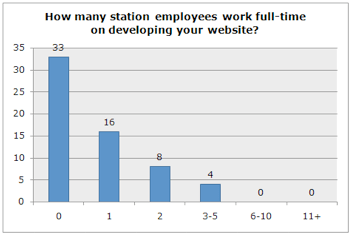
Allocating resources to web development and maintenance is critically low:

  • More than half (55%) of respondents have ZERO full-time employees developing their website.

Top of the development list–stations are looking for:

  • 72% – Freestanding player for streams, archives and user created playlists
  • 72% – Tools to integrate existing social media networks into public media sites
  • 68% – Complete CMS website solution, including audio file management
  • 66% – Software to enable more community participation for public media
  • 61% – Application for supporting micro payments (granular giving) to enable giving around specific content

In addition, the survey provides a snapshot of how stations are managing web content, what in-house skills and tools are available to them, how they are tracking visitors, and what they want to be able to do online, given the necessary resources.

There are more charts, more quotes and summary statements if you visit the site to see it all.

We need these kinds of surveys to be as accurate as possible, and the results are already illuminating. If you’re at a station, work with the web, and have just a few minutes, please take the survey.

Another nail in the AP coffin

There have been so many great news services popping up in the last few years in the online space. Politico.com has been one of the big success stories. They make most of their money on a print edition distributed on Capitol Hill and K Street in DC, but their web property is followed nationally and their writers and pundits regularly appear on talking-head shows.

Now they’re undermining the Associated Press. Good for them.

At the rate things are changing for the AP and the news business in general, you’d think the AP would unleash a new plan to get folks interested in their services again. But I think not. The AP is still a juggernaut in the news business with a long way to go before their execs begin to freak out over lost customers and revenue. It sure is interesting to watch, though.

Back from the dead / digital collaboration

It’s has been — and remains — insane at the office these days. We’re in the midst of a pledge period for TV, we’re preparing for another one in FM, and for the most part it’s my first run-through these events as the person ultimately in charge of our streams, so there’s a learning curve. I’m finding it easy to pick things up — it just takes time. Plus, the company is still shaking out some of the changes from about a month ago as we radically redesigned the management structure. So far, so good.

I’ve been neglecting Twitter and Facebook and this site for nearly a month as these events have played out. Luckily, it’s kind of a quiet period in public media as folks work through pledge drives and just get back into the non-summer swing of things.

Yet this past week a critical post went up from Dennis Haarsager that’s required reading for pubradio folks and I think for public TV folks as well:

It makes a good deal of sense to me, as it gives a revitalized reason/purpose for national/local collaboration, as opposed to simple distribution. I’m not quite convinced it can be successful, but it’s got a shot if a critical mass of system leaders get on board. I know I’m paying attention.

That said, I’m concerned about future collaborations of all kinds, especially in the wake of a semi-private discussion in which I participated recently.

It seems public media’s chief difficulty today is not one of distribution, but one of mission. Why are we here, really? And do we all share the same response to that question? “Public service,” is not a real answer. We need a product, a specific service that can bind all of us together.

Personally, I think that’s news. I’ve railed against the national TV news media before for their lack of real public service, and I’ve suggested that public media’s greatest strength comes from news.  Not music, not arts and culture, not high society, but news. (Those other things are nice-to-haves, but they aren’t core things around which we can easily collaborate on various geographic or business scales.)

What does news, as a primary mission for public, have going for it?

  • The Associated Press is breaking down as newspapers and stations — including my own — tell the AP to take a flying leap with their high costs and their regurgitated stories
  • Newspapers are distracted as their profits crumble and they seem unable to find a way forward
  • TV news is an abysmal, rancid landfill of time-wasters and poor information
  • New low-cost journalism methods (not necessarily bad stuff, by the way) is on the rise, both in video and print, offering us new opportunities
  • Digital exchange of information and finished media products has never been faster, cheaper or easier
  • We have a public service mission unparalleled in the commercial world — a world setup to distribute commercials, not thoughtful information

NPR grew as media consumers discovered that quality news and information was, in fact, a good thing to have around. It grew in an otherwise toxic radio environment.

We have a chance, now, I think, to develop this shared mission and build collaborative structures around that. At the moment, Haarsager’s initial diagram (PDF) speaks to a broader service set than news alone. But keep the mission focused and the distribution / collaboration system begins to make sense.

Anything new that proposes to simplify collaboration in an ecosystem of diverse and often competing missions probably won’t get us very far.

The Big Announcement – Part 1

So I’ve hinted at it via Twitter over the past couple of days, but not spoken openly until now.

On Thursday, August 14 we began, in earnest, the reorganization of Alaska Public Telecommunications, Inc. (APTI) in Anchorage, Alaska. APTI is a public media company that operates KSKA Public Radio (FM 91.1), KAKM Public Television (Channel 7) and the Alaska Public Radio Network (APRN).  APTI is both an NPR and PBS member and APRN is a statewide news network composed of about 24 public radio stations.

At the moment, I’m kind of exhausted from the many conversations and meetings swirling around this change, so I won’t go into much detail now. I’ll stick to the headlines now and try to do a longer explanation this weekend.

First off, I’m now in a new position. A position so new it has a non-traditional title: Vice President, Community Media Streams.

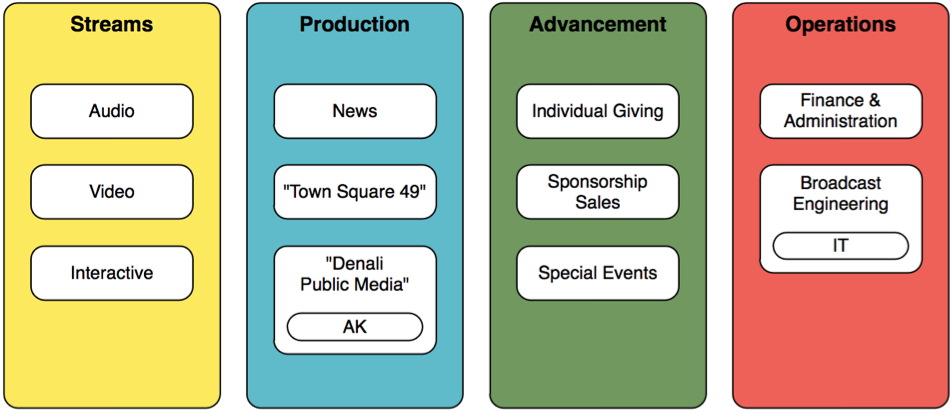
We’re organizing the company in a completely new way, using four divisions:

  • Community Media Streams
  • Media Production
  • Advancement
  • Operations

Previously we were arranged into platform and functional units with a total of 8 people at the “management” table, including the CEO. Now our “managers” number only 4. The old breakdown:

  • KSKA-FM
  • KAKM-TV
  • APRN
  • Broadcast Engineering
  • Information Technology
  • Development
  • Finance & Administration

Much of this organizational structure stemmed from the two mergers that created APTI as it stands today.  TV and radio uneasily merged in the early 1990’s.  APRN was merged into the company (by necessity, I would contend) in 2004.  Since each merger, the units have largely acted alone — and have competed for resources.

The primary collapse is to bring together radio and television and the web — to date just a subset of my duties — under a single manager (me).  Other public media companies have called this a “Chief Content Officer” or some nomenclature like that. We decided to split what others might call “content” into streams and production because we felt the two were fundamentally different things. Media Production makes programs.  Streams creates experiences.

I’m falling asleep as I write this, so I’m going to stop here.  There’s much more to say, probably this weekend and, really, for months to come. In the mean time, here’s the formal press release (PDF) crafted by our own CEO on Thursday afternoon. It’s intentionally brief and vague.  We have longer docs we’ve been developing internally.

More later. And thanks to all the Twitter pals out there that patiently waited to hear more!

Not to be repetitive, but… NPR + PI = ?

Back on the 31st I mentioned the NPR purchase of Public Interactive (PI), wondered what the meaning was and hoped for some announcements or details from NPR. Since then there’s been more discussion out there, including a rather long post by Robert Paterson as well as a short one from Sue Schardt. The NPR CEO himself, Dennis Haarsager, posted on the topic as well, including…

I will have a lot more to say about this, how we got here, where we hope to go with it, and who the key players have been in this multi-year effort to extend public media’s impact in a future post.  PI will continue its current range of services, but it would also be useful to think of it as the beginnings of a new digital division within NPR which will operate with the same culture of neutrality as has characterized public broadcasting’s satellite distribution systems for decades.

That’s encouraging, but vague. Knowing Dennis’ capacity for system design and strategic thinking, I definitely feel better that he’s at the helm, but I sure would like more details on what’s behind the purchase.

In the mean time, I’ve exchanged private Twitter messages and e-mails with a few folks outside and inside NPR. To date, either no one knows what’s going on with the purchase or they’re not willing to say. Very odd. A major purchase like this would, presumably, be backed up with a “big idea” or a plan for the future, and you’d think people would be excited to talk about it.

So I’m still in the camp of “huh?” when it comes to the NPR / PI deal. I’m not against it, but I’m not seeing the value yet. I’m hoping Haarsager in particular can shed some light in the coming weeks.

But I’ll be more specific: I’m not interested in more web templating services from PI or any other vendor. They don’t really help me provide valuable, organic, human-scaled interactive experiences for — and with — my community.

My station’s use of any media platform must be authentic and must be “tuned” to the rhythms of the platform and the needs of the community.

So if I’m providing interactive web services, they need to feel organic, natural, part of the web’s fabric and not a “patch.” The PI offerings have, in my experience, felt like patches. They were designed for stations that had no “digital natives” on board and could not or would not invest in next generation services, but still had to have something on the web. A noble goal in its way. Unfortunately, such services encourage stations to treat the web as an afterthought, as a necessary evil, not as a next-gen media platform that operates on a new set of principles.

As tools on their own, the PI services are fine. They work as advertised (which is more than can be said for a lot of software). But they all have the feel of “made somewhere else” and “commodity package we bought just to get this done.” It feels hollow. Ning sites feel more organic.

If NPR bought the PI toolset and services with the idea of just selling them to stations as PI has done since inception, then this deal makes no sense; then it’s just a game: PRI owns it, then NPR owns it, maybe APM is next or PBS or whatever. But if NPR plans to use the skill sets resident in the PI staff to go in some new directions — more like API stuff, less like web templates — then this might make a ton of sense, and it’s a service I’ll want to use.

Too bad NPR already had a smart web services team in-house, unencumbered by the legacy PI business model. NPR could have started in-house with the team they have. Although I suppose buying PI gives you political cover while you develop these services. NPR Board and management can focus on traditional PI operations while substantial behind-the-scenes API / utility development costs are incurred. Maybe the PI purchase is just a new media red cape keeping the old media bulls distracted.

Am I being too cynical here? What am I missing? And when do we think NPR will come out and say what their plans are for the PI purchase?