If 'newspapers' can die, then 'public broadcasting' can die, too

I’m so glad the newspaper industry is blazing the trail to either self-transformation or self-immolation in this new media world. Public media companies are being given a very close look at an industry in gut-wrenching transformation just before our own will undergo the same. The trail before us has been blazed, and we should be thankful.

Recently in Online Journalism Review, Robert Niles wrote a great link-bait article — It’s time for the newspaper industry to die — in which he explains why newspapers need to dump the word “newspaper” from their internal lexicon and psychology. He offers several reasons for this.

But the best reason centers on that favorite word of mine: Community. And the reason applies to public media, too.

Niles recognizes a fundamental shift in newspapers over the last decade: they’ve cut back on real community service while maximizing shareholder profits.

Great content and great tools are not enough to build the large, habitual audience that content publishers will need to maximize their opportunities to make money online, through advertising and sales. Even more than those two things, a website needs great engagement with its readers. And engagement with the public is something that’s been budgeted out of too many newsrooms over the past generation.

It’s time to bring that back. It’s time to do that online. And if a beloved label needs to be sacrificed to inspire the innovation that will enable this effort, so be it. It’s time for the “newspaper” industry to die. Because we all need the news industry to survive.

I would submit the term “public broadcasting” can take the same route to oblivion. One-way broadcasting can no longer be the point, even if that’s the most comfortable thing to do. Community engagement, public service, gathering, convening, whatever — that’s got to be the goal. Broadcasting is a tool, a means to an end of public service.

What we want from a “newspaper” isn’t fish wrapping or bird cage lining, it’s news, information, connection to events. What we want from broadcasting is pretty similar. But let’s not confuse the delivery system with the purpose. And let’s not believe for a moment that retransmitting someone else’s non-local, marginally-relevant content is something worth preserving in a world of on-demand access to all content anywhere.

Since entering the public media world professionally almost four years ago, I’ve always thought the Corporation for Public Broadcasting (CPB) was ripe for transformation (and not because of that Bush administration weasel Kenneth Tomlinson). Why? Because they need a name change and a mission reevaluation. It’s too bad the purpose of the CPB — funding and fostering public Broadcasting — has its instructions enshrined in law.  It’s making it difficult, if not impossible, to fund new projects. Consider this Q&A between IMA’s Mark Fuerst and CPB’s current president, Pat Harrison, at the recent IMA 2008 conference in Los Angeles (audio clip, about 1 minute):

[audio:https://gravitymedium.com/wp-content/uploads/2008/04/harrison-on-funding2.mp3%5D

Harrison gets it. Sure, she’s referring to reauthorization for CPB in Congress, but that’s just cover for avoiding talk about shifting funding out of pure broadcasting and into community engagement. (In fairness, the CPB has spent millions over the past several years on new media research and projects, but as I’ve noted before, we haven’t really seen any transformations.)

This is really too bad. Because while newspapers are stuck with an old term and a psychology that’s hard to shake, we have those challenges plus actual laws that govern a significant portion of our funding. To change the laws or create new ones to foster and fund community building and interaction via all available media may be politically impossible.
TWiT tackles news, blogs, NPR, podcasting, new media

This Week in Tech (TWiT) is a great little tech-oriented podcast with a broad international following (somwhere north of 200,000 weekly listeners). But on the March 31 show they went off the tech industry track and tackled issues related to news, newspapers, news radio, NPR, podcasts, blogs, Twitter, reporting and more.

Public media folks may be interested to hear how folks that work in media — but outside our industry niche — talk about what we’re doing and the major trends affecting everyone publishing everything.

You can listen to and/or download this week’s episode here.

While you were out…

Robert Paterson continued the hit parade of great writing while I was away and there are two do-not-miss pieces that public media folks should have read. If you haven’t yet be sure to check these out…

WETA – Bringing the heart to Radio – Future of Public Radio
There’s a ton of great insight in this one piece. Given that many stations are in pledge at this time, I found one quote to be especially timely:

Look deep into the idea of Membership and you will find it is usually about if you do this we will do that. Or it may be if you don’t do this we will go off the air. The word Tawdry comes to my mind.

But he’s not really writing about membership or pledge or ratings, in the end. His piece talks about building relationships through shared experiences and values. It’s the essence of “social media” and what we do when we’re at our best today and what we must do to build a sustainable future that has shared meaning for a media outlet and a group of media consumers.

If you want to get a handle on how/why social media will trump mass media in time, this is where you start reading.

The Mystery of Attraction on the web – Luis Suarez
This piece is a little more personal and for public media folks requires a little more reading between the lines. While Paterson describes an experience of meeting a new person via social media tools online (which in itself is fascinating), the real meaning comes later as he discusses how online media is closing the loop on human social patterns that began before recorded history. Technology may in fact be recreating social models that have been broken (by technology) over the past 100 years or so.

I know — that sounds really big and really out there. But be sure to read the piece in full and all the comments. My own experience is beginning to parallel Paterson’s due to three changes in my life: first, I live in a smaller community than in the past; second, I work in public media (which is a tiny community); and third, through online tools like blogs, Twitter and more I’m finding others that are grappling with issues similar to mine and interacting with them. My “community” is deepening at a time when society as a whole is becoming much more shallow.

Some choice passages:

We most of all wish to live in a village – in a tribe – the web enables us to find the best village and tribe possible as it offers us the choice of the whole world to find the best matches rather than having to make the best of our blood and local pool.

It means that we have to rethink the whole idea of “local”. My village is made up of people who live all over the world. I have closer ties to them than to most that live 10 miles away from me.

It means that community as far as My Community cannot scale beyond a small town. Otherwise there is too much noise.

It means that those who wish to design for community would be advised to follow the rules of community in real life – In real life, we scale out from those that mean the most to us to the noise.

So if you worked for a TV or radio station and you accepted this realty – how would you approach connecting to your city?

For public media folks that wish to move from mass media to social media, these ideas are critical. The tribe — as described here and repeatedly by Seth Godin — is not just some marketing-speak. It’s about shared experience and shared values, and it’s a path to establishing a new and enduring meaning for public media. After all, haven’t we promoted the idea that public media are the beacons of quality in a world of crass quantity?  Well, now we have the chance to live up to the talk.

We won’t be everybody’s best friend, but we can aim to be in the smallest, tightest circle possible with those that share and value our public service ideals.

Why traditional TV production is dead

TV stations and professional staffs — commercial and noncommercial alike — have been around for more than a generation. Television started in the middle of the last century and since then thousands of people across the country have built careers upon the technologies, processes and the advertising dollars that flowed freely for decades. A complex art and science, TV demanded workers develop expertise with an arcane and complex set of tools for their unique work. Creating a high-quality TV show was impossible without armies of specialists to turn all the required knobs and punch all the required buttons at synchronized moments.

Money from national and local advertisers flowed easily to television stations — the mass medium of choice that gave advertisers access to an impossibly huge audience; an audience bigger than the daily newspapers; an audience bigger than any single radio station. Advertising money built the industry, dollar by dollar, viewer by viewer. It’s been a great ride.

But those days are coming to an end. Actually, they’ve already ended. Advertisers and TV execs have simply been slow to realize it and are only now starting to act. (Think of it as the music industry, circa 1995.)

Why? What’s happened in the TV market to make stations swing from cash-rich to cash-poor in just the last 10 years? What’s bankrupting the system? And is this a permanent trend or just a temporary blip? Here’s the answer in less than 5 minutes:

The economic model of traditional TV has imploded as the viewing options have exploded (not to mention all the competing technologies that have emerged in the last 10 years, exacerbating the problem). And as the money for TV broadcasting goes away, the ability to produce programming similarly dries up.

For small and midsize public television stations (not the rich behemoths like WGBH) that want to produce original programs of public value, the path ahead is actually pretty clear and comprises two primary modes:

  1. Big TV. Large-scale high-end TV productions will be few and far between. They will be funded as independent projects, will mostly involve outside contractors rather than inside employees, and will draw most of their funding from external one-off granting sources. Public media companies might manage or “host” these projects, but we won’t fund them from operating cash. When 1 or 2 hours of “PBS quality” video costs $250,000+ to produce, it’s clear the economics are beyond the meager budgets of smaller stations.
  2. Small video. Ongoing local productions must scale back to one person + camera + laptop, in variations of the VJ (video journalist) model, as espoused by Michael Rosenblum and others. These small productions must be aimed at multiplatform niche distribution rather than mass entertainment. Plus — an important second fact — we won’t produce all this content by ourselves. We’ll curate and collaborate in ways that will make the traditionalists scoff and sputter. In the end, “TV” folks will either become multifunctional “video” folks or will have to leave for production jobs at specialty video houses.

And that’s just the short-term transformational model (up to 5 years), focused on video content production. It’s quite possible that owning an actual television station (the licenses, the towers, the impossibly heavy technical infrastructure) will become economically unsustainable rather quickly as new technologies chip away at TV’s traditional dominance. Indeed, owning a local over-the-air TV station is likely to be financially dangerous to all but the most efficient regional or national network owner-operators by 2015.

If we in public media believe it’s our mission to serve the public interest using digital media, then video must be part of the equation. But does “TV” have to be in the mix? In the short term, definitely. In the long term, maybe, but probably with significant strategic changes.

For now, we may not know the fate of local TV stations, but traditional TV production models are already dead. The revolution is underway. Click below for another 90-second forehead slap:

So these are the market realities. It’s up to us to decide whether these are exciting or threatening developments. Should we engage and evolve or should we hunker down and hope for a different future?

I know my answer. What’s yours?

Paterson, Mundt, Carvin trifecta on KCUR

Great show today on Kansas City’s public radio station KCUR with guests Robert Paterson, Todd Mundt and Andy Carvin. The topic? Surprise! New media and public media.

Worth a listen, especially if you’re a little confused about how public radio and public TV can engage the world in an online context.

[audio:http://kcurstream.umkc.edu/UTD/UTD_3-20-2008.mp3%5D

Total time: about 51 minutes. Download the MP3 here.

(By the way, I’d link to the web page at KCUR, but it appears it won’t be available after this week due to the way it’s published using the Public Interactive CMS.)

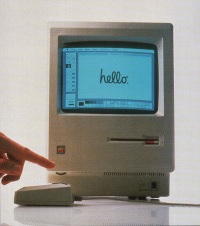
Apple II vs. Macintosh — Can public media follow this example?

Do you remember the Apple II series of personal computers? I certainly do. I got my first one in January 1983 (the Apple IIe) and it was a revelation. Back then the Apple II dominated the personal computer space (IBM was just introducing the first IBM PC). It was a serious cash cow for the new wonders of Silicon Valley: Steve Jobs and Steve Wozniak.

But even in 1983, in the peak of this tremendous success, Apple was reinventing the personal computer. They were secretly inventing the Macintosh, which was introduced a year after I got that Apple IIe in January 1984 (with the famous Superbowl ad).

Developing the Mac was a massively expensive proposition. New chips, new software, new case designs, a mouse, even a brand new 3.5″ floppy drive developed by Sony but still considered cutting-edge and risky. Everything called for clean slate development in order to get it all just right.

So what funded this engineering miracle? The successful and highly profitable Apple II series. And guess what — the Mac wasn’t profitable at launch. That first year was deadly. Apple introduced a $2,500 computer ($5,100 in 2007 dollars) that had two software programs: MacPaint and MacWrite, and it wasn’t compatible with the growing library of Apple II software titles.

Check out this brief video (43 seconds) of Guy Kawasaki recounting how the Mac team was funded by the Apple II team, and the considerable tension this created:

I often think of the Apple II / Macintosh example when conversations in public media circles turn to the question of how will we pay for this new media stuff that doesn’t make any money and takes money out of the profitable broadcasting business. Newspapers and the music industry are also great analogies for public broadcasting.

It takes real leadership, real courage to deliberately take cash from a profitable and successful unit and sink it into the next big thing, even if it takes years for it to pay off. Plus, you have to deal with the political pressures to stop funding this financial black hole from the “reasonable” business people all around you (on the board, on the management team, in the community, on the staff). As I look at my own public media business today, we’ve not even begun to seriously tackle the challenges of the new media world — chiefly because “Apple II” folks are in charge. I often wonder whether we should give up trying to reform the core of the company (a la Ideastream) and simply fund an external unit that can focus on the new media challenge without interference from the traditional “cash cow” part of our business.

The one example of “put it outside the core” I know of in the public media world can be found at Chicago Public Radio. Their Vocalo project (as described by Robert Paterson), is an external unit in every sense of the word. They have separate facilities, a new name unaffiliated with the old name, a separate budget, different leadership, different content and business models, etc. It’s a fascinating approach, and it mimics the Apple experience.

But I’m wondering… is anyone else in public media doing this? Who else, if anyone, is creating distinct subsidiaries for innovation? Is anyone else willing to spend their Apple II money on their Macintosh project?

Tending the Public Media Tribe

If you’re not reading Seth Godin, you’re not paying attention to the future of successful public media. Godin doesn’t address public media directly, but he does address issues of marketing and community and the economics of making money through the products or services a company provides in a new media world.

Godin talks a lot about tending to your “tribe” — that group of people that love your product/service and who share your values or perspectives and interests. If you’ve been in public radio or TV for any length of time, you know these folks. Most likely you’re already a member of this tribe yourself.

Recently Godin gave a talk at a music conference and his comments, while aimed at a music marketing audience, are applicable to all of us in public media — news, music, radio, TV, whatever — because the trends affecting the music business (disastrously) today are the same ones rewriting the rules for all media. And the rules for success in the next generation will be the same: serve your tribe; be indispensible; be the best.

Here are some highlights from Godin’s talk, pointed out by Gerd Leonhard and partially chosen by digitalwaveriding (the boldface highlights are mine):

if I asked you for the name and address of your 50,000 best customers, could you give it to me? Do you have any clue? [No?] Then what happens every day is you go to a singles bar and you walk up to the first person you meet and propose marriage and if that person won’t marry you, you walk down the bar to every single person until someone says “I do.” That’s a stupid way to get married. A better way to get married is to go on a date. If it goes well, go on another date. Wait to tell them on the third before you tell them you’re out on parole. Then you meet their parents, they me your parents, you get engage, you get married. Permission is the act of delivery. Anticipated, personal and relevant messages to people who want to get them.

… The next thing is what I call the Seinfeld curve. The Seinfeld curve shows us Jerry’s life. If you like Jerry Seinfeld you can watch him on television, for free, in any city in the world two or three times a day. Or, you could pay $200 to go see him in Vegas. But there is no $4 option for Jerry Seinfeld. This is death. You can’t make any money in here. Because if you’re not scarce I’m not going to pay for it because I can get it for free. And one of the realities that the music industry is going to have to accept is this curve now exists for you. That for everybody under eighteen years old, it’s either free or it’s something I really want and I’m willing to pay for it. There is nothing in the center — it’s going away really fast.

… The next thing is this idea that people care very much about who is sitting next to them at the concert. They care very much about the secret handshake. They care very much about the tribal identification. “Oh you like them? I like them!”

… It’s really important to people to feel like they are part of that tribe, to feel that adrenaline. We are willing to pay money, we’re willing to go through huge hoops, trampled to death in Cincinnati if necessary, in order to be in the environment where we feel that’s going on.

… I want to argue that the next model is tribal management. That the next model is to say, what you do for a living is manage a tribe, many tribes, silos of tribes. That your job is to make the people in that tribe delighted to know each other and trust you to go find music for them.

… There is a lot of music I like. There is not so much music I love. They didn’t call the show, “I Like Lucy,” they called it “I Love Lucy.” And the reason is you only talk about stuff you love, you only spread stuff you love. You find a band you really love, you’re forcing the CD on other people, “You gotta hear this!” We gotta stop making music people like. There is an infinite amount of music people like. No one will ever go out of the way to hear, to pay for, music they like.

Fortunately or unfortunately, the future for public media companies will involve considerable “tribe management” and will involve a smaller audience than we have today, either locally or collectively — all media will have far more fragmented communities than in the past. Now is the time to identify who’s in and who’s out of your tribe and figure out how best to serve the community that gathers around public media content and values.

This may sound elitist or even fatalistic to the traditional mass media thinkers out there: “But I want the biggest audience possible!” Well, you can’t have it. Large audiences of mildly engaged viewers or listeners or readers are the old model. The new model requires deep and authentic engagement with that “tribe” of people. You can still invite everyone into the tribe, and you should. But in a world of infinite tribes, folks will naturally gravitate to the tribes that best serve their needs and interests (and they will have multiple tribes, of course).

Personally, I think this is an incredibly exciting time for public media folks that embrace this new approach. There’s new opportunity not only for sustainable businesses, but for truly meaningful, impactful and interactive work. The only problem is developing the courage to let mass media thinking fade over time, even though it’s been tremendously successful for the last 40 years.

Haarsager on NewsGang podcast

Dennis Haarsager, new interim CEO at National Public Radio (NPR), appeared on the NewsGang podcast this past Friday. He spoke fairly openly about the unusual CEO transition and about how NPR may change as it deals with an audience that’s moving to new media distribution channels and interaction platforms.

In addition to Haarsager, the guest list included Stephen Hill from Hearts of Space, Steve Gillmor (the host), and Doc Searls, who also appeared on a panel at the recent Integrated Media Association conference along with Haarsager and others.

UPDATE: Highly Recommended Listening. Haarsager and friends go into depth talking about new media economics and public media’s entanglements — or lack thereof — with new platforms. Money quote from Stephen Hill: “Show the stations how you’re gonna keep them in business and they’ll be very happy to cooperate with [NPR].”

Running time of the MP3 file is about 1 hour, 25 minutes.

[audio:http://www.gillmorgroup.com/media/NewsGangLive-2008.03.14.mp3%5D

The link to the NewsGang podcast has also been added to my (still growing) list of Ken Stern articles.

Proponent of FREE appears on Charlie Rose

I’ve pointed to the new Chris Anderson article/book on the notion of “free” as a business model before. But here’s a great introduction for those that want a no-nonsense introduction, mediated by Charlie Rose.

Additionally, offering insights into recent tech industry developments is TechCrunch’s Michael Arrington (this part is less important).

[google -1951879923858017460]

Found via Gerd Leonhard’s site MediaFuturist

Defining community and audience

One of the things I’ve found my traditional pubcasting colleagues have trouble understanding is the difference between the words community and audience when it comes to discussing Media 2.0 strategies and modes of action. It’s a critical distinction, as understanding which type of group you’re serving completely changes how you’ll approach what you do for them (or with them).

Mindy McAdams, online journalism professor, pulling a quote from Clay Shirky’s latest book, points to the key differences between having an audience and participating in a community.