PublicMediaCamp thoughts and project coming

pubcamp

I’m currently in Washington, DC, about to board a flight home to Anchorage. I’m still thinking about the weekend’s activities at PublicMediaCamp. I have session notes to post to the wiki, I need to edit up and post the video I shot and I need to get rolling on the project I agreed to start. Sheesh!

But for now I have 14 hours of flying, a short night, and then back to my day job. In the mean time, thanks to @corbett3000, @acarvin, @jdcoffman and everyone else that supported and attended the event.

Should public media make Education its mission?

UPDATE: I added some comments about what “education” means to me at the bottom of the post.

O'Reilly RadarAn interesting new article was posted last week that caught my eye (thanks to @kevintraver):

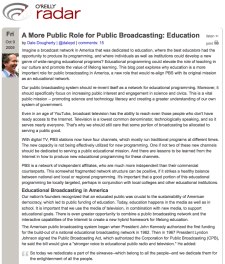
A More Public Role for Public Broadcasting: Education
by Dale Dougherty / O’Reilly Radar

The gist of the article seems to be that public media — though Dougherty focuses almost solely on public TV — should use it’s ample broadcasting bandwidth to focus on educational content, from traditional kids programming up through lifelong learning and civics topics. Using TV is considered better than using the web for accessibility reasons (which broadly makes sense given the cost of broadband in this country).

While I like the idea in broad strokes, I think Dougherty is missing a lot of insider knowledge of the industry as it exists today and how it’s funded. So I submitted a comment to the site that goes like this:

This is a nice idea that will never happen. At least not without a huge change in direction for public media and government (i.e. voters).

Whether or not education / lifelong learning was in the 1967 PBA is now irrelevant. Public media institutions have drifted far from education over the years and aren’t coming back. Why? Because education doesn’t make enough money to be self-sustaining. Which is why taxes pay for schools and students pay for college.

With all due respect to Mr. Lippincott and other former colleagues in public TV, let’s get real. PBS’s best work is done in children’s programming and it’s marginally educational. The only way it’s strongly educational is with deep parental involvement (rare) or direct classroom tie-ins in schools (limited for political and time management reasons).

To make the Education mission a reality in public media, taxpayers would have to agree to foot the bill of perhaps $1-2 billion annually. That would be cheap for what we could get, but not likely. Further, it’s becoming very clear that education via online video and other means is exploding and to do this work via TV is anachronistic if not downright wasteful.

The short-run plan for PBS: keep doing what it’s doing until it collapses financially (by 2015, I’m betting). Once that happens, the children’s programming will remain in a reformatted PBS, the news content will go to a reformatted NPR, and WGBH will gobble up the rest and become a national superstation.

If, on the other hand, you consider quality news a form of education (which, in truth, it is), then you’re talking about NPR for the most part, and they’re the shining hope for public media.

I’m big on having a bold mission, articulating it and making meaningful community impacts. But my take is that well-done news that intelligently informs the electorate in times of turmoil (say, the next 25 years) is more supportable and more meaningful than trying to take on the education monster, in which everyone has opinions of what should be done but no one is really in charge and everyone is underfunded.

UPDATE 14 Oct 2009 2:30am EDT

After a Twitter exchange with @MarkRyanWFWA (follow him!) I realized that I may be defining “education” more narrowly than others would like.

For me, education is a fairly systematized approach to providing information and then following up to ensure the information was understood and can be practically applied. So when I say public media should not adopt education as its primary mission, I mean it. I just mean it in my own way.

Of course, “public media” can even be debated as to its meaning. In it’s largest sense it means creating / curating / sharing media in service of a public good. That’s great, but I do think for practical reasons we have to sharpen our missions much more than that. To me, that means news and information aimed at already-educated (to some degree) people to allow them to live their lives more successfully and make decisions as citizens that have positive impacts.

Education is definitely a public good. I just don’t think public broadcasting, as it moves to public media, should focus exclusively on that mission.

PublicMediaCamp 2009

PublicMediaCampWelcome PublicMediaCamp attendees!

You may be wondering, “What — or who — in the world is Gravity Medium?”

Well, the short version is this:

  • my name is John Proffitt, I currently live in Anchorage, Alaska and this is my blog
  • I’ve worked in public media in the past (radio, TV, web and news)
  • I’ve been blogging here since early 2008 on public / digital media topics
  • I’ve been on Twitter — @jmproffitt — since early 2007; I also have @gravitymedium on Twitter
  • I lead a Twitter community called Alaska Tweets
  • I’m a huge fan of Umair Haque, Seth Godin, Robert Paterson, Clay Shirky, Jay Rosen, Jeff Jarvis and all the hard-working web pros in public media today
  • more than anything, I want the legacy values and services of traditional public media moved to the web, where I and the generations that follow me already live most of our lives

And perhaps most importantly…

  • I’m damn excited to be attending PublicMediaCamp 2009 in DC!

I chose to become a “sponsor” because, well… it’s going to be a great conference (or un-conference, if you prefer) and I feel kinda bad about getting in for free. And, c’mon — let’s get real — a little blog traffic wouldn’t kill me. 😉

Blogging & Tweeting

me-180Right now (early October), I’m firing the blog back up with a revised site design and more postings. Plus, I’m expanding my Twitter community via @gravitymedium. Gravity Medium has been largely quiet for months as I’ve made some professional changes and as I’ve worked heavily on building a social media community in Anchorage.

The PublicMediaCamp has given me new energy to fire things back up. And I owe special thanks to both Karen Olstad, COO at WOSU Public Media and to the Energizer bunny of digital media at NPR — Andy Carvin — for suggesting I attend. They moved me from “meh” to “Yeah!” and I can’t thank them enough.

PublicMediaCamp Tweetup: Friday

Thanks to @acarvin and @jdcoffman for organizing one of my favorite things: a Tweetup!

Photos

My photos from the conference are all posted to Flickr. Check out my photos or all the photos in the Public Media Camp group.

Finding me online

If you’re looking for me anywhere online, you can find pretty much everything on my Google Profile.

Nonprofits and engagement media

I’m out of the nonprofit world these days, but I’ve spent some years in it, so I’m not at a total loss as to how things work and how cultural norms accrue. I’ve got my opinions, to be sure.

So when I saw, via FriendFeed, a post from Beth Kanter — Seth Godin’s Non Post About Nonprofits: Deers in the Headlights? — I was curious. I like both Kanter’s and Godin’s work and this seemed to be generating some buzz. So I clicked over to both Kanter’s post and to the original Godin post: The problem with non.

Quite a bit of the conversation was on Kanter’s site, so I joined the fray with the following post-length comment…

I was, until recently, trying to develop engagement media practices inside a public media company. It was a disaster, but not for the reasons most nonprofit managers would point to.It wasn’t about the tiny budgets or the excessive time required. It was about EXACTLY what Godin was talking about: resistance to change and slothful, good-enough-for-a-nonprofit management practices. It was also because the traditionalists liked their ivory tower positions; they liked speaking from on high to the little people in the audience. I was told we didn’t want to get the public involved in public media — that’s too messy.

Godin has nailed it and the reason for the violent response is precisely because he nailed it.

Lots of nonprofit workers, after a while, develop a sort of victimization mythology that serves the stagnation problem. “I don’t have enough money, so I can’t do this, so I can’t make more money… woe is me. But I’ll keep at it because I’m such a nice person. And maybe someone rich will come along and notice me. It could happen!” I saw that all the time.

Is it all nonprofits? Nope. But it’s a lot of them. Of the 2 million out there, how many are really creating engaging relationships with donors or their constituents regularly? Maybe 10,000? Whatever the number is, it’s not enough.

Here are the key nonprofit organization questions you have to answer:

  1. Who are you, why are you here, and why should anyone care? (And if you spit out a mission statement, you just failed step 1.)
  2. What are you doing today to build authentic, meaningful relationships with donors and potential donors? (Mass mailings via any means don’t count.)
  3. What are you doing today to build authentic, meaningful relationships with the individuals, firms or communities you serve? (Look up the words “authentic” and “meaningful” before you answer.)
  4. What are you doing today to connect your donors and your beneficiaries, either directly or indirectly, so the donors feel energized and involved and the beneficiaries feel supported and involved, too? Or in other words, how are you building a community around your mission? (And broadcasting doesn’t count as connecting.)
  5. Given #1, what tools will best help you handle #2-4? (Notice I made no mention of Twitter or any other social media tool.)

charity:water is just the beginning. There’s a new generation of donors growing up right now and they won’t take your call or your e-mail or your mass mailing. But they will respond to an earnest call for help, especially from a friend they know. The next-gen trick is to be that friend first.

Nonprofits had best start making new friends. Because the old ones are dying and the broadcast campaigns (e-mail blasts, newsletters, appeal letters) will largely die with them. There’s still a place for building awareness, but action will come via relationships.

Godin’s pointing all this out through this post, his recent Tribes book and plenty of other posts. It’s a tough message, especially if you’re a “victim” inside a change-averse nonprofit (or a for-profit, for that matter!).

From here, you can deal with it — seeking new ways to engage your community — or just hope he’s wrong.

Frankly, I think it’s more fun to engage with your community regardless of what Godin says. But if proving Godin wrong sounds more fun to you, enjoy.

What I didn’t mention in my comment was my own immediate experience with fundraising for a cause via social media — via connections built across my own “community.” It was a small, first effort. But it was the collective action of a group of people with no nonprofit organization whatsoever. We came together to help a friend we’d literally never met.

For my generation and especially for Generations Y and Z, the old impersonal “broadcast” approaches used in public media and across the nonprofit spectrum will have diminishing returns.

But if I know you and you know me and we know we care about one another in some meaningful way — if we’re engaged in each other’s lives — the support will be there.

Alaska public media falling apart

Updated 16 Sep 2011. Updates at the bottom of the post.

Things are tough all over the public media world these days. But if you think you’ve got it bad, you should try working in the Alaska public media world. It’s brutal.

In case you hadn’t heard or figured it out, I was fired from APTI back in March, along with our news director, ostensibly for failing to “align” with the CEO’s preferred — and secret — strategy of merging all the public radio and TV operations in the state into a single company (there are roughly 25 separate companies). We were firings #3 and #4 from a management team of 7, all in less than a year. The GM hired a personal friend to replace us literally the next day. Oh, and the rest of those 7 managers? Only 1 is left, and that position was demoted below management level last year.

So if you’re feeling down about pay freezes, furloughs or being laid off, just be glad you’re not living with this series of unfortunate events (and these are just the ones from memory)…

August 2008

  • APTI (Anchorage): Reorganization – General Manager (GM) fires Communications/TV and Development directors; no one hired to replace them

December 2008

  • APTI (Anchorage): Award-winning and beloved statewide program, “AK” is canceled, staff terminated

February 2009

  • APTI (Anchorage): GM decides a statewide merger of all public radio and TV stations into a single company is the strategy of the future; GM doesn’t announce his intentions to the rest of the company or the other stations in the state — stations that have been suspicious Anchorage would try this one day
  • KTOO (Juneau): It’s revealed — privately — that the Juneau-based stations are roughly $250,000 in the hole due to falling underwriting sales and other issues
  • KUAC (Fairbanks): It’s revealed — privately — that the Fairbanks stations and statewide TV service (AlaskaOne) lose roughly $1,000,000 per year, but the University of Alaska Fairbanks fills in the financial hole annually

March 2009

  • APTI (Anchorage): Strategy change! News/content and broadcasting/web directors fired; GM’s personal friend hired to replace them (a print journalist and professor with no broadcast or public media experience)
  • KUAC (Fairbanks): GM quits to take a job out of state; he’s not replaced

May 2009

June 2009

About that last item… I met with and worked with KYUK’s GM a few times. He was one of the good guys. He resurrected the station’s finances and dealt with the privations of living in rural Alaska — a far cry from his decades of work in the Lower 48. I won’t name him here as that’s not really my right to do so — you can look him up if you’d like. But I can say I sure wish he had taken the GM job in Anchorage back in mid-2007. Things could have turned out very differently for a great group of people that have persevered through so many challenges in the last few years. They don’t deserve the chaos they’ve inherited.

Crystal Ball Time

I have no idea what the future holds for public media in Alaska. Public radio — of the rebroadcasting NPR variety practiced in Anchorage — is probably pretty safe, barring straight-up mismanagement. Pubradio gathers a good chunk of change in Anchorage and the cost structure is comparatively light. Public TV is another story. The cost of merely rebroadcasting prepackaged material is excessive and traditional TV production is out of the question for pretty much all the stations in Alaska (without special project funding, which goes to outside contractors anyway).

Internet effects on the business models are definitely coming to urban Alaska, as are demographic shifts that represent brand new media consumption habits for which public media outlets aren’t really prepared, at least not here on the continent’s edge. Those changes will occur slowly, accumulating quietly until, one day, it’s just too late for the old guard to meet the new challenges, and that’s when public media either gets more government funding (a bailout) or it just disappears.

For the Alaska stations, and especially APTI in Anchorage, the biggest problem remains the same one I identified when I started working there in late 2004: You must answer two questions: [1] Who are you? and [2] Why are you here?

Those questions remained unanswered for my entire career in Alaska’s public media world, no matter how many times I asked or how hard I pressed for an answer. (The current GM thinks he answered those questions with a “strategic planning” process everyone regarded as a waste of time.) But without knowing, deeply, the answers to those seemingly-simple questions, it doesn’t matter what “strategy” you have — you’ll drift, you’ll live off the good intentions of past supporters. Without those two answers your future will be created by fate, happenstance, luck and disaster rather than by coordinated effort around a shared, meaningful goal that’s relevant to the world today.

But enough of all that. What happens next in the 49th state’s 50th year? Hopefully nothing worthy of adding to the harrowing list above. Public media up here needs a breather.

And maybe, one day, new leadership.

UPDATE: 15 Sep 2011

A few weeks back, the other shoe dropped. APTI and the other Alaska stations officially gave up on merging the stations together into a unified company. They are continuing to look at unifying the TV service.

This is both a relief and a vindication.

In the months leading up to my ouster, I was clear with the CEO in that I opposed the organizational merger concept, though I agreed that the TV services should be unified since they were so deeply and unnecessarily duplicative.

In place of pursuing a merger, I specifically recommended the organization spend its energies on reconnecting with the local community, not trying to create some mythical “all Alaska” media firm. There were so many things we could do to create meaning and value locally, in Anchorage, that we didn’t need to create a bunch of new work, namely beating back the obvious wishes of those local Boards and communities we’d have to take over.

Now that the merger push is dead, Alaskans that favor local public media can breathe a sigh of relief. Too bad it took 3 years of dragged-out talks and $88,000 of CPB money to get here. I should have just charged CPB $44,000 for the advice I gave on Day 1 and they could have pocketed the other half.

The last thing still under consideration: merging the TV signals into one. This is a slam-dunk and should have been pursued years ago. Oh, wait… it was!

Many years ago (the mid-1990s) 3 of the 4 Alaska public TV stations merged their signals into AlaskaOne. Anchorage was the only hold-out — they wanted to retain local control and — the real reason — local fundraising (cha-ching!). Back then, local PBS stations were pretty localized and raised a lot more money. But over the years all the stations converged on the same schedules as PBS tightened control over common carriage and everyone gave up local production and scheduling capacity as their fundraising and ad sales collapsed.

Today, merging Anchorage into the AlaskaOne family should just be done. The schedules are carbon copies anyway. Hell, I’ve been in favor of PBS just going all C-SPAN and taking the signal national and being done with it. But that’s another story. For now, let’s hope AlaskaOne finally captures Anchorage public TV and APTI turns its attention further and further toward local media and local public services.

Well, except for all the money made by rebroadcasting NPR stuff.

Out of the mouths of (27 year old) babes

If you’re involved in public radio, this is required reading / listening.

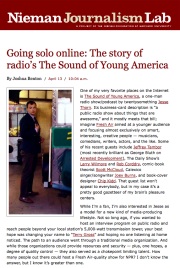
Jesse Thorn, host of public radio’s The Sound of Young America (which is really a podcast that happens to be on a handful of 25+ public radio stations nationwide), speaks with Josuha Benton (Nieman Journalism Lab / Harvard) about his notions of creativity, business, media scale, public radio economics, audience interaction, passion, awesome content and more.

In particular, he nails the problems of the public radio industry today: the saturation of the older, educated white market and the industry’s pull back from attempts to stretch into new market segments with old formulas. He also keenly understands and explains the financial models in “the system.”

Because what Thorn proposes is that public media programs, hosts, writers, and others do is, well… make great content and directly interact with the audience that gels around the content and experience. He’s suggesting you build a Tribe.

Take a listen…

While listening, pay special attention to his observations about how he pays himself for his work, how he interacts with his audience, and how small-scale his show’s production model is. Also pay attention to how he thinks programs in the future will work — using mass media as “calling cards” or “advertising” for the interactive media experience the programs are creating.

From a Tribes perspective and a mass media model perspective, there’s only one other major national project I know of that’s doing the same thing: Planet Money, in a tiny, experimental pocket of NPR. And that could be said to be an outgrowth of the defunct Bryant Park Project.

There will remain a place for mass-produced and mass-appeal general news production. But for everything else, and especially for any local station that wants to survive, your future is in building a community around awesome content and services, a la Jesse Thorn.

Bonus Listening: If you haven’t heard the SxSW presentation by Merlin Mann and John Gruber on creating content online, that’s your immediate next destination. Indeed, here’s your reading list for surviving in the 21st century media world:

Double-Bonus Listening / UPDATE 2009-04-19: Thanks to the unstoppable Jesse Thorn for stopping by with a comment (below) and sharing the link from the discussion at the 2009 Integrated Media Association conference in Atlanta. Highly recommended, too. Thanks Jesse!

Digital Public Media: From Broadcasting to Leading a Tribe

Thanks to @garyinalaska, I was invited to speak at the Alaskan Apple Users Group (AAUG) on March 4 in Anchorage, on a topic more or less of my choosing, but dealing with “digital media survival.”

I took that notion, applied it to public media, and tried to bring forth my current thinking about how we in the public media space — at least where I am these days — must change in order to better serve our original mission and do it in a sustainable and meaningful way. Broadly, I suggested we must move from being a purely broadcasting-focused firm to leading a “tribe,” as Seth Godin would put it.

Frankly, my presentation needs work. A lot of work. But the core ideas are there. We’re only just getting started on this in my firm, so I should be able to revise this in the future once we’ve got more experience. For now, however, here’s the presentation files as well as lots of links that are the foundational pieces of the notions presented. I’d love to hear your comments or suggestions, and if you take these ideas and expand upon them, drop me a link.

  • Tribes: We Need You to Lead Us, by Seth Godin (Amazon.com)
  • Tribes: We Need You to Lead Us, by Seth Godin (free at Audible.com)
    Godin’s book on the tribes notion isn’t perfect (there are complaints out there about generalities that aren’t backed up with examples), but it’s quite good and I suspect it will form the backbone of our strategy going forward. It is not a prescriptive book; it has no “instructions” — it’s more faith than religion, if you know what I mean. In any case, as I noted in the presentation at AAUG, if all we in the current public media are doing is talking at people instead of communicating with and connecting people with shared interests and values, we’re not likely to survive. Content is free. Distribution is free. Contact, context, connection and community are priceless.
  • Seth Godin’s blog
    Godin covers the tribes notion periodically and relates tons of next-generation marketing and communications concepts; highly recommended reading for just about anyone.
  • Seth Godin Talking About Leading a Tribe (YouTube, 6 min)
    Audio quality is a little weak, but crank it up and you’ll hear everything you need to hear. Godin succinctly hits the notion that companies are focused on interrupting you enough to trick you into buying their products or services, but they don’t care about you.
  • Seth Godin: Sliced bread and other marketing delights (TED / YouTube, 19 min)
    TED Talks are legendary and Godin does his typically masterful job talking about marketing. This one is not about tribes, but the notions covered are integral to understanding how our historic mass media model is failing. It’s 19 minutes, but it doesn’t feel like it — he’s a wizard of fast presentations that are smart, funny and revealing.
  • “No One Cares About You” (YouTube, 2 min)
    Short and to-the-point advice to companies that think they need to get into social media to tell the world about what they are doing. Surprise: people don’t care about your company.
  • Kevin Kelly / The Technium: Better than free
    This piece set off a ton of blogosphere and public media commentary last year because Kelly sets forth not only the notion that you can’t stop things (media) from being free, but that there are still ways for companies and individuals to create value and gather revenue. Brilliant stuff.
  • Kevin Kelly / The Technium: 1,000 true fans
    Godin refers to this piece in Tribes, and rightly so. It’s a seminal work in the new media world, as it proposes that an artist can surivive if only he or she can find 1,000 true fans/supporters. Godin suggests, rightly, that the number might be 1,000, but it also might be 100 or 10,000 or 1,000,000 — depending upon your situation. But there is a number, and you need those true fans.
  • The Cluetrain Manifesto
    Now 10 years old, the Cluetrain is still being studied as companies of all kinds try to understand how to behave in the new media, interactive world. The 95 Theses are priceless.
  • Clay Shirky: “Gin, Television, and Social Surplus”
    Shirky addresses the rise of television in concert with the industrial revolution and how it acted as a “cognitive heat sink,” yet now people are participating in media creation rather than simply passively consuming it. Critical to understand because it signals and explains how and why people are, more and more, rejecting
  • Clay Shirky: Here Comes Everybody (the web site)
  • Clay Shirky: Here Comes Everybody (Amazon.com)
    Subtitled, “The Power of Organizing Without Organizations,” this is a critical idea that public media companies must understand. There are aspects of running a public media service that require the power of a formal organization. But engaging with and leading a tribe cannot be achieved by a pure firm (or corporate) approach because it cannot scale. But if we can “organize without an organization,” we can get there. Of special note are his brief references to “cost of coordination” and how and when a firm (a formal organization) is useful and when it stands in the way of progress.
  • Umair Haque / Bubblegeneration Strategy Lab
  • Umair Haque / Harvard Business Publishing
    His writing is perhaps the most dense of any of the links here — it’s probably a half- or full-generation ahead of contemporary economic thinking, so it can be hard to follow. But if you’ve got an imagination to see a world that doesn’t quite look like ours and a world that operates on different economic principles, expectations and practices, you should be following Haque. Those in traditional mass media — especially commercial media — will ignore Haque at their peril. By the way, his PowerPoint slides on co-creation of content (at Bubblegeneration) are equally dense, but there’s a kernel of public media’s future in there: a collaborative approach to media capture, editing and distribution that we could never have considered in the past.

Thanks again to @garyinalaska for the invite. The crowd was great!

Great survey… Have you taken it?

I know in a political election year we all cringe when someone approaches us with a “survey,” especially since those are almost always slanted to one side or the other. But here’s a great one — the PubForge Open Source Collaboration Survey. If you or someone at your public media station haven’t yet taken the survey, please do so right away.

The early results are interesting, as promoted by new media leader Dale Hobson (North Country Public Radio) in a recent e-mail to public radio folks (excerpted here):

Open source software has been widely adopted by stations as a whole: A majority of stations utilize open source software for some aspect of their online service. Where open source tools are not in use, there is considerable interest in finding ways to use them.

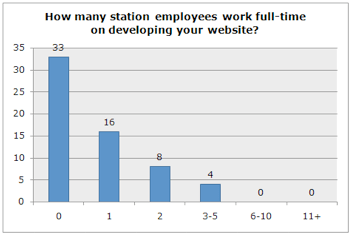
Allocating resources to web development and maintenance is critically low:

  • More than half (55%) of respondents have ZERO full-time employees developing their website.

Top of the development list–stations are looking for:

  • 72% – Freestanding player for streams, archives and user created playlists
  • 72% – Tools to integrate existing social media networks into public media sites
  • 68% – Complete CMS website solution, including audio file management
  • 66% – Software to enable more community participation for public media
  • 61% – Application for supporting micro payments (granular giving) to enable giving around specific content

In addition, the survey provides a snapshot of how stations are managing web content, what in-house skills and tools are available to them, how they are tracking visitors, and what they want to be able to do online, given the necessary resources.

There are more charts, more quotes and summary statements if you visit the site to see it all.

We need these kinds of surveys to be as accurate as possible, and the results are already illuminating. If you’re at a station, work with the web, and have just a few minutes, please take the survey.

Back from the dead / digital collaboration

It’s has been — and remains — insane at the office these days. We’re in the midst of a pledge period for TV, we’re preparing for another one in FM, and for the most part it’s my first run-through these events as the person ultimately in charge of our streams, so there’s a learning curve. I’m finding it easy to pick things up — it just takes time. Plus, the company is still shaking out some of the changes from about a month ago as we radically redesigned the management structure. So far, so good.

I’ve been neglecting Twitter and Facebook and this site for nearly a month as these events have played out. Luckily, it’s kind of a quiet period in public media as folks work through pledge drives and just get back into the non-summer swing of things.

Yet this past week a critical post went up from Dennis Haarsager that’s required reading for pubradio folks and I think for public TV folks as well:

It makes a good deal of sense to me, as it gives a revitalized reason/purpose for national/local collaboration, as opposed to simple distribution. I’m not quite convinced it can be successful, but it’s got a shot if a critical mass of system leaders get on board. I know I’m paying attention.

That said, I’m concerned about future collaborations of all kinds, especially in the wake of a semi-private discussion in which I participated recently.

It seems public media’s chief difficulty today is not one of distribution, but one of mission. Why are we here, really? And do we all share the same response to that question? “Public service,” is not a real answer. We need a product, a specific service that can bind all of us together.

Personally, I think that’s news. I’ve railed against the national TV news media before for their lack of real public service, and I’ve suggested that public media’s greatest strength comes from news.  Not music, not arts and culture, not high society, but news. (Those other things are nice-to-haves, but they aren’t core things around which we can easily collaborate on various geographic or business scales.)

What does news, as a primary mission for public, have going for it?

  • The Associated Press is breaking down as newspapers and stations — including my own — tell the AP to take a flying leap with their high costs and their regurgitated stories
  • Newspapers are distracted as their profits crumble and they seem unable to find a way forward
  • TV news is an abysmal, rancid landfill of time-wasters and poor information
  • New low-cost journalism methods (not necessarily bad stuff, by the way) is on the rise, both in video and print, offering us new opportunities
  • Digital exchange of information and finished media products has never been faster, cheaper or easier
  • We have a public service mission unparalleled in the commercial world — a world setup to distribute commercials, not thoughtful information

NPR grew as media consumers discovered that quality news and information was, in fact, a good thing to have around. It grew in an otherwise toxic radio environment.

We have a chance, now, I think, to develop this shared mission and build collaborative structures around that. At the moment, Haarsager’s initial diagram (PDF) speaks to a broader service set than news alone. But keep the mission focused and the distribution / collaboration system begins to make sense.

Anything new that proposes to simplify collaboration in an ecosystem of diverse and often competing missions probably won’t get us very far.

The Big Announcement – Part 1

So I’ve hinted at it via Twitter over the past couple of days, but not spoken openly until now.

On Thursday, August 14 we began, in earnest, the reorganization of Alaska Public Telecommunications, Inc. (APTI) in Anchorage, Alaska. APTI is a public media company that operates KSKA Public Radio (FM 91.1), KAKM Public Television (Channel 7) and the Alaska Public Radio Network (APRN).  APTI is both an NPR and PBS member and APRN is a statewide news network composed of about 24 public radio stations.

At the moment, I’m kind of exhausted from the many conversations and meetings swirling around this change, so I won’t go into much detail now. I’ll stick to the headlines now and try to do a longer explanation this weekend.

First off, I’m now in a new position. A position so new it has a non-traditional title: Vice President, Community Media Streams.

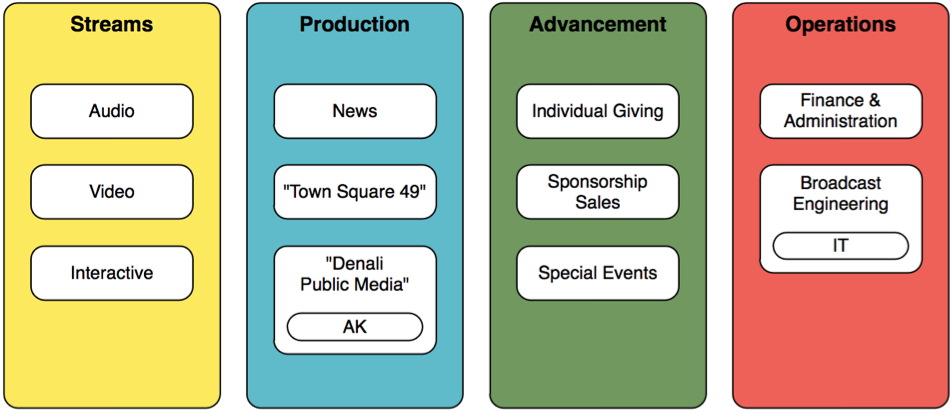
We’re organizing the company in a completely new way, using four divisions:

  • Community Media Streams
  • Media Production
  • Advancement
  • Operations

Previously we were arranged into platform and functional units with a total of 8 people at the “management” table, including the CEO. Now our “managers” number only 4. The old breakdown:

  • KSKA-FM
  • KAKM-TV
  • APRN
  • Broadcast Engineering
  • Information Technology
  • Development
  • Finance & Administration

Much of this organizational structure stemmed from the two mergers that created APTI as it stands today.  TV and radio uneasily merged in the early 1990’s.  APRN was merged into the company (by necessity, I would contend) in 2004.  Since each merger, the units have largely acted alone — and have competed for resources.

The primary collapse is to bring together radio and television and the web — to date just a subset of my duties — under a single manager (me).  Other public media companies have called this a “Chief Content Officer” or some nomenclature like that. We decided to split what others might call “content” into streams and production because we felt the two were fundamentally different things. Media Production makes programs.  Streams creates experiences.

I’m falling asleep as I write this, so I’m going to stop here.  There’s much more to say, probably this weekend and, really, for months to come. In the mean time, here’s the formal press release (PDF) crafted by our own CEO on Thursday afternoon. It’s intentionally brief and vague.  We have longer docs we’ve been developing internally.

More later. And thanks to all the Twitter pals out there that patiently waited to hear more!