Paterson, Mundt, Carvin trifecta on KCUR

Great show today on Kansas City’s public radio station KCUR with guests Robert Paterson, Todd Mundt and Andy Carvin. The topic? Surprise! New media and public media.

Worth a listen, especially if you’re a little confused about how public radio and public TV can engage the world in an online context.

[audio:http://kcurstream.umkc.edu/UTD/UTD_3-20-2008.mp3%5D

Total time: about 51 minutes. Download the MP3 here.

(By the way, I’d link to the web page at KCUR, but it appears it won’t be available after this week due to the way it’s published using the Public Interactive CMS.)

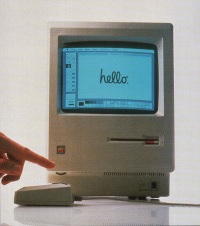
Apple II vs. Macintosh — Can public media follow this example?

Do you remember the Apple II series of personal computers? I certainly do. I got my first one in January 1983 (the Apple IIe) and it was a revelation. Back then the Apple II dominated the personal computer space (IBM was just introducing the first IBM PC). It was a serious cash cow for the new wonders of Silicon Valley: Steve Jobs and Steve Wozniak.

But even in 1983, in the peak of this tremendous success, Apple was reinventing the personal computer. They were secretly inventing the Macintosh, which was introduced a year after I got that Apple IIe in January 1984 (with the famous Superbowl ad).

Developing the Mac was a massively expensive proposition. New chips, new software, new case designs, a mouse, even a brand new 3.5″ floppy drive developed by Sony but still considered cutting-edge and risky. Everything called for clean slate development in order to get it all just right.

So what funded this engineering miracle? The successful and highly profitable Apple II series. And guess what — the Mac wasn’t profitable at launch. That first year was deadly. Apple introduced a $2,500 computer ($5,100 in 2007 dollars) that had two software programs: MacPaint and MacWrite, and it wasn’t compatible with the growing library of Apple II software titles.

Check out this brief video (43 seconds) of Guy Kawasaki recounting how the Mac team was funded by the Apple II team, and the considerable tension this created:

I often think of the Apple II / Macintosh example when conversations in public media circles turn to the question of how will we pay for this new media stuff that doesn’t make any money and takes money out of the profitable broadcasting business. Newspapers and the music industry are also great analogies for public broadcasting.

It takes real leadership, real courage to deliberately take cash from a profitable and successful unit and sink it into the next big thing, even if it takes years for it to pay off. Plus, you have to deal with the political pressures to stop funding this financial black hole from the “reasonable” business people all around you (on the board, on the management team, in the community, on the staff). As I look at my own public media business today, we’ve not even begun to seriously tackle the challenges of the new media world — chiefly because “Apple II” folks are in charge. I often wonder whether we should give up trying to reform the core of the company (a la Ideastream) and simply fund an external unit that can focus on the new media challenge without interference from the traditional “cash cow” part of our business.

The one example of “put it outside the core” I know of in the public media world can be found at Chicago Public Radio. Their Vocalo project (as described by Robert Paterson), is an external unit in every sense of the word. They have separate facilities, a new name unaffiliated with the old name, a separate budget, different leadership, different content and business models, etc. It’s a fascinating approach, and it mimics the Apple experience.

But I’m wondering… is anyone else in public media doing this? Who else, if anyone, is creating distinct subsidiaries for innovation? Is anyone else willing to spend their Apple II money on their Macintosh project?

Tending the Public Media Tribe

If you’re not reading Seth Godin, you’re not paying attention to the future of successful public media. Godin doesn’t address public media directly, but he does address issues of marketing and community and the economics of making money through the products or services a company provides in a new media world.

Godin talks a lot about tending to your “tribe” — that group of people that love your product/service and who share your values or perspectives and interests. If you’ve been in public radio or TV for any length of time, you know these folks. Most likely you’re already a member of this tribe yourself.

Recently Godin gave a talk at a music conference and his comments, while aimed at a music marketing audience, are applicable to all of us in public media — news, music, radio, TV, whatever — because the trends affecting the music business (disastrously) today are the same ones rewriting the rules for all media. And the rules for success in the next generation will be the same: serve your tribe; be indispensible; be the best.

Here are some highlights from Godin’s talk, pointed out by Gerd Leonhard and partially chosen by digitalwaveriding (the boldface highlights are mine):

if I asked you for the name and address of your 50,000 best customers, could you give it to me? Do you have any clue? [No?] Then what happens every day is you go to a singles bar and you walk up to the first person you meet and propose marriage and if that person won’t marry you, you walk down the bar to every single person until someone says “I do.” That’s a stupid way to get married. A better way to get married is to go on a date. If it goes well, go on another date. Wait to tell them on the third before you tell them you’re out on parole. Then you meet their parents, they me your parents, you get engage, you get married. Permission is the act of delivery. Anticipated, personal and relevant messages to people who want to get them.

… The next thing is what I call the Seinfeld curve. The Seinfeld curve shows us Jerry’s life. If you like Jerry Seinfeld you can watch him on television, for free, in any city in the world two or three times a day. Or, you could pay $200 to go see him in Vegas. But there is no $4 option for Jerry Seinfeld. This is death. You can’t make any money in here. Because if you’re not scarce I’m not going to pay for it because I can get it for free. And one of the realities that the music industry is going to have to accept is this curve now exists for you. That for everybody under eighteen years old, it’s either free or it’s something I really want and I’m willing to pay for it. There is nothing in the center — it’s going away really fast.

… The next thing is this idea that people care very much about who is sitting next to them at the concert. They care very much about the secret handshake. They care very much about the tribal identification. “Oh you like them? I like them!”

… It’s really important to people to feel like they are part of that tribe, to feel that adrenaline. We are willing to pay money, we’re willing to go through huge hoops, trampled to death in Cincinnati if necessary, in order to be in the environment where we feel that’s going on.

… I want to argue that the next model is tribal management. That the next model is to say, what you do for a living is manage a tribe, many tribes, silos of tribes. That your job is to make the people in that tribe delighted to know each other and trust you to go find music for them.

… There is a lot of music I like. There is not so much music I love. They didn’t call the show, “I Like Lucy,” they called it “I Love Lucy.” And the reason is you only talk about stuff you love, you only spread stuff you love. You find a band you really love, you’re forcing the CD on other people, “You gotta hear this!” We gotta stop making music people like. There is an infinite amount of music people like. No one will ever go out of the way to hear, to pay for, music they like.

Fortunately or unfortunately, the future for public media companies will involve considerable “tribe management” and will involve a smaller audience than we have today, either locally or collectively — all media will have far more fragmented communities than in the past. Now is the time to identify who’s in and who’s out of your tribe and figure out how best to serve the community that gathers around public media content and values.

This may sound elitist or even fatalistic to the traditional mass media thinkers out there: “But I want the biggest audience possible!” Well, you can’t have it. Large audiences of mildly engaged viewers or listeners or readers are the old model. The new model requires deep and authentic engagement with that “tribe” of people. You can still invite everyone into the tribe, and you should. But in a world of infinite tribes, folks will naturally gravitate to the tribes that best serve their needs and interests (and they will have multiple tribes, of course).

Personally, I think this is an incredibly exciting time for public media folks that embrace this new approach. There’s new opportunity not only for sustainable businesses, but for truly meaningful, impactful and interactive work. The only problem is developing the courage to let mass media thinking fade over time, even though it’s been tremendously successful for the last 40 years.

Haarsager on NewsGang podcast

Dennis Haarsager, new interim CEO at National Public Radio (NPR), appeared on the NewsGang podcast this past Friday. He spoke fairly openly about the unusual CEO transition and about how NPR may change as it deals with an audience that’s moving to new media distribution channels and interaction platforms.

In addition to Haarsager, the guest list included Stephen Hill from Hearts of Space, Steve Gillmor (the host), and Doc Searls, who also appeared on a panel at the recent Integrated Media Association conference along with Haarsager and others.

UPDATE: Highly Recommended Listening. Haarsager and friends go into depth talking about new media economics and public media’s entanglements — or lack thereof — with new platforms. Money quote from Stephen Hill: “Show the stations how you’re gonna keep them in business and they’ll be very happy to cooperate with [NPR].”

Running time of the MP3 file is about 1 hour, 25 minutes.

[audio:http://www.gillmorgroup.com/media/NewsGangLive-2008.03.14.mp3%5D

The link to the NewsGang podcast has also been added to my (still growing) list of Ken Stern articles.

When a public radio lover turns hater

While searching for more NPR / Ken Stern articles today, I stumbled across a blog post that refers to the news, but spends much more time listing the crimes and misdemeanors of the current public radio landscape, especially as emanating from NPR and other national outlets (APM, PRI, etc.).

Written by Dave Slusher, Public Radio Fails Me explores at length the ways in which Slusher was first captured by public broadcasting and especially public radio many years ago. But it goes on to lambaste public radio for what he feels its become — populist when it comes to cash, elitist when it comes to control, and tired when it comes to programming.

Written by any person on the street, it’s a damning indictment of some of public radio’s (perceived) trends over the past 10 years or so. But this was not written by any random man on the street — it’s written by a man with experience inside the system as a producer as well as consumer.

While I’m not entirely in agreement with Slusher, I do think there are some truths in there with which public radio (and all of public media) must seriously grapple. Slusher’s comments on the changes in the flagship NPR newsmagazines in particular I find fairly accurate. Of course, those changes may account for the doubling in NPR’s weekly audience over the past 10 years. But it’s definitely changed, and for those with an interest in deeper news coverage, it’s not all positive changes.

In any case, it’s a long post but worth a read and a comment at his site, whatever your opinions.

How 1998 isn't like 2008

I’m a week late blogging it, but I wanted to make sure I highlighted the interview with Clay Shirky on WNYC’s On the Media right at the end of February. Plus I wanted to plug his book, which I’m ordering right now.

One of the points made in the interview is that just 10 years separates this new mode of Internet activism and participation from the old model that didn’t allow people to easily find one another and co-create social action and original media around shared values and interests.

In a world like this — where the audience (or community) is in control as much as the old gatekeepers (perhaps in even more control) — what is the role for public service media?

Tonight at 11… Sweeps can KILL you!

Found via Lost Remote, this Idaho Radio News post includes one of the funniest (and saddest) send-ups of local news promotions in commercial media.

[audio:http://idahoradionews.com/go/wp-content/uploads/2008/03/sweepscankillyou.mp3%5D

Can you imagine a public radio or public television station doing a promo like this? Of course not — it’s the polar opposite of the public media ethos.

Perhaps one of the ways to define public service media going forward is to declare what we are not.

Required Reading: FREE!

I was chatting with the boss this week when I made a shocking suggestion.

I told him that one or perhaps all of the audio (radio) programs we create today — and for which we charge hefty fees to “member” stations — be simply given away to any station that wanted it.

Immediately he shot back: “But someone has to pay for that content!”

I love these situations. I get to try out newfangled business or economics insights to suggest something that’s anathema to the old guard (people and/or ideas). Plus, it’s a little logical fallacy that’s fun to pick apart:

  • Me: Give it away for free.
  • Him: We can’t — someone has to pay for it.
  • Me: Who said no one would pay for it?

Indeed, someone must pay for the people and equipment (mostly people) required to produce award-winning content, regardless of medium or delivery system. The future isn’t all user-generated content (UGC).

The notion of free has come up a lot for me in the last year, as I’ve ruminated on the idea that PBS and NPR should give away all their content to incumbent pubcasting stations for free. (But someone has to pay for that content!) I’ll explore more of that idea in postings to come.

For now, I’d like to share some FREE readings that have been published within the last week concerning this notion of giving it away, seemingly willy-nilly. The notion of “free” has actually been a viable business option for decades, but in the digital media space the idea is gaining widespread traction very quickly.

Why free?

Because in the digital media world, where every user is one link away from any other user and everything can be digitally copied to perfection with little or no impediments, maintaining control is becoming impossible. Plus, as media content volume rises toward infinity (or certainly more than any one person can possibly consume), the value of content (in broad terms) falls toward zero.

So, here are my picks for the late February 2008 “free reader” if you want to get schooled in how and why giving it away makes sense in lots of situations:

Free! Why $0.00 Is the Future of Business
Chris Anderson / Wired / 25 Feb 2008

Anderson was the author of the article and follow-on book called The Long Tail that’s been cited as much as any Web 2.0 meme can possibly be cited. It’s accepted as a given truth (a little too easily, I might add) at this point. Now he’s been exploring the notion of free as a part of viable business models and this is the opening article in what’s sure to be both a series of thought pieces and, eventually a book. This is basically the seminal article of “free” at this point. There’s even a little intro video included with the article, featuring Anderson himself.

Chris Anderson Takes Up The Free Banner
Mike Masnick / Techdirt / 25 Feb 2008

That ‘Free’ Stuff Is Catching On…
Mike Masnick / Techdirt /26 Feb 2008

Masnick is a wizard at both succintcly explaining tech-focused business developments and eviscerating ideas that make no sense. In these two cases, he points out the Anderson article, adds some other links, and in the first article points out the mistake in Anderson’s logic — the notion that the “free” model turns economic principles on their heads. He rightly points out that, no, in fact no laws of economics are broken. Well worth your two clicks so you don’t get sucked into believing FREE is bigger than it is.

Free is the Future
Lee LeFever / Common Craft / 26 Feb 2008

Step aside from the free hyperbole for a moment and read this piece. In this case, the guy that owns and operates the Common Craft custom video development service explains all the ways in which his business — a money-making venture, to be sure — has benefited by using free technologies and services from other businesses. Indeed, his two-person shop is wildly successful today precisely due to the impacts those free services had on their ability to get the word out and share their work. It’s a great piece because Lefever takes you step by step through the ways in which “free” made their profitable business possible.

Free Is A Great Way To Make Money
Fred Wilson / A VC / 25 Feb 2008

This post is mostly a link over to the Anderson article — with one exception. Wilson points to one of his own posts from July 2005 (!) that discusses the notion of free in business models.

Better Than Free
Kevin Kelly / The Technium / 31 Jan 2008

  • Immediacy
  • Personalization
  • Interpretation
  • Authenticity
  • Accessibility
  • Embodiment
  • Patronage
  • Findability

Sick of discovering how you have to give it all away? Wondering how you’ll actually make money? Well here’s the antidote to the free movement — here’s what can’t be given away, what really carries lasting value. This article probably had more buzz at the IMA conference than perhaps any other because it lays down a conceptual map for the services that public media can provide that are fundamentally undisruptable (yes, I just made that word up).
The IMA impasse

I’m finally back home from the IMA 2008 conference (2,300 miles later). I’m tired, I’m Twittered out, and I’m facing both a mound of catch-up work as well as one of the busiest weeks of the year. But I wanted to capture my impressions from the conference, much as Todd Mundt and Tim Eby have done.

Overall, it was a good conference as usual. Interesting projects were profiled from all over the system, but nothing was truly game-changing at a macro level. There were exhortations that we need to do more, reserve more of our budgets, boost traffic and so on. Palpable fear ran through the conference about TV, partially due to DTV in 2009, partially sparked by the universally-hated NY Times article. Radio, while considered at risk eventually, is firing on all cylinders for the moment and doesn’t yet show fear.

But here are, in my opinion, the truly interesting items, borne from meta-issues swirling around the conference but not directly addressed:

  1. The IMA and Mark Fuerst (one of the IMA’s originators and the de facto CEO for many years) have changed the nature of their relationship. They now have a formal (or more formal) contractual relationship, and will pursue full 501(c)(3) status for the organization. The implications of this change are unclear to me, but it might signal a real sea change in how IMA operates and what goals it pursues. The way it was presented left me with lingering concerns, given Fuerst’s strong advocacy for online service. If he’s not pushing as hard in the future as he has in the past, what becomes of IMA?
  2. Fuerst ended the conference with comments that were strongly (and accurately) critical of the system’s lack of development in the online space, pointing out one stat showing that in 2005 the PubTV system invested just 0.66% of spending in online work. Naturally, this paucity of investment has resulted in pathetic web traffic systemwide. Fuerst seemed almost angry in his closing comments. Rightly so, but it was the first time I’d experienced a conclusion that was negative in tone.
  3. The IMA members meeting and one of the sessions focused on the questions, “Can we / should we bring more nonprofit public service media entities into the IMA fold?” Reactions were positive to the idea, though I don’t think anyone could imagine what this would mean to the IMA in the long run. The most obvious nonprofit pure-play web entity that might partner with IMA was Wikipedia, represented at the conference by their Executive Director, the former interactive manager for cbc.ca.

In my (current) view, IMA appears to be at an impasse. We seem to have reached a point where integrated media advocacy has given out, where recommendations and demonstrations fail to move our organizations to meaningful action.

To date, IMA has been effective at putting the online services question on the table within public broadcasting and has done so eloquently and repeatedly. But for all the work completed, no significant sea change has yet arrived. Meanwhile, the house of public TV is on fire, we’re losing audience to a fracturing media world across the board and new players (like Wikipedia and others) have stolen “our” web traffic and possibly our raison d’etre.

I’ve been to IMA for the past four years straight. I’ve been excited by the projects and keep feeling like there’s so much opportunity in front of us. But in those four years, not much has changed in my shop nor in the system at large.

I’m left wondering… what now?