The human rationale for Web 2.0

Tech writer David Pogue has a great little piece up today explaining why using Web 2.0 (interactive) technologies and methods are important for any company. Public media is no different, of course, and if we are supposedly community-focused, then it means even more sense that we open the doors to the public. (It’s always surprised me how little the “public” appears in public media.)

He has a particularly funny example from an internal — yet open-to-the-public — disussion at Microsoft regarding whether the game Minesweeper should be included with Windows.

Bottom line?

Yes, you’ll have to moderate this stuff. Yes, it means spending money with no immediately visible return on investment. Yes, it’s more work for everyone.

But you’ll gain trust, goodwill and positive attention. You’ll put a human face on your company. And you’ll learn stuff about your customers that you wouldn’t have discovered any other way.

Funny how trust comes up first in his list of benefits. Sound familiar?

Good reading.

Why traditional TV production is dead

TV stations and professional staffs — commercial and noncommercial alike — have been around for more than a generation. Television started in the middle of the last century and since then thousands of people across the country have built careers upon the technologies, processes and the advertising dollars that flowed freely for decades. A complex art and science, TV demanded workers develop expertise with an arcane and complex set of tools for their unique work. Creating a high-quality TV show was impossible without armies of specialists to turn all the required knobs and punch all the required buttons at synchronized moments.

Money from national and local advertisers flowed easily to television stations — the mass medium of choice that gave advertisers access to an impossibly huge audience; an audience bigger than the daily newspapers; an audience bigger than any single radio station. Advertising money built the industry, dollar by dollar, viewer by viewer. It’s been a great ride.

But those days are coming to an end. Actually, they’ve already ended. Advertisers and TV execs have simply been slow to realize it and are only now starting to act. (Think of it as the music industry, circa 1995.)

Why? What’s happened in the TV market to make stations swing from cash-rich to cash-poor in just the last 10 years? What’s bankrupting the system? And is this a permanent trend or just a temporary blip? Here’s the answer in less than 5 minutes:

The economic model of traditional TV has imploded as the viewing options have exploded (not to mention all the competing technologies that have emerged in the last 10 years, exacerbating the problem). And as the money for TV broadcasting goes away, the ability to produce programming similarly dries up.

For small and midsize public television stations (not the rich behemoths like WGBH) that want to produce original programs of public value, the path ahead is actually pretty clear and comprises two primary modes:

  1. Big TV. Large-scale high-end TV productions will be few and far between. They will be funded as independent projects, will mostly involve outside contractors rather than inside employees, and will draw most of their funding from external one-off granting sources. Public media companies might manage or “host” these projects, but we won’t fund them from operating cash. When 1 or 2 hours of “PBS quality” video costs $250,000+ to produce, it’s clear the economics are beyond the meager budgets of smaller stations.
  2. Small video. Ongoing local productions must scale back to one person + camera + laptop, in variations of the VJ (video journalist) model, as espoused by Michael Rosenblum and others. These small productions must be aimed at multiplatform niche distribution rather than mass entertainment. Plus — an important second fact — we won’t produce all this content by ourselves. We’ll curate and collaborate in ways that will make the traditionalists scoff and sputter. In the end, “TV” folks will either become multifunctional “video” folks or will have to leave for production jobs at specialty video houses.

And that’s just the short-term transformational model (up to 5 years), focused on video content production. It’s quite possible that owning an actual television station (the licenses, the towers, the impossibly heavy technical infrastructure) will become economically unsustainable rather quickly as new technologies chip away at TV’s traditional dominance. Indeed, owning a local over-the-air TV station is likely to be financially dangerous to all but the most efficient regional or national network owner-operators by 2015.

If we in public media believe it’s our mission to serve the public interest using digital media, then video must be part of the equation. But does “TV” have to be in the mix? In the short term, definitely. In the long term, maybe, but probably with significant strategic changes.

For now, we may not know the fate of local TV stations, but traditional TV production models are already dead. The revolution is underway. Click below for another 90-second forehead slap:

So these are the market realities. It’s up to us to decide whether these are exciting or threatening developments. Should we engage and evolve or should we hunker down and hope for a different future?

I know my answer. What’s yours?

XM + Sirius = Meh

If anyone in public media hasn’t figured it out yet, the merger of the two satellite radio providers — which just got antitrust approval by the Justice Department — is not a big deal. It was inevitable, but it shouldn’t affect your core strategies going forward.

Internet radio, in various forms, was, is and will be bigger than satellite radio. That’s where the action is — the threats and the opportunities.

If you haven’t seen the Bridge Ratings chart before (linked above), be sure to study it at least a little. The satradio providers are just bulking up in the hopes they can eliminate duplicative overhead costs and, together, get a bigger audience. After that, there’s no more “there” there than there was before. And without direct competitors, the merged company is more likely to enter into a period of strategy decay.

So good luck, guys.

UPDATE: Just found Mark Ramsey’s take on the news.

It's high time for real-time community engagement

Geeks out there probably know Leo Laporte, the long-time commercial radio and TV host, made especially well-known via the now-defunct TechTV cable channel. He continues to develop media, having built the TWiT podcast “network” over the past couple of years, including the flagship This Week in Tech podcast, drawing some 200,000 listeners a week.

In a blog post this weekend, Laporte describes several changes he’s bringing to the core show, centered on live video streaming. I’m recommending the post because he describes both some Media 1.0 troubles he’s had lately and then describes the changes he’s about to make in his Media 2.0 company.

Why should public media folks care?

Because Laporte is doing what many of us in public media are not, and his strategy is especially well-suited to the Media 2.0 economy:

  • he’s engaging with his community in a two-way and multi-way fashion that’s meaningful, open and authentic
  • he’s increasing his real-time contact hours across multiple digital platforms (he doesn’t limit himself to one platform)
  • he’s doing it all himself, on the cheap — there’s no network or corporation pushing him forward or holding him back

Laporte’s example is inspiring. Imagine what a public service media company with a true local engagement mission could do, using similar methods and the same low-cost, low-risk, rapidly-developing technologies. Engaging your community, communicating with your “true fans” is not a matter of holding public meetings or taking pledge calls. I’m hoping to steal some of this TWiT model for use in my shop (assuming we can get past our difficult strategic planning process).

But we’d better move fast.

Because in a world where Content is a commodity with a value approaching zero (or as Robert Paterson described content recently: noise), all we have left is Contact and Context. PBS and NPR can provide content on a national scale and with unrivaled quality. They can even distribute it and gather financial support for it directly. So we, the locals, must do what they cannot: provide authentic contact and develop a contextual service in tune with our local communities.

Take a look again at Laporte’s example. He’s building out in service of his “tribe,” his community. He’s co-creating value with volunteers in his “TWiT army.” He’s using two-way platforms authentically. He’s got real-time contact with his audience. He’s doing it without transmitters or other oppressively heavy engineering costs. We should be so lucky.

We can be so lucky.

Why innovation must be part of public media's DNA

If it seems like the world moves faster, technologically, with each passing year, you’re not imagining things.

Consider this chart:

Starting from its introduction, the simple telephone took 71 years to arrive in just 50% of American homes. Think about that. An entire generation was born, lived and died waiting for a telephone to arrive in their home, and only half of them got it!

Even electricity took 52 years to reach 50% of homes. Cell phones — that ubiquitous device most of us take for granted — took 14 years, but the MP3 player took less than half that time.

Basic Internet access — the new omnimedia connection — took 10 years to reach 50%, and in the early days it wasn’t even that much to talk about. Today, high-speed Internet access is in well over 50% of homes in the U.S. and average speeds are rising (though not fast enough for me).

There are two lessons here I can see:

  1. We cannot be transmitter companies (and indeed, we never were — we just thought we were because it was easier that way). Technology is a tool, not a purpose.
  2. The public naturally innovates as better tools arrive for information gathering, sharing and entertainment. We must innovate with them to serve them; innovation must be built into our DNA.

What other lessons can you see in this chart?

A good hockey player plays where the puck is. A great hockey player plays where the puck is going to be. –Wayne Gretzky

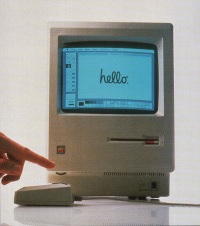
Apple II vs. Macintosh — Can public media follow this example?

Do you remember the Apple II series of personal computers? I certainly do. I got my first one in January 1983 (the Apple IIe) and it was a revelation. Back then the Apple II dominated the personal computer space (IBM was just introducing the first IBM PC). It was a serious cash cow for the new wonders of Silicon Valley: Steve Jobs and Steve Wozniak.

But even in 1983, in the peak of this tremendous success, Apple was reinventing the personal computer. They were secretly inventing the Macintosh, which was introduced a year after I got that Apple IIe in January 1984 (with the famous Superbowl ad).

Developing the Mac was a massively expensive proposition. New chips, new software, new case designs, a mouse, even a brand new 3.5″ floppy drive developed by Sony but still considered cutting-edge and risky. Everything called for clean slate development in order to get it all just right.

So what funded this engineering miracle? The successful and highly profitable Apple II series. And guess what — the Mac wasn’t profitable at launch. That first year was deadly. Apple introduced a $2,500 computer ($5,100 in 2007 dollars) that had two software programs: MacPaint and MacWrite, and it wasn’t compatible with the growing library of Apple II software titles.

Check out this brief video (43 seconds) of Guy Kawasaki recounting how the Mac team was funded by the Apple II team, and the considerable tension this created:

I often think of the Apple II / Macintosh example when conversations in public media circles turn to the question of how will we pay for this new media stuff that doesn’t make any money and takes money out of the profitable broadcasting business. Newspapers and the music industry are also great analogies for public broadcasting.

It takes real leadership, real courage to deliberately take cash from a profitable and successful unit and sink it into the next big thing, even if it takes years for it to pay off. Plus, you have to deal with the political pressures to stop funding this financial black hole from the “reasonable” business people all around you (on the board, on the management team, in the community, on the staff). As I look at my own public media business today, we’ve not even begun to seriously tackle the challenges of the new media world — chiefly because “Apple II” folks are in charge. I often wonder whether we should give up trying to reform the core of the company (a la Ideastream) and simply fund an external unit that can focus on the new media challenge without interference from the traditional “cash cow” part of our business.

The one example of “put it outside the core” I know of in the public media world can be found at Chicago Public Radio. Their Vocalo project (as described by Robert Paterson), is an external unit in every sense of the word. They have separate facilities, a new name unaffiliated with the old name, a separate budget, different leadership, different content and business models, etc. It’s a fascinating approach, and it mimics the Apple experience.

But I’m wondering… is anyone else in public media doing this? Who else, if anyone, is creating distinct subsidiaries for innovation? Is anyone else willing to spend their Apple II money on their Macintosh project?

Tending the Public Media Tribe

If you’re not reading Seth Godin, you’re not paying attention to the future of successful public media. Godin doesn’t address public media directly, but he does address issues of marketing and community and the economics of making money through the products or services a company provides in a new media world.

Godin talks a lot about tending to your “tribe” — that group of people that love your product/service and who share your values or perspectives and interests. If you’ve been in public radio or TV for any length of time, you know these folks. Most likely you’re already a member of this tribe yourself.

Recently Godin gave a talk at a music conference and his comments, while aimed at a music marketing audience, are applicable to all of us in public media — news, music, radio, TV, whatever — because the trends affecting the music business (disastrously) today are the same ones rewriting the rules for all media. And the rules for success in the next generation will be the same: serve your tribe; be indispensible; be the best.

Here are some highlights from Godin’s talk, pointed out by Gerd Leonhard and partially chosen by digitalwaveriding (the boldface highlights are mine):

if I asked you for the name and address of your 50,000 best customers, could you give it to me? Do you have any clue? [No?] Then what happens every day is you go to a singles bar and you walk up to the first person you meet and propose marriage and if that person won’t marry you, you walk down the bar to every single person until someone says “I do.” That’s a stupid way to get married. A better way to get married is to go on a date. If it goes well, go on another date. Wait to tell them on the third before you tell them you’re out on parole. Then you meet their parents, they me your parents, you get engage, you get married. Permission is the act of delivery. Anticipated, personal and relevant messages to people who want to get them.

… The next thing is what I call the Seinfeld curve. The Seinfeld curve shows us Jerry’s life. If you like Jerry Seinfeld you can watch him on television, for free, in any city in the world two or three times a day. Or, you could pay $200 to go see him in Vegas. But there is no $4 option for Jerry Seinfeld. This is death. You can’t make any money in here. Because if you’re not scarce I’m not going to pay for it because I can get it for free. And one of the realities that the music industry is going to have to accept is this curve now exists for you. That for everybody under eighteen years old, it’s either free or it’s something I really want and I’m willing to pay for it. There is nothing in the center — it’s going away really fast.

… The next thing is this idea that people care very much about who is sitting next to them at the concert. They care very much about the secret handshake. They care very much about the tribal identification. “Oh you like them? I like them!”

… It’s really important to people to feel like they are part of that tribe, to feel that adrenaline. We are willing to pay money, we’re willing to go through huge hoops, trampled to death in Cincinnati if necessary, in order to be in the environment where we feel that’s going on.

… I want to argue that the next model is tribal management. That the next model is to say, what you do for a living is manage a tribe, many tribes, silos of tribes. That your job is to make the people in that tribe delighted to know each other and trust you to go find music for them.

… There is a lot of music I like. There is not so much music I love. They didn’t call the show, “I Like Lucy,” they called it “I Love Lucy.” And the reason is you only talk about stuff you love, you only spread stuff you love. You find a band you really love, you’re forcing the CD on other people, “You gotta hear this!” We gotta stop making music people like. There is an infinite amount of music people like. No one will ever go out of the way to hear, to pay for, music they like.

Fortunately or unfortunately, the future for public media companies will involve considerable “tribe management” and will involve a smaller audience than we have today, either locally or collectively — all media will have far more fragmented communities than in the past. Now is the time to identify who’s in and who’s out of your tribe and figure out how best to serve the community that gathers around public media content and values.

This may sound elitist or even fatalistic to the traditional mass media thinkers out there: “But I want the biggest audience possible!” Well, you can’t have it. Large audiences of mildly engaged viewers or listeners or readers are the old model. The new model requires deep and authentic engagement with that “tribe” of people. You can still invite everyone into the tribe, and you should. But in a world of infinite tribes, folks will naturally gravitate to the tribes that best serve their needs and interests (and they will have multiple tribes, of course).

Personally, I think this is an incredibly exciting time for public media folks that embrace this new approach. There’s new opportunity not only for sustainable businesses, but for truly meaningful, impactful and interactive work. The only problem is developing the courage to let mass media thinking fade over time, even though it’s been tremendously successful for the last 40 years.

Proponent of FREE appears on Charlie Rose

I’ve pointed to the new Chris Anderson article/book on the notion of “free” as a business model before. But here’s a great introduction for those that want a no-nonsense introduction, mediated by Charlie Rose.

Additionally, offering insights into recent tech industry developments is TechCrunch’s Michael Arrington (this part is less important).

[google -1951879923858017460]

Found via Gerd Leonhard’s site MediaFuturist

Paterson on leadership (at NPR)

While I do appreciate Robert Paterson’s take on the leadership issue that’s likely below the surface of the NPR / Stern debate, I’m struggling to believe that that’s the core of this week’s story — that Ken Stern just ruffled too many feathers and it was time for a different leader. Sure, hard-charging generals are not the best leaders in all situations, and after 10 years of whip-cracking you might need a smooth operator. That makes eminent sense.

But in the shifting media environment about which so many of us write and ruminate, isn’t a hard-charging general needed at the top? Someone that has both the vision and the drive to push through to a new way of thinking and doing. The media environment changes in play today are not just operational in nature, where a COO might fix this, improve that — they’re strategic shifts. Seismic shifts. World-upside-down shifts. Only a CEO and her or his board of directors can handle those issues and realign the company. And given the time-to-market pressures of new media on old media, NPR probably didn’t (and doesn’t) have the time for all the required dinners and socials and private meetings, nor could it afford compromise after political compromise on the way to a new strategy.

NPR — like all media companies, for-profit or nonprofit, operating in any or all media formats — must grapple with the fundamental changes in progress. The relationship between producers, distributors and consumers is completely inverting.

Of course, this entire discussion could be moot. Public media’s future may have to be created outside the voluminous corpus of NPR (or APM or PRI or APT or PBS or …). Developing a new model with fundamentally different DNA may not be possible inside the system, either with a hard-charging general or a sweet-talking politician.

Jarvis on NPR

Well he’s not “on” NPR, but he comments on the NPR / Ken Stern thing, as you might expect. He even gives a shout-out to yours truly (blush!). I returned the favor by commenting on his post.

  • Trouble for NPR — BuzzMachine / 7 Mar 2008 (Update: Note Dennis Haarsager’s comment to this post at Jarvis’ blog)

In that post he also refers to a great year-old post about public radio, following a meeting he had at NPR along with other new media folks. This is the post that introduces the great new word “converstation”: