A new pro-social media video

These “revolutionary” videos are always fun — seems like everyone makes them these days.

This one is a little over-the-top for my taste (some of the statistics are taken out of context) and it’s clearly a calling card for the author of Socialnomics. But it’s still well-done and contains lots of little tidbits to get you thinking. Enjoy!

Broadcast Schedule vs. On-Demand

…with the 18- to 34-year-old crowd, who have shown undaunted support for Mr. O’Brien, a time slot is as relevant as which brand of frying pan your favorite restaurants use to cook your meal — maybe it makes a difference in the kitchen, but 99 percent of the patrons just want good food.

via bits.blogs.nytimes.com

This quote is from a great little piece posing the question: Should Conan O’Brien take his show directly to the web and give up on TV?

O’Brien has made the comment that the 11:35 p.m. time slot is the core concept of “The Tonight Show.” I hope, for his sake and comedy’s sake, that was just guff that was part of his fight with NBC.

If O’Brien really believes the schedule is the thing, he won’t just quit NBC, his TV future will be cut short.

Late night TV shaken up by changing media habits

The contract between viewers and late-night hosts can be an intimate one. Yet while we all like to be told bedtime stories, in the main, late-night television is very hit or miss. We watch and wait for the moment of serendipity when a single joke happens to define a moment or a banal interview takes an unexpected turn. But today, if magic happens, you don’t have to wait for the show to enjoy the moment.

Take the Thursday episode of “The Jay Leno Show,” for example. We all know that Mr. Leno has been using the show to land some haymakers on his NBC bosses, but the tables were turned during the “Ten @ Ten” segment that night, when Jimmy Kimmel responded to a question about his best prank: “I told a guy that five years from now, I’m going to give you my show, and then when the five years came, I gave it to him, and then I took it back almost instantly.”

Now that’s a funny comeuppance, but Twitter and various entertainment blogs were alive with references to the joke, and I didn’t have to sit through a bunch of shows to see it.

via nytimes.com

Columnist David Carr picks apart the Conan / Leno debacle by exploring it from the lens of how new forms of media consumption have actually created this mini-crisis for NBC. Excellent piece.

Yeah, we're a sensible business. What of it?

One thing I cannot abide is prevarication. It’s why I’ll never be a successful politician (or an unsuccessful one, for that matter).

So it irks me every time a public broadcasting leader gets up in front of a crowd and trots out the old chestnut of how public broadcasting — especially public TV — is so much better than commercial broadcasting because we produce “Masterpiece Theater” and they produce “Dog the Bounty Hunter.” Recently PBS CEO Paula Kerger took to one of these many stages and talked about how PBS kids programming is so much better than the commercial kids garbage out there, especially since PBS doesn’t attach kids merchandising to the broadcasts.

Too bad someone blew the bullshit siren. [Hat tip to Current for the find.]

And please, let’s not slice-and-dice this story into “well, it wasn’t PBS that did it, it was WGBH, the producer…” yadda, yadda, yadda. The public does not understand these distinctions and we all know it. The conservative blogger also busts out the old Sesame Workshop example, which has dogged the network for years because  no one has had the guts to speak the truth without blushing (which I’ll get to in a minute).

Separately, the issue of PBS buying Nielsen ratings data came up in this Washington Post column (scroll to the bottom), in which Kerger attempts to politically sidestep the fact that the network bought the access to help it sell air time to sponsors. The columnist said Kerger’s explanation of the Nielsen deal “sounded suspiciously like a CBS sales exec at a pitch with potential advertisers.”

Good grief. The problem isn’t that Kerger sounded like a CBS sales exec, it’s that she sounded suspiciously like a CBS sales exec! It’s suspicious because her language was deliberately double-talky. We’ve been taught to be apologetic for operating like businesses, and her roundabout language gives away our cultural discomfort with bottom-line considerations.

I’m tired of the song-and-dance promoted from the tops of our public media ecosystem. Our leaders attack commercial media and praise noncommercial despite the fact that the differences are not so stark; there are good programs in commercial media, and we have some dogs of our own. We rag on “Ice Road Truckers” but secretly sit transfixed for hours during a weekend marathon. We despise the rampant commercialism of kids programming but align ourselves with companies that participate in the same TV-industrial complex.

Let’s get real. Here’s some of what I would like to see in print and hear from our leaders when they talk to the public:

  • Nonprofits are still businesses. If they’re run without good business practices, they will fail. If a nonprofit corporation fails, the public good they were organized to pursue will be lost. So it’s good to operate like a business. Stop acting like this is a bad thing!
  • Sesame Workshop makes money from character licensing? Good for them! Money they make in that way offsets the cost to PBS and stations. Without that separate income, that show would cost stations a metric ton more to produce, meaning that show or others would be canceled. Nonprofits are specifically allowed to make unrelated income — they just have to pay taxes on that income. So guess what happens…
    • kids get “Sesame Street” products they like, attaching them to a program with great educational value
    • people are employed in making, transporting and selling the products
    • taxes are collected on the profits, helping pay for government programs (like public broadcasting)
    • actors, directors, producers, writers and other artists are paid a fair wage
    • the cost to PBS and stations is reduced for a beloved program
    • …and this is bad how?
  • Corporations used to be more openly philanthropic, but now they want something for their money — we can’t change that. So we can either take their money and create “advertising lite” options for them, or leave the money on the table. Maybe it is wrong to take the money and add corporate messages to our content. If you’ve got a better idea, we’re all ears.
  • Yeah, we don’t like the slide toward advertising either. But watch 1 hour of PBS and 1 hour of Discovery and compare the number, frequency, length and stridency of the commercials you see. There’s a difference and you know it.
  • Buying Nielsen data is standard practice in the TV world. It helps us get sponsorship dollars. Frankly, you should be shocked it took us this long.
  • Don’t like our mild commercialism? Push for legislation to fund public media at a level where corporate sponsorship isn’t needed, BBC-style. We don’t like selling ourselves anyway.
  • We produce “Antiques Roadshow” because it gets ratings (and dollars) not because it’s programming that consistently lives up to our mission.
  • We broadcast “Lawrence Welk” because old people like it and we want their money when they die.
  • There’s quite a few programs on commercial media we like and respect — it’s not all garbage. For example, we’re mad we didn’t think of “Mythbusters” first.
  • Sometimes we will use marketing tactics to make people aware of our programs. Deal.

Would I phrase all the messages exactly this way? No, of course not.

But the messages must be clear: we’re businesses, we do good things for our communities and we use a variety of tactics to achieve our goals, some of which involve trade-offs of mission and sustainability.

And if you can suggest ways in which we never have to make trade-offs, let’s talk.

Devastation and Response

The Haiti disaster is especially sobering for those of us living in the hometown of North America’s largest recorded earthquake. We’ve got earthquakes, tsunami and volcanoes up here. Plus any quake here has a 50/50 chance of striking us in the midst of sub-freezing temperatures. So yeah, we’re thinking about Haiti a lot.

Devastation

There are lots of stories out there on the Haiti quake. But perhaps the most important story comes from the images, not from things like “7.0” or “200 years.” Be sure to visit The Big Picture to see the devastation and gain a sense of the tragic scale. Just a sense.

Response

There are lots of ways to help, most involving money. Choose carefully, of course, as the scammers come out of the woodwork during these events, and some charities are barely charitable at all. For me, a specifically-directed donation to the Red Cross or Doctors Without Borders makes the most sense. But that’s me.

Support Doctors Without Borders in Haiti

By the way, you can help spread the word with graphics like the one above by visiting Doctors Without Borders here.

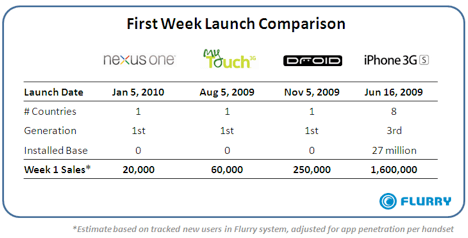
Nexus One: 20,000 / iPhone 3GS: 1,600,000


via gigaom.com

This is not good.

I love the iPhone, but it needs competition. While the Android series of phones are interesting, they still aren’t stacking up as serious competitors, either from a unit sales perspective or, more importantly, from a software perspective.

This is the difference between messianic vision for a product or service and simply throwing engineers and marketers into a room together.

When will someone give Apple a run for its money?

The mission problem

On December 6, 2009 Rob Bole, the CPB’s VP for Digital Media Strategies, wrote a great post: The Mogul’s Dilemma: Our Mystic Guideposts to Failure. Highly recommended reading. I was reminded of it today in the MediaShift post that actually started with me and then ended with Rob while talking about the infrastructure needed for modern public service media.

Back in late December, when I finally read Bole’s post, I posted my own comments. I saw my notes again today and was surprised to see just how much I wrote. And rather than let the comments sit there alone, I wanted to capture them here on my site for reference. Here’s what I had to say in response:

I totally agree about operators and strategic thinkers as you’ve presented in your thoughts here. When I started in public media in 2004, I was taken aback by how risk-averse the system was in technology, but also in core services and mission. So while I’ve personally beaten the drum for moves toward web services, I’ve also come to realize there’s a very deep-seated problem in “the system” that hasn’t yet been solved in most places.

It’s a mission problem.

What I’ve found is a lot of folks who built their careers and even their personal identities within broadcasting. To ask them or — if you dare — tell them to change, to learn new things and to act in new ways is pretty much an insult to their finely-crafted sense of selves (even if you deeply respect their past work).

But I found more than just entitlement along the way. I also found a loss of Passion and Purpose.

Public broadcasting became a system, an industry, a business. It became broadcasting, it became TV, it became radio — the platform was the thing and identities were inextricably intertwined with the platform. I’ve worked with TV engineers that were irritated when asked to solve radio engineering problems because TV Mattered and Radio Didn’t. In a world defined by technology platform, how do you have a serious conversation about ethereal things like “mission?”

It seems to me that over the years the high-minded notions of the Public Broadcasting Act have been lost. There’s been a failure to renew the mission, to redefine it in modern terms and to find people passionately committed to it. “Broadcasting fulfilled that mission, so why does it need to change?”

It’s taken me 5 years to reach the conclusion that the Internet, TV, radio, newspapers — none of that matters. Those are all technology choices, and they’re all commodities now. What matters is what you do with them, and frankly, most public broadcasting companies and leaders haven’t committed to this new perspective yet.

But there’s one that’s on the way. KETC in St. Louis is transforming itself, little by little, into a company on a mission for its community. They’re learning the best ways to be the “operator” you call for in this post, and they’re doing it across media platforms and out in the community. They originated the “Facing the Mortgage Crisis” project, and they did it because their community needed help and they felt a calling to deal with the issue, not to curry favor with the CPB or other funders.

And it’s not been easy. Each of the projects they’ve undertaken in the last couple of years have been big risks. They didn’t have complete funding. They had to bring together teams from legacy and new units to get the work done. They had to invent new methods and go out into a community that they, like most stations, had largely ignored for many years, preferring to broadcast, broadcast, broadcast.

I would encourage you to help stations find their Purpose and build Passion around that. With those two things, the right operators will magically show up — they’ll want to be a part of that Purpose. The strategic thinkers will join up, too, because there’s plenty of strategy to work out once you have your broad Purpose defined (or re-defined).

Here’s something practical:

Ask stations the two questions I first asked when I joined a public media company back in 2004:

  1. Who are you?
  2. Why are you here?

Very simple questions. You might be surprised how many people across the “system” don’t have good answers.

But if they can’t answer those questions — without quoting a tired mission statement — none of the rest of the debate over operators or strategy will really matter.

P.S. I’ve never gotten a good answer to my questions. But KETC may be the first to at least SHOW us some answers.


The Levelator 2 has arrived

If you work with digital audio recorded under less-than-studio-perfect engineering — especially spoken content — you are hereby requested and required to immediately download the new Levelator 2, free from the awesome nonprofit Conversations Network.

Public media’s good friend — nay, philanthropist innovatorDoug Kaye and his audio engineering wizards have offered up this tool for free to help all us poor schlubs make our audio sound better. It’s perfect for podcasting and especially well-suited to multi-person multi-microphone recording in which the various speakers are alternatively louder and softer than the next speaker.

I’ve been using The Levelator for years now and it almost always makes your audio sound much better, especially when you’re distributing the audio to online listeners or folks subscribing to your podcast.

Read more and download right away for Mac, Windows or Linux.

You know what they say: Location, Location, Location!

via youtube.com

I remember talking to IT pals of mine 5 years ago about how location-based information was going to be the Next Big Thing. It took 5 years, but we’re finally here.

Public service media can use location, too. Indeed, as creators, conveners and curators of media that’s focused on communities in specific locations, this stuff will be huge.

If we get out of the studio and get into the community, that is.

Google sidesteps the commodity phone business

The second point that I think is key is the recognition that Google has the opportunity to play a bit of business model jujitsu against competitors with Android, noted in this sentence: “It could afford to do this because Google aims solely to protect the great business they already have in advertising, not to make money directly from the product (HW or SW in this case).” This is a point that we discuss in a variety of different business markets. It’s why we think that those who understand how to embrace the difference between scarce and infinite goods have a huge advantage. If you can make money by giving away a product for free that some legacy business relies on charging for — and then making your money up in an ancillary market (made bigger by giving your product away for free), then you have a massive advantage to disrupt the market.

Google doesn’t need or even want your handset money or your OS licensing money — those things have no margin and/or entail too much overhead cost in support. But if Google can build a vast lead in mobile device advertising (which is more than just display ads, by the way), then their core business is protected from new entrants.

In public service media, I’ve previously talked (and presented) about commodity news and how we should either be giving away the commodity product — even to our legacy “competitors” — or simply stop producing it altogether. Know what business you’re in. Let everyone else scramble for the commodity scraps.