Additional links from WOSU presentation

In prepping my presentation for WOSU Public Media last week, I spent a lot of time reviewing other people’s recent presentations, stories, blogs, data and so on. Really, I read stuff every day related to digital media, so tracking it all back down is kind of hard. But I wanted to make sure I gathered a list of links and other resources folks could review if they wanted to dig deeper than my presentation alone allowed. So here they are, in no particular order…

From Broadcast to Broadband: Redesigning public media for the 21st Century
Discusses how public media must change to meet the challenges of a 21st century media universe. Jake Shapiro, PRX and Ellen Goodman, Rutgers; presented at Harvard’s Berkman Center for Internet & Society. Note: The pie chart showing CPB expenditures is incorrect. There’s an extra $71M included in the TV programming slice that shouldn’t be there.

The Future of News
This was a conference held at MPR in St. Paul, MN in November 2009 bringing together journalism leaders and pundits from public and commercial media in all formats. Lots of video and other resources. Props to Julia Shrenkler for tons of work on this one.

The Good, the Bad and the Ugly
Michael Rosenblum offers a critique of the folks that appeared at The Future of News, as linked above.

A Collection of Social Network Stats for 2009 (Jeremiah Owyang)
A frequently-updated list of social media statistics, including links, for all the major services.

The Chaos Scenario (video)
The Chaos Scenario (blog / book)
Bob Garfield, co-host of NPR’s “On the Media,” has written a book and built a wide-ranging presentation on how current media companies are faced with a chaotic world that’s changing the fundamental models of media economics. It’s a long video, but a good one.

Continue reading “Additional links from WOSU presentation”

Rosenblum Resurrected

Back in February 2007 I was blown away by Michael Rosenblum, keynote speaker at the Integrated Media Association conference in Boston. I’ve shared this video on DVD, shown it to colleagues and helped the IMA post it to their web site back then. But it’s buried at the IMA site and it deserves much more play. So I’m resurrecting it here.

I was actually running the cheap camcorder at the event, in a dimly lit hotel ballroom from about 50 feet away off to the side — so the video itself is blah. But the audio is awesome because it was professionally recorded and I was able to merge the blah video with the fantastic audio. Makes all the difference.

Blurry and dim video aside, Rosenblum’s presentation is mesmerizing. His grip on historical stories brings to life the peril that’s present for traditional TV broadcasters and TV producers, including public broadcasting companies. This is must-watch stuff if you’re in any way involved in TV or video.

Length: about 1 hour. Introduction by KQED‘s Tim Olson. Download a QuickTime copy here (113MB).

http://vimeo.com/moogaloop.swf?clip_id=8212211&server=vimeo.com&show_title=1&show_byline=0&show_portrait=0&color=ff9933&fullscreen=1

Rosenblum on Video News

Sing it brother! Rosenblum instinctively understands the next wave in both local video news production and local advertising production. While working at the stations in Anchorage, I proposed that we develop a democratized advertising platform to allow folks to write their own material, submit it online and pay for it instantly. Why aren’t we doing that today?

http://vimeo.com/moogaloop.swf?clip_id=8079409&server=vimeo.com&show_title=1&show_byline=1&show_portrait=0&color=&fullscreen=1

Brian Lehrer Live Interview from Rosenblum TV on Vimeo.

Rosenblum on TV Economics

Everyone in the PBS community knows that stations and the network screwed up when cable became a major national media distribution force. PBS should have been allowed an encouraged to develop a multi-channel national content distribution system tailored to the cable world. Too bad we missed that boat. And now, with hundreds of cable channels and millions of web outlets, video economics have jumped and it’s time we rethink our work.

Presentation: The Future is Public Service Media

UPDATE: In the comments, Tom White from the CPB noted that the math for TV production and operations noted in the presentation — stating that 84% of CPB’s annual appropriation goes to TV — is incorrect. In fact, for both FY2009 and FY2010 it’s about 67% of the total, not 84%. I based my 84% figure on the presentation slides offered by Jake Shapiro and Ellen Goodman in their November 3 talk. The figures in their presentation — on slide 15/32 — miscalculated CPB’s allocations by more than $70,000,000. I apologize for the error and will attempt to update my slides soon. In the mean time, keep in mind that 84% figure is wrong.

Last week I gave a presentation at WOSU Public Media in Columbus, Ohio, sharing with them some of the trends in media generally, talking about the economic pressures of a changing media landscape and sharing some ideas of how the station might change to meet the needs of the community in ways that transcend mere broadcasting.

WOSU was kind enough to gather a great group of people from across the company, plus one visitor from ThinkTV in Dayton and one from WYSO in Yellow Springs. (I’m not listing names here because I didn’t get permission to mention anyone specifically.) I’m hopeful some of the elements in the presentation were at least thought-provoking. One person told me afterward that he came away with three new ideas. Awesome!

I’m posting a ton of presentation links here so anyone can view and download the materials as desired. As I mentioned to a former colleague of mine, the materials are free for the taking, remixing and so forth under a Creative Commons license.

If WOSU posts a YouTube video of the live presentation itself, I’ll embed it here later. And I may just do another version of the presentation in voice-over style anyway.

I’ll start off with the embeddable SlideShare presentation, then include more links below.


Presentation Downloads

The Future is Public Service Media – Keynote (Mac) format (242MB zip)
This is the complete presentation in its native format, including all embedded videos, graphics, transitions and so on. Playback requires iWork ’09 on a Mac.

The Future is Public Service Media – QuickTime format (638MB mov)
Complete presentation in a clickable “movie” format (click to advance, click links to get to the web) that includes the complete video files inside the presentation. Playable on any Mac or any PC with QuickTime installed.

The Future is Public Service Media – JPEG images (8MB zip)
This is all the slides from the presentation as individual JPEG images.

The Future is Public Service Media – PDF (6MB PDF)
This is all the slides from the presentation in a single PDF document, readable on all computers with Adobe Reader or another PDF application.

The Future of Public Media

foggy highwayIn a little over a week, I’m supposed to appear at WOSU Public Media in Columbus and tell them what the future of public media will be.

Ha! Okay, that’s not going to happen — I can’t really tell the future, especially when it comes to public media.

But I am thinking deeply about it, and a recent post I wrote has me thinking more broadly about the future, with respect to public broadcasting / public media / nonprofit media / what have you. And that post ended with a simple question:

Are public media’s best days behind it or are they yet to come?

Like so many things in life, the answer to the question is driven by your personal history with and perspective on “public media.” But it seems to me the future is either what we make it, or we simply agree to take whatever happens to us.

That’s what I’m thinking I’ll explore with the group at WOSU: are we going to take the future, or make the future?

The Media Inflection Point You Can’t Avoid

We’re in the midst of the biggest media reshuffling in history. Literally. There are more people on the planet today than at any time in Earth’s past. And almost all those billions of people have contact with some form of media every day — print, radio, TV, Internet, and all the forms therein. The 20th century witnessed the mass adoption of electronic media (telephone, radio, TV, Internet), ending with the mass popularization of the web in the industrialized world.

Not since the adoption of the printing press and its mass-produced written material has human society been faced with such an expansion of media to the point of ubiquity. Distribution of the written word fundamentally changed how humans think, gather information, communicate, organize, share, learn and so much more.

Similarly, radio and TV have had a huge impact on human society. But they’ve simply continued the mass distribution (broadcast) phenomenon of print, in which a cloistered few control what media is produced and distributed and how it’s experienced.

In contrast, the web — with its many-to-many decentralized and self-organizing design, coupled with a capacity for storing and delivering video, audio, text, photos, and structured data — changes the fundamental ways in which we use media. Indeed, all our older forms of media are maneuvering to either combat or leverage the power of the web for themselves.

By the way, let’s remember we’ve only just begun this transformation, we’re only now starting to see possibilities of what this will do to us or for us. Today we’re raising the world’s first generation of children who will never live without the web and its capabilities. For them, instant ubiquitous communication, sharing, and participation is a birth right.

In short, the world is undergoing tremendous change because media — a force in all our lives — is fundamentally changing. The future of media is being created right now, much more so than 10, 20 or even 100 years ago.

Given these changes, do you let the future happen, or do you find a way to make the future?

(Oh, and bad news: you can’t avoid making this choice, consciously or unconsciously.)

The Future: Taking It

Public broadcasting has largely been waiting as this media revolution takes root. Waiting to see the patterns emerge. Waiting to see what commercial media companies do. Waiting to see what the audience wants. Waiting to see the “business model.” Waiting for the CPB to fund this plan or that plan or give instructions. Waiting for NPR or PBS to make it all better.

This approach assumes the future is knowable, and that it’s more knowable the longer you wait. Public media companies using this strategy are betting if they sit back and let the future happen, they can re-engage once everything “settles down” and “success” can be achieved by following an established plan.

The flip side is that if the current business model collapses (as the elderly population supporting public broadcasting dies) but the magical solution hasn’t been delivered yet, then you go out of business. “Oh, well. All good things come to an end. It was inevitable. Nothing I could do.”

The “taking it” approach also presumes a good future is achieved by repeating past success. This is music to the ears of folks that built their careers shooting big TV shows, or built NPR from the ground up, surviving lean times to reach the “safe” place they’re in today. If we just keep pumping out TV shows, we’ll get viewers and advertisers and money, right? If we just keep playing good music or running national news programs that people like, we’ll get enough money to make it and that’s fine.

Finally, using the wait-and-see approach is less messy, more predictable. Sure, as your public broadcasting company shrinks, some people will lose their jobs, but that will be a slow bleed, and you can just hold on longer than anyone else, right? Talk to someone that worked at a newspaper recently — they’ll draw the roadmap for you.

NOTE: This is the strategy in play in Alaska right now: consolidate the community-based stations into a statewide entity to save operating cash and hope by the time the reorganization dust settles a business model will be “blessed” by CPB or “proven” at other stations. It’s the classic wait-out-the-storm strategy. Only this storm will rage for a generation.

When it comes to the future of public media, “taking it” has its charms — most notably predictability and an unquestioned reverence for past success. But it’s an inevitable failure for you, for the company and for the community the public media company ostensibly serves.

The Future: Making It

Where “taking it” passively hopes for a brighter future (despite indications to the contrary), “making it” meets the ambiguous future head-on and searches for ways forward that still fulfill your purpose. Making the future, in such a time of change, also presumes the search for the “best way to do things” won’t end in our lifetimes — an acceptable approach today may not be appropriate tomorrow.

When choosing to make the future, you’ll have to accept some assumptions:

  • you cannot know or predict the future with any degree of accuracy
  • though you can’t predict the future, you must, however, clearly know your mission and purpose as a public service media firm — that’s what gives you certainty in ambiguous circumstances
  • the present and future are significantly different from the past, so repeating past success does not guarantee future success; proposals to repeat past successes must be evaluated as if they’d never been done before
  • waiting for a perfect model of the future means you’ll miss opportunities to learn and/or succeed in the present
  • unpredictability of the future is scary, but guaranteed failure is scarier
  • failure is fine; failure is a teacher; failure is a universal experience and can bring people together
  • courage is sexier than cowardice; courage will generate more and better support via collaboration, funding and mindshare; people are drawn to ambitious projects and people

If you’ve opted to “make the future,” it also means accepting the fact that you are not an expert in what you’re doing. That might be the hardest pill to swallow for public broadcasting veterans. “Not an expert? Then why do it?” Here’s why: You can’t be an expert on the never-done-before. No one can. But you can be smart, experimental and you can ask for help. Bonus: Humility builds community respect, which leads to support.

The Best Days of Public Media

Are public media’s best days behind it or are they yet to come?

If you think public media = public broadcasting, then the best days are behind you. Broadcasting, while not worthless, is worth less — it commands less attention and loyalty and gathers less money, while the cost of operation (especially for TV) grows and broadcast loses political power to broadband. There’s a place for broadcasting, to be sure, but it’s not at the leading edge of a public media company that’s making the future. What company puts a weakening, shrinking and economically tired division at the forefront of corporate strategy? Put in the team with new ideas, courage, and a hunger for dynamic growth in the driver’s seat!

If you think public media can only succeed in a calm, cool, collected, neatly organized and predictable organization, then the best days are behind you — because the future, like the present, is messy and unknown. A public media company waiting for the future can only decline while a public media firm exploring new media horizons and new relationships will have to take risks.

But if you think we’re living in an age where public service media can achieve more than in any prior time in history, then the best days are ahead of you. Costs for media creation, distribution and collaboration are falling rapidly, and many are effectively zero. It’s easier to maintain deeper relationships over extended space and time and gather masses of niche interests for public good. There are things you can organize and do today that would have been impossible 20 years ago, and public media firms — if they choose to make the future — can create and enable tremendous value using network effects and a blended influence of broadcasting, digital media, social media and community relationships.

We stand at the edge of an ocean of opportunity — and risk — for ourselves, our companies and especially our communities. The ocean’s waters are rising as the mediated world grows. We can stand firm as the waters rise, or we can try our hand at swimming.

If we swim, we might die. But if we stand firm, we’ll die for sure.

The Big Announcement – Part 1

So I’ve hinted at it via Twitter over the past couple of days, but not spoken openly until now.

On Thursday, August 14 we began, in earnest, the reorganization of Alaska Public Telecommunications, Inc. (APTI) in Anchorage, Alaska. APTI is a public media company that operates KSKA Public Radio (FM 91.1), KAKM Public Television (Channel 7) and the Alaska Public Radio Network (APRN).  APTI is both an NPR and PBS member and APRN is a statewide news network composed of about 24 public radio stations.

At the moment, I’m kind of exhausted from the many conversations and meetings swirling around this change, so I won’t go into much detail now. I’ll stick to the headlines now and try to do a longer explanation this weekend.

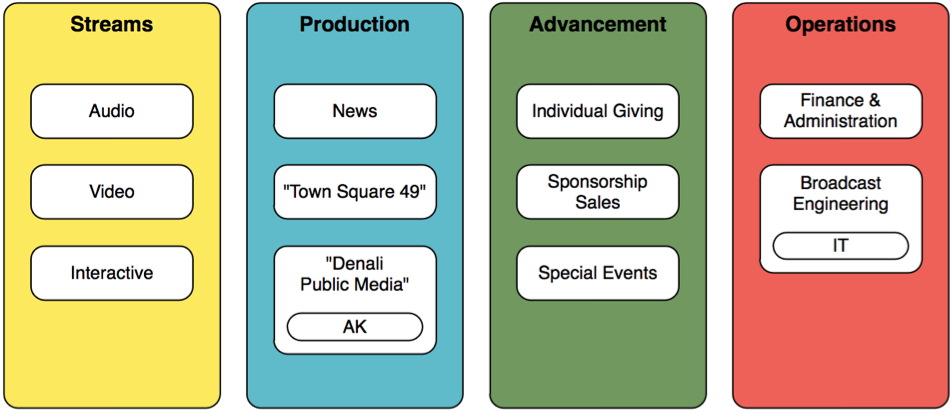
First off, I’m now in a new position. A position so new it has a non-traditional title: Vice President, Community Media Streams.

We’re organizing the company in a completely new way, using four divisions:

  • Community Media Streams
  • Media Production
  • Advancement
  • Operations

Previously we were arranged into platform and functional units with a total of 8 people at the “management” table, including the CEO. Now our “managers” number only 4. The old breakdown:

  • KSKA-FM
  • KAKM-TV
  • APRN
  • Broadcast Engineering
  • Information Technology
  • Development
  • Finance & Administration

Much of this organizational structure stemmed from the two mergers that created APTI as it stands today.  TV and radio uneasily merged in the early 1990’s.  APRN was merged into the company (by necessity, I would contend) in 2004.  Since each merger, the units have largely acted alone — and have competed for resources.

The primary collapse is to bring together radio and television and the web — to date just a subset of my duties — under a single manager (me).  Other public media companies have called this a “Chief Content Officer” or some nomenclature like that. We decided to split what others might call “content” into streams and production because we felt the two were fundamentally different things. Media Production makes programs.  Streams creates experiences.

I’m falling asleep as I write this, so I’m going to stop here.  There’s much more to say, probably this weekend and, really, for months to come. In the mean time, here’s the formal press release (PDF) crafted by our own CEO on Thursday afternoon. It’s intentionally brief and vague.  We have longer docs we’ve been developing internally.

More later. And thanks to all the Twitter pals out there that patiently waited to hear more!

What Kodak could teach public media

Below is a great little video I’d never seen before today. Had to share it. It concerns Kodak and while it starts out slow for the first minute, it rapidly picks up speed:
Kodak has for many years been the butt of innovation jokes, but it would appear they’ve survived, albeit changed in many ways. They found their way back to their mission: helping folks capture, store and share important images from life. Prior to the turnaround, they thought they were in the film business.

When I finished chuckling I wondered… What would a video similar to this one look like or sound like if it were being done for the public media industry, say 5 years from now?

Many seem to think we’re public broadcasters (I’ve been lectured on this more than once). Really? We only exist to fill FM frequencies or put pictures into living room boxes? That’s it? God, I hope not. I’d much rather be in the business of going out into the community, capturing stories and information, and sharing all that with the community in a thoughtful and community-developing way. I couldn’t give a rip about FM or TV technologies. Or the web for that matter. Those are all just tools.

In any case, thanks to Howard Weaver for blogging the video, but also blogging some great comments collected at a conference panel with Kodak, P&G and Owens-Corning executives. Weaver’s quick write-up is well worth a visit, especially for the killer quotes provided by the execs.

If 'newspapers' can die, then 'public broadcasting' can die, too

I’m so glad the newspaper industry is blazing the trail to either self-transformation or self-immolation in this new media world. Public media companies are being given a very close look at an industry in gut-wrenching transformation just before our own will undergo the same. The trail before us has been blazed, and we should be thankful.

Recently in Online Journalism Review, Robert Niles wrote a great link-bait article — It’s time for the newspaper industry to die — in which he explains why newspapers need to dump the word “newspaper” from their internal lexicon and psychology. He offers several reasons for this.

But the best reason centers on that favorite word of mine: Community. And the reason applies to public media, too.

Niles recognizes a fundamental shift in newspapers over the last decade: they’ve cut back on real community service while maximizing shareholder profits.

Great content and great tools are not enough to build the large, habitual audience that content publishers will need to maximize their opportunities to make money online, through advertising and sales. Even more than those two things, a website needs great engagement with its readers. And engagement with the public is something that’s been budgeted out of too many newsrooms over the past generation.

It’s time to bring that back. It’s time to do that online. And if a beloved label needs to be sacrificed to inspire the innovation that will enable this effort, so be it. It’s time for the “newspaper” industry to die. Because we all need the news industry to survive.

I would submit the term “public broadcasting” can take the same route to oblivion. One-way broadcasting can no longer be the point, even if that’s the most comfortable thing to do. Community engagement, public service, gathering, convening, whatever — that’s got to be the goal. Broadcasting is a tool, a means to an end of public service.

What we want from a “newspaper” isn’t fish wrapping or bird cage lining, it’s news, information, connection to events. What we want from broadcasting is pretty similar. But let’s not confuse the delivery system with the purpose. And let’s not believe for a moment that retransmitting someone else’s non-local, marginally-relevant content is something worth preserving in a world of on-demand access to all content anywhere.

Since entering the public media world professionally almost four years ago, I’ve always thought the Corporation for Public Broadcasting (CPB) was ripe for transformation (and not because of that Bush administration weasel Kenneth Tomlinson). Why? Because they need a name change and a mission reevaluation. It’s too bad the purpose of the CPB — funding and fostering public Broadcasting — has its instructions enshrined in law.  It’s making it difficult, if not impossible, to fund new projects. Consider this Q&A between IMA’s Mark Fuerst and CPB’s current president, Pat Harrison, at the recent IMA 2008 conference in Los Angeles (audio clip, about 1 minute):

[audio:https://gravitymedium.com/wp-content/uploads/2008/04/harrison-on-funding2.mp3%5D

Harrison gets it. Sure, she’s referring to reauthorization for CPB in Congress, but that’s just cover for avoiding talk about shifting funding out of pure broadcasting and into community engagement. (In fairness, the CPB has spent millions over the past several years on new media research and projects, but as I’ve noted before, we haven’t really seen any transformations.)

This is really too bad. Because while newspapers are stuck with an old term and a psychology that’s hard to shake, we have those challenges plus actual laws that govern a significant portion of our funding. To change the laws or create new ones to foster and fund community building and interaction via all available media may be politically impossible.

Broadcast Law Blog

I’m assuming that everyone in the public media universe (especially those with FCC licenses of one kind or another) already knows about the Broadcast Law Blog published by law firm Davis Wright Tremaine, LLP.

If it’s not already in your RSS reader or list of sites to review regularly, be sure to get it in there.  The FCC, under the direction of telco-loving politico Kevin Martin, has been very busy in the last year proposing new rules on all kinds of stuff related to broadcasters.  And it’s not little niggling things — this is big stuff that will impact operating costs, reporting activities and more.

Naturally, you should consult with your own attorney before embarking on any changes or new plans, but this is sound coverage of FCC changes and how they relate to broadcasters.

Talk about required reading…

Paterson, Mundt, Carvin trifecta on KCUR

Great show today on Kansas City’s public radio station KCUR with guests Robert Paterson, Todd Mundt and Andy Carvin. The topic? Surprise! New media and public media.

Worth a listen, especially if you’re a little confused about how public radio and public TV can engage the world in an online context.

[audio:http://kcurstream.umkc.edu/UTD/UTD_3-20-2008.mp3%5D

Total time: about 51 minutes. Download the MP3 here.

(By the way, I’d link to the web page at KCUR, but it appears it won’t be available after this week due to the way it’s published using the Public Interactive CMS.)

Apple II vs. Macintosh — Can public media follow this example?

Do you remember the Apple II series of personal computers? I certainly do. I got my first one in January 1983 (the Apple IIe) and it was a revelation. Back then the Apple II dominated the personal computer space (IBM was just introducing the first IBM PC). It was a serious cash cow for the new wonders of Silicon Valley: Steve Jobs and Steve Wozniak.

But even in 1983, in the peak of this tremendous success, Apple was reinventing the personal computer. They were secretly inventing the Macintosh, which was introduced a year after I got that Apple IIe in January 1984 (with the famous Superbowl ad).

Developing the Mac was a massively expensive proposition. New chips, new software, new case designs, a mouse, even a brand new 3.5″ floppy drive developed by Sony but still considered cutting-edge and risky. Everything called for clean slate development in order to get it all just right.

So what funded this engineering miracle? The successful and highly profitable Apple II series. And guess what — the Mac wasn’t profitable at launch. That first year was deadly. Apple introduced a $2,500 computer ($5,100 in 2007 dollars) that had two software programs: MacPaint and MacWrite, and it wasn’t compatible with the growing library of Apple II software titles.

Check out this brief video (43 seconds) of Guy Kawasaki recounting how the Mac team was funded by the Apple II team, and the considerable tension this created:

I often think of the Apple II / Macintosh example when conversations in public media circles turn to the question of how will we pay for this new media stuff that doesn’t make any money and takes money out of the profitable broadcasting business. Newspapers and the music industry are also great analogies for public broadcasting.

It takes real leadership, real courage to deliberately take cash from a profitable and successful unit and sink it into the next big thing, even if it takes years for it to pay off. Plus, you have to deal with the political pressures to stop funding this financial black hole from the “reasonable” business people all around you (on the board, on the management team, in the community, on the staff). As I look at my own public media business today, we’ve not even begun to seriously tackle the challenges of the new media world — chiefly because “Apple II” folks are in charge. I often wonder whether we should give up trying to reform the core of the company (a la Ideastream) and simply fund an external unit that can focus on the new media challenge without interference from the traditional “cash cow” part of our business.

The one example of “put it outside the core” I know of in the public media world can be found at Chicago Public Radio. Their Vocalo project (as described by Robert Paterson), is an external unit in every sense of the word. They have separate facilities, a new name unaffiliated with the old name, a separate budget, different leadership, different content and business models, etc. It’s a fascinating approach, and it mimics the Apple experience.

But I’m wondering… is anyone else in public media doing this? Who else, if anyone, is creating distinct subsidiaries for innovation? Is anyone else willing to spend their Apple II money on their Macintosh project?