Here’s some humorous bits and pieces to enjoy. Consider it a Christmas present!
Category: Gravity Medium
Seth Godin: First, organize 1,000
What’s difficult is changing your attitude. Instead of speed dating your way to interruption, instead of yelling at strangers all day trying to make a living, coordinating a tribe of 1,000 requires patience, consistency and a focus on long-term relationships and life time value. You don’t find customers for your products. You find products for your customers.
This is a monumental challenge for public broadcasters.
You already have donors, but are they in your tribe? Do you have a tribe?
Are you ready to lead the tribe and not just find folks that want to give you money because they feel good about your broadcast schedule?
I know lots of folks think it’s the same thing. But it’s not.
GigaOM: 1999-2009 – How Broadband Changed Everything
From 1999 to 2009, the world changed dramatically. We destroyed an unprecedented amount, and yet thanks to technology, built an unprecedented amount, too. Indeed, like a man obsessed, I cannot help but look at our modern lives through the lens of broadband. Thanks to that technology, the world today is more closely knit than ever. From 9/11 to the Asian tsunami to the election of Barack Obama to the terror attacks in Mumbai to the uprising in Iran, broadband enabled us to experience such global events together.

via gigaom.com
A great look back at the past 10 years of Internet time. Well worth reading in full. And this is just the first of 3 parts.
MacBreak Weekly explores NPR/station disintermediation
 On each MacBreak Weekly — a podcast focusing on all things Mac (and iPhone / iPod) — the host and guests make “picks of the week” in which they highlight hardware or software from every imaginable corner of the Mac and iPhone universe. Some stuff is small, some stuff is big, some is expensive and some is free. This week one of the guests — Alex Lindsay, a videography and special effects pro — picked the tremendously popular NPR News iPhone app (currently #4 in the free News apps category in the iTunes App Store).
In discussing the NPR News app, host Leo Laporte and Alex lavish praise on NPR itself for doing such a great job meeting the needs of Internet users that want access to NPR News and other public radio content and stations. They also rave about This American Life (currently the #2 podcast in the entire iTunes podcast directory) and the heavily revised NPR.org.
But then things get interesting.
Laporte and Lindsay don’t stop with reviewing the app or praising NPR. Together they demonstrate both tremendous insight and notable ignorance of how public radio is architected in the U.S. Here’s what’s right and what’s wrong in their discussion:
Right
- The NPR News app, combined with the new NPR.org, is one of the most advanced distribution approaches in use by a major media company today.
- Livio is offering an Internet-connected radio with built-in NPR branding and features ($200).
- NPR was afraid to offer fully atomized programming elements via the web in an on-demand fashion for many years due to fears of station backlash, and resisted that through the early days of podcasting, despite prodding from Laporte and others in the tech world.
- Donations from listeners are still primarily directed toward stations, not NPR itself, and national producers reinforce that notion currently.
- NPR has done what many media entities have not done: face the future and make significant changes to the way they distribute content, answering the requests of listeners, even if it means stepping on local station toes.
- NPR produces industry-leading audio programming; it’s the “gold standard” in audio production and other professionals use it as a benchmark for their work.
- This American Life includes advertising in its podcast (it may be “sponsorship,” but it sounds to listeners like advertising). Laporte also realizes that advertising in a podcast gets around FCC regulations governing nonprofits and broadcast advertising.
- This disintermediation — content flowing from producers to listeners directly, without local stations — could be “the beginning of the end” for NPR stations across the country.
- Given the way content is produced and distributed in this new model, there needs to be a “reversal” of how the system works, in that NPR should pay local station reporters for news gathering (this is also listed below in the “wrong” section).

Wrong
- Alex says the app is “either free or $0.99” — it’s free, no question about it.
- All Things Considered is not produced by a network other than NPR — it’s not from APM, it’s not from PRI, etc.
- Lindsay suggests that NPR should be paying local reporters for their reporting. What he doesn’t know is that NPR already does this, it just does it on a pay scale and frequency that’s not sustainable for local journalists.
 Given how badly most people understand the public radio system in the U.S., they get a ton of this stuff right. And they instinctively know how the disintermediation game works — Laporte used to work on the defunct cable channel TechTV but today has built his own network of audio (and now video) podcasts and streams, amassing more than $1,000,000 in annual revenues for his 2-4 person multimedia production house. (For the record, he’s also a commercial radio broadcaster.)
“The Reversal”
I was shocked by Alex Lindsay’s suggestion that the economic model on which the network/stations system works should be turned on its head. That’s something I’ve been saying since about 2006, once I realized that the content power rests with NPR, but the radio distribution power and the social relationship power rests with geographically-bound stations.
I’ve been laughed out of more than one conversation when suggesting NPR should pay stations to distribute their content. Or at the very least, NPR should be passing its content to stations for free or for the cost of operating the distribution system (PRSS / ContentDepot).
Today, stations pay anywhere from tens of thousands to millions of dollars annually to NPR for the “privilege” to carry their content (depending on market size and lots of other factors). That’s the bulk of NPR’s income: fees collected from local stations. That’s why you pay your local station and not NPR (although NPR does sell advertising space nationally and they do seek high-dollar gifts from rich donors).
Some think the annual CPB operating grants go straight to NPR and PBS, but they do not. Only tiny bits go to a few specialized programs or services at the networks — the vast majority of CPB’s money goes out to 600 public radio stations and 350 public television stations every year (67% to TV). That model has been in place for decades.
But it’s time we rethink this model. Maybe we don’t need a total reversal of all the flows. But the balance of power has shifted dramatically into the hands of the major national producers at the same time they’ve sucked the life out of most local public media outlets in the country with their incredibly hefty (extortionary?) fees. Money collected locally keeps the lights on and pays the national producers, but it affords precious little local production of any sizable amount or quality.
This has to change. Or we might as well just nationalize the system, a la BBC, and get it over with. Either approach can be made to work, but the current model doesn’t match how the world works in the 21st century.
Listen for Yourself
In any case, check out the conversation to hear these comments and insights from outside the public radio universe. It starts around 1 hour, 20 minutes in the original podcast. Or just listen to the excerpt I’ve clipped here (or click the play button below). The excerpt is about 5 minutes long (MP3).
Twitter at the top 100 U.S. newspapers
We were able to find multiple Twitter accounts for all of the top 100 newspapers using common sense searching techniques. However, only 62% of the newspapers included links to at least one of their accounts from their website. In many cases, these links were buried on the site and difficult to track down. In addition, this means 38% of the newspapers are actively using Twitter, but haven’t yet integrated their presence with their website in even a minimal way.
56% of newspapers maintained a directory of their Twitter accounts on their website. This directory from the Los Angeles Times is a good example of the form these listings usually took. Many of these directories were quite extensive, listing dozens of accounts.
I wonder what the numbers would look like for the top 1,000.
Good to see some innovation in this space.
Yelvington on paywalls and community
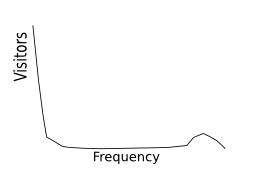 I recently told public broadcasters, er… I mean public service media folks, to ignore the paywall option. Don’t do it. And while I stand by that assertion generally, the invaluable Steve Yelvington has a much more nuanced take in his piece Thinking about a paywall? Read this first.
It involves this little chart, and there are lessons for those that would create both a popular general web destination and an online community, all in one. Highly recommended.
Local TV ad revenue down 27% in Q1-3 of 2009
For the first nine months of 2009, network TV was down 10.7%, syndicated TV was down 2.8%, and local broadcast TV was down 27.4%, producing a total broadcast TV loss of 15.7%.
via tvb.org
Some of the downturn is the loss of election advertising revenue, but not all of it. I can’t wait to see the 2010 vs. 2009 numbers next year. All predictions are pointing downward, though. If all you do is broadcast, and you don’t really care about building community, this is your future.
FINAL CUT: The Future is Public Service Media
Here’s the final cut of my recent presentation for WOSU Public Media in Columbus. This time I’ve got a video I created myself plus a complete set of slides and links back to all the original material.
In this case, the video is a revised presentation deck with a brand new voiceover track. This way, if you couldn’t see or hear the presentation clearly in the video shot at WOSU, now you can get the slides and the talk directly.
First, the video, then I’ll follow up with a final collection of links.
Final Cut Presentation Material
- View the video above at Vimeo (and get embed codes, etc.)
- Download a copy of the video (MP4, 1024×768, 570MB)
- Download the final cut slide deck, complete with embedded links (PDF, 11MB)
- Download the Keynote presentation deck (requires Keynote ’09, ZIP, 85MB)
Additional Material
- Pirates, legless dogs and public media — first in a three-part set of posts on my thoughts leading up to the presentation
- Do your own work — the second post
- The Future of Public Media — the third post in the series
- Presentation: The Future is Public Service Media — the original presentation content, as given at WOSU in Columbus
- Video from WOSU Presentation — this is a YouTube video of me giving the presentation in Columbus, as provided by WOSU (it cuts out after 1 hour, however)
- Additional links from WOSU presentation — a very long list of links to articles, references and other presentations I used when preparing for the talk
Leaders are lame, Builders rule / The Builders' Manifesto
Matt Taibbi & Nick Kristof vs Tom Friedman & Maureen Dowd. Tom and MoDo are textbook examples of leaders in journalism; churning out column after column that challenge the conventional wisdom and set the agenda. Yet, that’s not nearly enough to save journalism — let alone the New York Times. Matt and Nick, in contrast, are (re)building the institution of journalism for the 21st century, by utilizing the power of the Internet to reconstruct relationships with readers, publishers, and sources.
via blogs.hbr.org
Tons of great thinking in this new Umair Haque post. The snippet above is a mere taste — the full article explains what’s wrong with leadership today and why we need to encourage buildership to create a new and better businesses, communities and even politics.
Public media “leaders” need to give up the leadership role and take on a “buildership” role. Or find people that can do it.
Perspective
Hat Tip: @gruber
 Gravity Medium